Freedom Fighters
 81
★ /10
81
★ /10
 Ninitendo GameCube,
  PC,
PC,  PS 2,
PS 2,  Xbox
Xbox
 Electronic Arts,
  Softclub


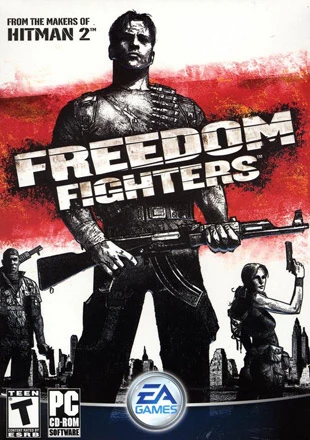
Freedom Fighters is a 2003 third-person squad shooter developed by IO Interactive and published by EA Games, released between late September and early October 2003 for PlayStation 2, Xbox, GameCube, and PC — the Danish studio’s one non-Hitman game of its first decade, made between Hitman 2 and Contracts on the same Glacier engine. It holds Metacritic scores in the low 80s on all four platforms (83 GameCube, 82 Xbox, 81 PS2, 80 PC), a GameSpot 9.3, and the kind of cult standing that produces two decades of “why was there never a sequel?” threads. Its premise is a Cold War nightmare run in reverse: the Soviet Union, not the United States, dropped the first atomic bomb — on Berlin, in 1945 — won the century, and in the game’s present has landed the Red Army in New York City.
You are Christopher Stone, a Brooklyn plumber on a service call when the invasion begins, and the game is the story of how a man with a wrench becomes the “Freedom Phantom” — by recruiting, one New Yorker at a time, the resistance that takes the city back.
Technical Specifications
| Attribute | Details |
|---|---|
| Developer | IO Interactive (Copenhagen) |
| Publisher | EA Games (original) · IO Interactive (2020 digital re-release) |
| Composer | Jesper Kyd (with the Hungarian Radio Choir) |
| Engine | Glacier (shared with Hitman 2 and Contracts) |
| Release | September 26 – October 2003 (PS2, Xbox, GameCube, PC) · 2020 (Steam, GOG, Epic re-release) |
| Metacritic | 83 (GC) · 82 (Xbox) · 81 (PS2) · 80 (PC) · GameSpot 9.3 |
| Squad | Up to 12 recruits, scaled by Charisma |
| Genre | Third-person squad shooter, alternate history |
| Mode(s) | Single-player · 4-player split-screen (consoles only; absent from PC) |
Red Dawn, Brooklyn
The alternate history is sketched in a brisk opening newsreel — Soviet bomb on Berlin, a USSR that absorbs Europe and the Americas’ southern flank, an isolated America finally invaded — and then the game drops Chris and his brother Troy into a Brooklyn apartment as Soviet helicopters cross the skyline. Troy is taken; Chris falls in with the underground run by the journalist Isabella Angelina and the enigmatic Mr. Jones, and the campaign climbs from safe-house raids to the recapture of Governors Island and a final assault on the Soviet command under General Tatarin. Propaganda broadcasts from the collaborationist news anchor punctuate every chapter, the occupied city — Red Square-style banners over Manhattan, snow on burned-out cars — is one of the era’s great settings, and Jesper Kyd’s score, Russian choral arrangements recorded with the Hungarian Radio Choir, remains the composer’s most-cited work outside Hitman and Assassin’s Creed.
Charisma and the Twelve
The system that set the game apart is Charisma: heroic acts — freeing prisoners, destroying Soviet assets, healing allies — raise Chris’s standing, and his standing dictates how many fighters will follow him, from two frightened civilians to a dozen-strong platoon. Command is radically simple — Follow, Attack, Defend, pointed at a spot — and the squad AI was good enough in 2003 that reviewers called it the best of its kind, with recruits flanking, taking cover, and dying in ways that mattered. Missions open as hub districts with several objectives, and the second structural idea follows from the first: sabotage in one area changes another — blow a helipad here and the gunship stops hunting you there — a non-linearity Official U.S. PlayStation Magazine rated a perfect 100 for. Criticisms were few and consistent: a short campaign, limited replay value, and PC controls that lagged behind the console builds.
The Sequel That Never Came
The ending is an open door, and a sequel — set to continue the war beyond New York — was planned; it died when IO’s attention turned to Kane & Lynch and, after Eidos and then Square Enix, back to Hitman full-time. For twenty years the game was also nearly unplayable on modern PCs: no digital release, no widescreen, broken audio on new Windows. That changed in 2020, when IO Interactive — newly independent and holding the rights — re-released the PC version itself on Steam, GOG, and Epic, patched for current systems with any-resolution and ultrawide support, borderless windowed mode, and the cutscene and mouse fixes the community had been duct-taping together for years. Fans read it as a trial balloon; IO has said nothing about a sequel since, but the game is, at last, a $15 purchase instead of an eBay hunt.
Where to Play It Today
Freedom Fighters is on GOG (DRM-free, soundtrack included, 4.3/5 from 300+ reviews), Steam, and the Epic Games Store at $14.99, routinely discounted to under $2 — the 2020 IO Interactive release, single-player only; the four-player split-screen survives only on original PS2, Xbox, and GameCube discs. For anyone who knows IO only through Agent 47, it’s the studio’s most surprising game: a Red Dawn fantasy with better squad AI than most shooters shipped in the decade after it.