World of Warcraft: Battle for Azeroth
Expansion of World of Warcraft 79
★ /10
79
★ /10
 PC
PC
 Blizzard Entertainment
Blizzard Entertainment
Blizzard Entertainment
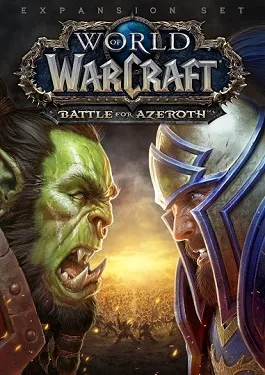
World of Warcraft: Battle for Azeroth (frequently abbreviated as BfA) is the 2018 expansion pack for Blizzard Entertainment’s MMORPG. Following the absolute triumph of Legion, expectations were sky-high. Promising a nostalgic return to the foundational “Orcs vs. Humans” faction war that birthed the franchise, BfA launched with incredible hype. However, it quickly became one of the most heavily criticized eras in the game’s history, plagued by deeply frustrating progression systems, layered RNG, and a narrative that deeply divided the community.
The story picks up immediately after the defeat of the Burning Legion. Sargeras’s massive sword remains plunged into the planet, causing Azeroth to bleed a powerful, highly volatile magical mineral called Azerite. A global arms race for this new resource violently reignites the faction war. In a preemptive strike, Horde Warchief Sylvanas Windrunner commits a shocking atrocity by burning the Night Elf capital of Teldrassil to the ground. In retaliation, the Alliance lays siege to the Undercity. Desperate for naval superiority, the Alliance travels to the maritime nation of Kul Tiras, while the Horde seeks the legendary golden fleet of the Zandalari Empire.
Gameplay
Battle for Azeroth raised the level cap from 110 to 120. It completely split the leveling experience; Alliance and Horde players leveled on entirely different continents before clashing together at maximum level.
Key gameplay mechanics and additions include:
- Allied Races: Instead of introducing entirely new races, BfA introduced “Allied Races”—variants of existing races tied to the game’s lore. By completing specific questlines and reputation grinds, players could unlock and play as Dark Iron Dwarves, Void Elves, Zandalari Trolls, Vulpera, and more.
- The Heart of Azeroth & Azerite Armor: Replacing the beloved Artifact Weapons from Legion, players were given a legendary necklace that absorbed “Artifact Power” (AP). Leveling up the necklace unlocked specific, highly randomized passive traits on your Head, Shoulder, and Chest armor pieces. This system was notoriously complex, forcing players to constantly re-grind AP to re-unlock traits they already had whenever they got a higher-level piece of armor.
- Island Expeditions: A new 3-player PvE mode designed to endlessly grind AP. Teams raced against the clock (and AI opponents) to strip randomly generated islands of their Azerite. While heavily hyped for their dynamic AI, they quickly became viewed as a tedious, mandatory chore.
- Warfronts: A 20-player PvE mode heavily inspired by the RTS roots of Warcraft III. Players gathered resources, captured lumber mills, built barracks, and pushed massive armies across a map to defeat an enemy commander. While visually spectacular, they were mechanically unlosable and lacked any true challenge.
- Warmode: Blizzard finally abolished the outdated concept of dedicated “PvP Servers.” Instead, any player could toggle “Warmode” on in a capital city, phasing them into shards strictly populated by other players looking for open-world PvP, rewarding them with bonus experience and loot for taking the risk.
Development and Legacy
Released in August 2018, Battle for Azeroth sold incredibly well out of the gate, propelled by some of the most spectacular, emotionally charged CGI cinematics Blizzard had ever produced. The zone design and music—especially the pirate-themed city of Boralus and the Aztec-inspired golden pyramids of Dazar’alor—were universally praised as some of the art team’s absolute best work.
However, the expansion quickly unraveled mechanically. The community coined the term “Borrowed Power” during this era to describe Blizzard’s habit of designing massive, expansion-defining progression systems only to completely throw them in the trash a year later. The Azerite Armor system was so universally disliked that Blizzard had to implement massive bandaids in later patches (like Azerite Essences and, eventually, the deeply chaotic and overpowered “Corruption” system).
Narratively, the expansion was a mess. What was advertised as a grounded faction war quickly spiraled into a cosmic threat. By the final patch, the faction war was abruptly abandoned so players could deal with Queen Azshara and the awakened Old God N’Zoth. Furthermore, the handling of Sylvanas Windrunner’s character arc alienated a massive portion of the Horde player base, making her feel like an irredeemable villain rather than a cunning tactician.
Today, Battle for Azeroth is viewed as a significant misstep that squandered the immense goodwill generated by Legion. It serves as the primary example of why modern WoW developers eventually pivoted away from endless AP grinds and borrowed power systems in favor of more evergreen, player-friendly design philosophies in current expansions.
Key Features:
- Two New Continents — Level through the haunted, nautical realm of Kul Tiras for the Alliance, or the vibrant, dinosaur-filled jungles of Zandalar for the Horde.
- Allied Races — Recruit and play as highly requested lore-factions, including the Mag’har Orcs, Kul Tiran Humans, and the Nightborne Elves.
- Warmode — Opt into a seamless, highly populated open-world PvP experience across all servers, earning bonus rewards for surviving enemy assassins.
- Warfronts — Participate in massive, 20-player PvE sieges that heavily evoke the base-building and resource-gathering roots of classic RTS Warcraft.
- Visions of N’Zoth — Experience the eerie, sanity-draining final raid tier, battling the horrific Old God N’Zoth and utilizing the chaotic “Corruption” gear system.
Release Platforms:
- Microsoft Windows (PC) / macOS — August 14, 2018
- (Included in the base retail World of Warcraft subscription).
Warcraft news
More news
Blizzard Caps Dungeon XP in WoW: Forever to Keep World Central

WoW: Forever's First Patch Is Adding Intense Weather Effects Back
Blizzard Vows Aggressive Bans for WoW: Forever Gold Buyers
WoW Forever Beta Breaks Servers, Stuns Devs With Record Numbers