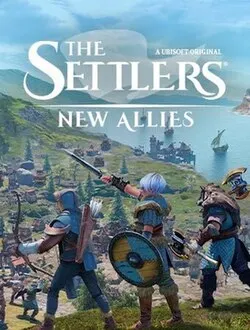
The Settlers: New Allies
 54
★ /10
54
★ /10
 Nintendo Switch,
  PC,
PC,  PS4,
PS4,  PS5,
PS5,  Xbox One,
  Xbox Series X/S
 Ubisoft
Where to buy




The Settlers: New Allies
From Wikipedia, the free encyclopedia
The Settlers: New Allies (originally announced as The Settlers; German: Die Siedler: Neue Allianzen) is a real-time strategy and city-building video game developed by Ubisoft Düsseldorf and published by Ubisoft. Released for Microsoft Windows on February 17, 2023, with console ports following on July 4, 2023, the title serves as a modern reboot of the long-running The Settlers franchise. It is the first mainline entry in the series since 2010’s The Settlers 7: Paths to a Kingdom.
Powered by Ubisoft’s proprietary Snowdrop engine, New Allies sets out to reimagine the traditional building-and-battle mechanics of the series. However, the game marks a sharp departure from the complex logistical micro-management and layered supply chains of early legacy entries, opting instead for a streamlined, faster-paced real-time strategy layout designed to support cross-play and accessible console gamepad mechanics.
Technical Specifications
| Attribute | Details |
| Developer | Ubisoft Düsseldorf |
| Publisher | Ubisoft |
| Director | Christian Hagedorn |
| Producer | Christian Grünwald |
| Engine | Snowdrop |
| Platform(s) | Microsoft Windows, Nintendo Switch, PlayStation 4, PlayStation 5, Xbox One, Xbox Series X/S |
| Release Date(s) | Windows (Ubisoft/Epic): February 17, 2023 Consoles: July 4, 2023 Windows (Steam): March 26, 2024 |
| Genre(s) | Real-time strategy, City-building |
| Modes | Single-player, Multiplayer |
Gameplay Architecture
The Settlers: New Allies blends baseline settlement-building loops with traditional RTS skirmishing. Players begin a match with a handful of engineers and carrier settlers, tasked with exploring unknown territories, gathering raw physical components, and laying down infrastructure grids to fund an offensive military presence.
Streamlined Economy and Mechanics
In an intentional effort to lower the barrier of entry compared to older entries like The Settlers III or IV, the processing matrices were heavily condensed:
- Automated Transportation: Road networks return to facilitate basic organization, but the physical requirement of assigning donkeys or manual carriers to specific flags is eliminated. Carriers move goods across the landscape autonomously based on direct building demands.
- The Engineer Unit: Unlike previous games where construction workers were non-selectable civilians, New Allies introduces Engineers as directly commandable specialized units. Engineers are manually directed by the player to construct buildings, claim territorial expansion nodes, locate hidden mineral deposits, and steal unguarded enemy resources.
- The Condensed Roster: The resource tree focuses heavily on baseline commodities such as Logs, Stones, Iron Ore, Coal, and Meat. Weapons fabrication is flattened down to a simplified production loop, feeding iron and coal directly to a smithy to mass-produce uniform axes or bows.
Game Modes
- Story Campaign: A narrative single-player mode detailing a specific faction’s exodus to settle an unknown region.
- Skirmish (Multiplayer): Supports Solo vs. AI, Co-op vs. AI, or up to 8-player Player-vs-Player (PvP) matches across diverse handcrafted map variations.
- Hardcore Mode: A specialized operational sandbox where players encounter recurring scenario challenges layered with artificial constraints and aggressive AI behaviors.
Narrative Campaign
The central campaign chronicles the journey of the Elari, an insular, technologically progressive human civilization. Following a sudden, violent political coup in their native homeland, the Elari are forced to flee their kingdom by boat across uncharted oceans.
Marooned on a vast, unfamiliar archipelago, the survivors must organize defensive settlements, establish mining operations, and learn to adapt to the geographic environments of their new home. As they expand outward, the Elari discover that the region is heavily destabilized by ruthless bandit syndicates and conflicting rival cultures, initiating a multi-chapter narrative conflict centered on cultural survival, defensive diplomacy, and territorial consolidation.
Playable Factions
The game features three asymmetric cultures available for custom skirmish matching. While they share identical base extraction metrics, they are differentiated by unique architectural aesthetics, specialized combat perks, and an exclusive cultural military unit:
- The Elari: Highly optimized for architectural efficiency and fast spatial construction. Their residential buildings cost fewer resources to deploy, and they field highly lethal ranged Arbalest units that can pierce heavy physical armor plating.
- The Maru: An insular, coastal culture with deep roots in agricultural optimization and defensive architecture. Their outposts, walls, and defensive towers cost fewer materials to construct, and their unique field units include ritual Guardians capable of slowing enemy advance speeds.
- The Jorn: A rugged northern clan governed by honor, blacksmithing, and physical training. Their military units feature high passive health pools, and they recruit elite dual-axe Berserker warriors who gain aggressive attack-velocity spikes when taking damage.
Production and Redesign Delays
The development of The Settlers: New Allies is notable for a highly prolonged, publicly visible production cycle. Originally announced at Gamescom 2018 under the oversight of series creator Volker Wertich and Blue Byte, the title was target-marketed for a late 2019 commercial rollout. Following several internal schedule shifts into 2020, pre-orders were indefinitely refunded as the project vanished from public tracking.
The game resurfaced in January 2022 to host a highly publicized Closed Beta. Consumer feedback from long-time series veterans was overwhelmingly critical, with players lamenting that the game had removed almost all structural city-building depth, reducing the identity of The Settlers to a basic, generic real-time strategy clone.
In response to this severe pushback, director Christian Hagedorn confirmed that the development team had systematically frozen production to execute an extensive overhaul. The game systems were actively redesigned to strip out elements the team felt were overcomplicated while working to restore traditional identity markers. In November 2022, the game was officially retitled The Settlers: New Allies, establishing its definitive 2023 release frame.
Reception and Current Status
Upon its official release, The Settlers: New Allies received mixed to generally unfavorable reviews from strategy publications. Review aggregator Metacritic computed a composite score of 54/100 for the PC version.
Critics heavily scrutinized the game’s simplified macroeconomic loops, noting that the removal of complex resource logistics effectively stripped the game of the franchise’s historic charm. Reviewers from outlets like PC Gamer observed that while the Snowdrop engine delivered clean, smooth visual animations, the tactical combat felt slow and generic compared to contemporary RTS standards.
On March 26, 2024, the game officially transitioned to the Steam storefront, where user impressions mirrored earlier evaluations, maintaining a “Mixed” approval rating due to its departure from traditional series depth and its reliance on external launcher dependencies.
Current Lifecycle
The game remains actively maintained on modern console and PC architectures. System maintenance tasks and live-service components are tracked directly through the integrated Ubisoft Connect framework.
The game operates on a dual-currency framework, implementing a Shards and Credits system updated through official patches. In-game activities and recurring weekly hardcore challenges allow players to earn non-premium Shards to refresh mission modifiers and purchase baseline aesthetic adjustments. Parallel to this, real-money microtransactions authorize the purchase of premium Credits to buy high-tier character uniforms and cosmetic weapon modifications. Offline single-player capability remains supported through local client saving options, allowing historical continuity loops for strategy purists.