Tom Clancy’s EndWar
 68
★ /10
68
★ /10
 Nintendo DS,
  PC,
PC,  PS 3,
PS 3,  PSP,
PSP,  Xbox 360
 Russobit-m,
  Ubisoft


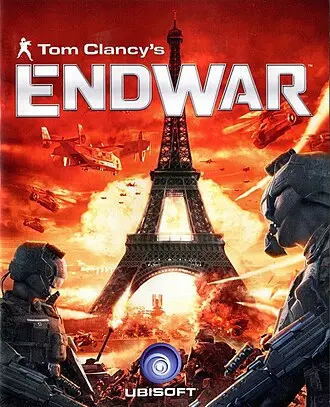
Tom Clancy’s EndWar is a military strategy video game designed by Ubisoft Shanghai and published by Ubisoft. It was released in November 2008 for the PlayStation 3, Xbox 360, Nintendo DS, and PlayStation Portable, with a Microsoft Windows version following in February 2009.
The game is set in a fictionalized 2020, charting the outbreak of World War III between the United States, the European Federation, and the Russian Federation due to global energy scarcity and space-based military proliferation. While the handheld iterations operate as turn-based tactics games, the console and PC releases are real-time tactics (RTT) titles defined by a revolutionary voice command system and an atypical, low-slung third-person battlefield perspective.
Technical Specifications
| Attribute | Details |
| Developer | Ubisoft Shanghai |
| Publisher | Ubisoft |
| Engine | Unreal Engine 3.1 |
| Platform(s) | PlayStation 3, Xbox 360, Microsoft Windows, PlayStation Portable, Nintendo DS |
| Release Date(s) | Consoles & Handhelds: • NA: November 4, 2008 • EU: November 8, 2008 Microsoft Windows: • WW: February 24, 2009 |
| Genre(s) | Real-time tactics (PC/Consoles) Turn-based tactics (PSP/DS) |
| Modes | Single-player, Multiplayer (Discontinued) |
Gameplay
The core gameplay of Tom Clancy’s EndWar differs dramatically from traditional real-time strategy (RTS) titles, stripping away standard macroeconomic base-building and high-amplitude pointer clicking in favor of streamlined tactical deployment, localized reinforcement vectors, and micro-positioning.
Voice Command System
The defining design mechanic of EndWar is its Voice Command Engine. Using any standard headset peripheral, players can dictate entire tactical operations using a structured, three-part verbal syntax: [Unit Designation] + [Action Command] + [Target Vector].
Example: Speaking “Unit 1, Attack, Hostile 3” commands a designated battalion to engage an assigned target, while “Calling All Tanks, Secure, Uplink Lima” routes all heavy armor units to a capture node.
The system natively calibrated across multiple languages and accents, offering near-instantaneous real-time execution that developers marketed as control at “the speed of thought.”
Camera and Tactical Positioning
Unlike the standard top-down “god-view” perspective common to the genre, EndWar implements a camera system locked strictly to a low, third-person perspective anchored behind whichever friendly unit is currently selected. This design choice highlights environmental typography, making physical cover, urban choke points, and line-of-sight terrain obstructions central to tactical survival. To view the broader battlefield layout, players must access the SITREP (Situation Report) screen, which transforms the interface into a flat, 2D holographic strategic map showing current vector paths and radar outlines.
Combat Logic and Customization
Tactical combat functions on a strict Rock-Paper-Scissors unit counter paradigm:
- Tanks (Heavy armor) effectively overrun and suppress mobile wheeled Transports.
- Transports (Anti-air infantry carriers) rapidly shred and down airborne Gunships.
- Gunships (Attack helicopters) flank and destroy heavily armored Tanks.
Other specialized battlefield assets include Riflemen (ideal for capturing neutral capture buildings known as Uplinks), Engineers (minefield placement and vehicle repair), and long-range Artillery.
Capturing and upgrading Uplinks grants command points used to summon reinforcements or trigger specialized support actions, including radar sweeps, localized electronic warfare blocks, and air strikes. Controlling a dominant portion of the map triggers a DEFCON 1 state, unlocking a faction’s Weapon of Mass Destruction (WMD)—a catastrophic, single-use superweapon capable of erasing entire grid sectors.
Mission Modes
Matches are categorized into four unique operational rule sets:
- Conquest: A tactical battle focused on capturing and holding the majority of map Uplinks until a persistent five-minute countdown timer expires.
- Assault: A traditional combat elimination match where victory requires the total destruction of all enemy field divisions.
- Raid: A time-gated sabotage simulation forcing attackers to target critical municipal infrastructure while defenders work to preserve the structures.
- Siege: Capital city matches where attackers must capture a fortified central command hub before incoming reinforcement windows expire.
Plot and Setting
Context
The narrative serves as a standalone timeline detached from alternate Tom Clancy continuity loops. In 2016, a devastating nuclear exchange occurs in the Middle East, destroying major regional oil infrastructure, killing 20 million people, and instantly destabilizing global energy access. In response, the United States and the European Union sign the Joint Space Defense Treaty, establishing a shared umbrella of anti-ballistic missile shields that render traditional nuclear missile weaponry entirely obsolete.
Russia emerges as the world’s leading supplier of crude oil and natural gas, experiencing an immense economic renaissance that funds a massive modernization of its military forces. Tensions reach a tipping point in 2020 as the United States approaches the deployment of the Freedom Star, a heavily weaponized, multi-battalion military space station designed to bypass existing missile shields via orbital kinetic strikes. Interpreting this as an existential threat to the global balance of power, the European Federation and Russia mobilize, and a subsequent terrorist strike on a US launch facility sparks a global conventional war.
Playable Factions
United States Joint Strike Force (JSF)
Led by Ghost Recon veteran General Scott Mitchell, the JSF is modeled after modern marine expeditionary units. Built around high-precision, low-profile tactical strike forces, they focus on stealth technology, advanced long-range precision firing parameters, and autonomous combat robotics (such as unmanned aerial vehicles and automated sentry drones). Their signature WMD is the Kinetic Strike, an orbital drop mechanism that launches solid tungsten rods from space to strike targets with kinetic force.
European Federation Enforcer Corps (EFEC)
The EFEC consists of elite counter-terrorist and peacekeeping personnel drawn from across Europe, incorporating elements of the historic Rainbow Six division. They specialize in high-velocity electronic warfare, rapid urban navigation, and directed-energy weapons like tactical microwaves. Their units are lightly armored but possess the fastest maneuvering and base-capture metrics in the game. Their signature WMD is the Orbital Tactical High Energy Laser (THEL), which fires a continuous beam of concentrated thermal energy from a satellite.
Russian Federation Spetsnaz Guards Brigade (SGB)
Composed of veterans of regional conflicts, the SGB focuses on raw heavy armor plating and heavy weapon output. Operating under a doctrine of total victory regardless of systemic collateral damage, their vehicles travel slowly but boast superior structural durability and close-range explosive firepower. They rely heavily on fuel-air ballistics, thermal damage upgrades, and combat flamethrowers. Their signature WMD is the Fuel-Air Missile / Vacuum Bomb, a heavy warhead that causes an atmospheric oxygen implosion.
Reception and Legacy
Tom Clancy’s EndWar received generally positive to mixed reviews upon launch. Aggregating site Metacritic listed a composite score of 68/100 for PC and mid-70s scores for the Xbox 360 and PlayStation 3 iterations.
Critics praised the technical precision and reliability of the voice recognition software, noting that it successfully made real-time strategy games playable on home consoles without the need for a mouse and keyboard peripheral. GameSpot honored the game with its Best Original Game Mechanic award. Conversely, traditional strategy reviewers found the rock-paper-scissors combat design overly simplistic and noted that the tight, low-slung camera limits a player’s macro-situational awareness.
Server Decommissioning
The game originally featured a persistent, online global multiplayer mode known as the Theater of War, where individual match outcomes actively shifted territory control on a real-time world map. On January 25, 2024, Ubisoft officially terminated all online architecture and multiplayer matchmaking services for EndWar. The game remains accessible entirely as an offline title, restricting players on Steam and modern backwards-compatible console systems to local skirmish modes and single-player campaigns against computer-driven AI opponents.