Settlers II
 PC
PC
 1C Company,
  Ubisoft
Where to buy

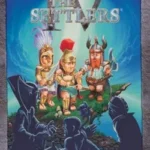
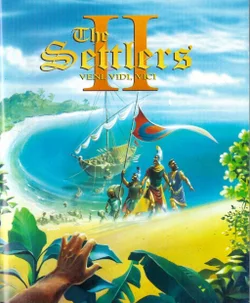
The Settlers II (originally released as The Settlers II: Veni, Vidi, Vici; German: Die Siedler II) is a city-building and real-time strategy video game developed and published by Blue Byte Software. Released in April 1996 for MS-DOS, it is the second installment in The Settlers series, following the 1993 debut title.
The game is widely considered the critical high-water mark of the classic series franchise, defining the core mechanical identity of the “German-style” economic simulation. Rather than emphasizing rapid real-time combat commands or direct unit manipulation, the game tasking players with constructing intricate logistics road networks and managing multi-tiered, interdependent production pipelines to supply an autonomous workforce and expand national territory.
Technical Specifications
| Attribute | Details |
|---|---|
| Developer | Blue Byte Software |
| Publisher | Blue Byte Software |
| Producer | Thomas Hertzler |
| Designer / Programmer | Thomas Häuser |
| Composer | Haiko Ruttmann |
| Platform(s) | MS-DOS, Classic Mac OS, Nintendo DS |
| Release Date | • DE: April 17, 1996 • UK: August 13, 1996 • NA: August 31, 1996 |
| Genre(s) | City-building, Real-time strategy |
| Modes | Single-player, Multiplayer (Split-screen) |
Gameplay Architecture
The core gameplay of The Settlers II revolves around macroeconomic balance, spatial optimization, and chain-supply logistics. Players possess no direct control over the day-to-day actions of their individual subjects. Instead, the workforce operates autonomously, reacting dynamically to the placement of buildings, infrastructure priorities, and road layout configurations.
The Flag-to-Flag Road Network
The defining architectural mechanic of The Settlers II is its logistical transit loop. To move resources between structures, players must construct a network of literal walking paths. Roads are manually drawn across a grid node layer and must be bookended or divided by Flags.
A single autonomous carrier worker is assigned to patrol the exact stretch of road between any two adjacent flags. When a resource is produced at a building, it is placed at the nearest flag; the localized carrier transfers the item to the next flag in sequence, functioning as a high-speed bucket brigade. To scale up transport volume on congested central thoroughfares, players can breed Donkeys, which automatically join carriers on a road section to double the total cargo capacity of that specific segment.
Economic Interdependence and Supply Chains
The economic layer features massive, multi-tiered raw material conversion matrices. For example, the creation of a high-tier military soldier requires coordinating multiple independent production streams:
[Geologist Finds Ore] ➔ [Iron/Coal Mines] ➔ [Iron Smelter] ➔ [Armorer] ➔ [Sword/Shield Crafted]
                                                               ▲
[Farm] ➔ [Grain] ➔ [Mill] ➔ [Bakery] ➔ [Bread] ➔ [Fed to Mines] ┘
Mines dug into high-altitude mountain ranges harvest Coal, Iron Ore, and Gold Ore, but will cease operations unless supplied with food rations (Bread, Meat, or Fish) produced via agricultural or maritime networks. Gold ore must be routed to a Minting House alongside coal to produce physical Gold Coins, which are highly critical for training advanced military forces.
Territorial Expansion and Combat
A player’s building zone is bounded by a visible global border line. Territory can only be expanded by constructing specialized military outposts—such as Barracks, Guardhouses, Watchtowers, and Fortresses—along the absolute periphery of the current boundary.
Once built, these structures are garrisoned by soldiers. Military combat occurs entirely at border intersections. Clicking a hostile outpost orders your units to march forward and engage the enemy garrison.
Combat plays out automatically as stylized, highly calculated 1v1 duels between opposing soldiers. The survivability and combat efficiency of a soldier is dictated entirely by their military rank (ranging from Private to General), which can only be elevated by supplying their home outpost with Gold Coins. If an attacking force successfully eliminates all defenders inside a building, the structure is captured, immediately shifting the global border line and automatically destroying or annexing any non-military civilian infrastructure caught within the newly captured territory.
Narrative and Campaign Layout
The primary single-player mode features a narrative campaign tracking ten interconnected chapters. The plot centers around Octavius, a veteran Roman ship captain tasked with leading an expedition across the seas. Following a catastrophic storm that decimates their fleet, Octavius and his crew are marooned on an uncharted island suffering from extreme resource scarcity.
Discovering that the local landmasses are inhabited by aggressive foreign empires, Octavius utilizes ancient traveling portals scattered throughout the regions to slowly guide his people across various continents. The campaign serves as a grand tactical political thriller, forcing the Romans to navigate military standoffs and economic sieges against varying civilizations to safely return to Rome.
Playable Factions
The Settlers II includes four fully distinct civilizations available for custom skirmish play and multiplayer modes. While all four nations are mathematically symmetrical regarding unit processing speeds, manufacturing costs, and raw combat parameters, they are highly differentiated by their custom visual aesthetics, military heraldry, and distinct architectural styles:
- The Romans: Modeled directly after classical Greco-Roman architecture, utilizing clean white marble pillars, red-tiled clay roofs, and traditional legionary iron armor plating.
- The Nubians: Sporting North-African inspired design principles, utilizing smooth sandstone blocks, geometric thatched-roof patterns, and bright linen tunics.
- The Vikings: Built around a rugged, heavy Nordic layout characterized by dark timber fortresses, heavy log cabins, thatched roofs, and fur-lined leather combat equipment.
- The Japanese: Emphasizing classic Feudal Asian architecture, featuring multi-tiered pagoda roof trims, delicate wooden sliding doors, and traditional samurai-themed plate armor.
Expansions, Remakes, and Legacy
The Settlers II Mission CD & Gold Edition
In late 1996, Blue Byte launched The Settlers II Mission CD. This official expansion pack added a fresh 9-mission world tour campaign, dozens of custom open-ended skirmish maps, and integrated a fully functional map editor utility. In 1997, the company compiled these files into The Settlers II: Gold Edition, which natively bundled the base game, the expansion, and the editor into a singular retail release.
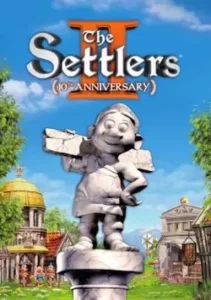
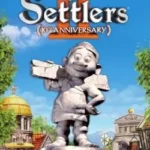
The Settlers II: 10th Anniversary (2006)
To mark a decade since the game’s release, Blue Byte and Funatics developed The Settlers II: 10th Anniversary. Released in September 2006, this standalone remake completely rebuilt the 1996 classic inside a modern, fully rotatable 3D graphics engine. While it retained the exact logistics rules, flag mechanics, and item conversion loops of the original DOS client, the remake added advanced quality-of-life adjustments, including automated building construction grids, a fully integrated multiplayer matching network, and visual asset balances.
Modern Digital Standard and Preservation (2026)
Following Ubisoft’s acquisition of Blue Byte Software, the historical footprint of The Settlers II was fully modernized for modern computing ecosystems. On November 14, 2018, the studio deployed The Settlers II: History Edition.
As of 2026, this definitive version remains readily available on digital storefronts such as the Ubisoft Store and GOG.com. The History Edition completely updates the game’s underlying source code to natively support contemporary 64-bit multi-core configurations on Windows 10 and Windows 11 out-of-the-box. It adds full widescreen layout tracking (scaling smoothly up to native 4K display formats), fixes mouse cursor tracking bugs, incorporates auto-saving modules, and reboots split-screen local co-op capabilities using dual mouse inputs.
Return to the Roots (RttR)
The game experiences an incredibly vibrant open-source multiplayer renaissance through Return to the Roots (RttR). This community-driven, non-profit open-source engine recreation replaces the archaic 1996 executable entirely.
By running over the original retail asset files, RttR injects native cross-platform compatibility for Windows, Linux, and macOS, removes legacy limit caps on global map dimensions, updates the computer-driven AI coding to play competitively, and hosts a dedicated online master server lobby system with built-in replay tools, keeping the classic flag-and-road logistics system permanently alive for strategy historians.