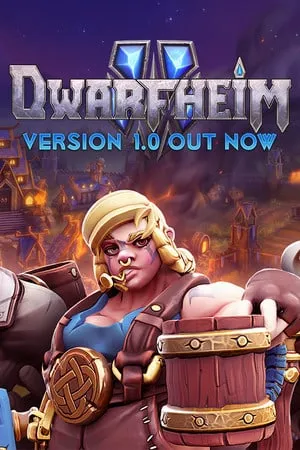
DwarfHeim
DwarfHeim (2021) stands as one of the most critical, hyper-experimental, and ultimately tragic turning points in the history of the real-time strategy genre. Following the structural fatigue of standard solo-managed “paint-the-map” sandboxes, the independent strategy scene was desperate for a structural disruption.
Trondheim-based Norwegian developer Pineleaf Studio stepped in, partnered with publisher Merge Games, and focused development duties on a radical reinvention of the RTS sub-genre: Cooperative Sub-Division Strategy. Faced with the intense task of proving that multiple players could seamlessly share a single economy and base without collapsing into chaotic infighting, Pineleaf delivered a fascinating chapter that beautifully bridged traditional RTS combat with automated manufacturing loops and strict role delegation.
The Grand Reset: The Underworld of Agnar
DwarfHeim completely severed ties with the standard, competitive multi-faction blueprints of its predecessors. Instead, it established a tightly focused, gritty fantasy lore continuity: The Reclamation of Agnar.
The game’s landscape is a brutal, dual-layered world on the brink of absolute ruin. Players are trapped in a perpetual survival war against endless, ravenous hordes of AI Feral Trolls. Rather than handing each player an isolated base to gather resources independently, the campaign and survival modes enforce a singular, collective entity. Up to three players operate as a unified clan council, sharing a single master health pool and a single structural base. They must work together to rebuild the ancient, collapsed industrial dwarven strongholds before the overworld or underworld breaches wipe them out.
The Core Evolution: Asymmetric Sub-Division & Dual Stratums
Pineleaf Studio boldly re-engineered the classic real-time strategy interface to enforce maximum mechanical interdependence:
- The Leap to 3-Player Co-Op Management: The game threw out individual resource banks. It explicitly splits the standard tasks of an RTS—base expansion, logistics gathering, and frontline military micro-management—between three radically different player Classes. You aren’t just allies; you are three distinct cogs in a single machine, meaning a failure in one department instantly starves or exposes the entire team.
- The Multi-Stratum Mapping Grid: Matches play out across two entirely separate map layers running simultaneously: the Overworld (traditional RTS surface building, farming, walls, and defensive choking points) and the Underworld (a dark, grid-based dungeon system void of sunlight where resources are embedded deep inside stone walls).
- The Friend Pass Infrastructure: Recognizing the severe difficulty of organizing three-player strategy lobbies, the game launched with an innovative “Friend Pass” feature. Only a single player was required to physically buy the retail client; they could natively invite two other friends to download a free companion client and jump into complete multiplayer skirmishes without spending a dime.
The Deep Meta: The Class Triad & Macro-Dependency
To maximize gameplay variance, DwarfHeim engineered three highly specialized player roles, transforming the standard gameplay loop into a collaborative puzzle:
| Player Class / Role | Geographic Operational Zone | Primary System In-Game Economy | Tactical Combat Role & Roster Access |
| The Builder | Strictly the Overworld Surface. | Agriculture, housing, housing tech, public order, and static turret defenses. | The Shell Protector: Builds defensive walls, spawns healing support units, and updates base research parameters. |
| The Miner | Deep Underworld Caverns. | Logistical automation, building raw conveyor belts, and smelting complex alloys. | The Industrial Pipeline: Plays a mini-game resembling Factorio or Dungeon Keeper; creates the heavy weapon ammunition the other roles need. |
| The Warrior | Global Map Patrols (Surface & Caves). | Entirely dependent on the Builder for food/housing and the Miner for elite weapon metals. | The Frontline Commander: Exercises sole control over heavy offensive dwarven combat squads and siege weaponry. |
“The Miner plays Factorio, the Builder plays SimCity, and the Warrior plays StarCraft. If the Miner miscalculates a single conveyor belt split, the Warrior’s weapons don’t spawn, and the base collapses.” — Community Balancing Focus
The Industrial Funnel
The tactical macro depth relies on a hyper-strict resource chain. The Miner must build elaborate tracking networks of automated drills, crushers, and sorters to extract raw Iron, Gold, and Coal. These resources must be mechanically blended into alloys and funneled back up to the surface. The Builder uses these processed metals to erect high-tier armor armories, which finally unlocks the Warrior’s capability to draft heavy line breakers to survive the massive, escalating Troll attacks.
The Modern Standard: Tragic Bankruptcy & Project Rebellion
The real-world history of DwarfHeim serves as a sobering cautionary tale within the independent wargaming ecosystem. Emerging from its Steam Early Access phase on September 27, 2021, the game was a profound commercial failure—selling roughly 30,000 units against a target requirement of hundreds of thousands. Just three months post-launch, in January 2022, Pineleaf Studio officially filed for bankruptcy.
The absolute final blow landed on November 30, 2023, when publisher Merge Games completely shut down the centralized, custom API backend servers. Because the code had been hardcoded to rely heavily on these external servers for profile authentication, the single-player and custom skirmish options were completely bricked along with the multiplayer—made worse by a controversial publisher announcement stating that the game could not be patched for offline play because they no longer possessed the master source code.
Today, the base game stands completely unplayable on standard Steam setups. However, the title experiences a tiny, hyper-dedicated grassroots preservation attempt through a community initiative called Project Rebellion.
Led by independent reverse-engineers, this fan-made project injects custom local server wrappers directly into the game’s Unity/Mono architecture. This allows dedicated historians to bypass the dead API checks, successfully unlocking the internal tutorial modules and a few survival maps offline under Windows 10 and Windows 11, preserving a small window into one of the most unique co-op strategy experiments ever conducted.
Release History
- Steam Early Access Launch: October 22, 2020 (Introduced basic 3v3 and Survival layouts)
- Official 1.0 Commercial Launch: September 27, 2021 (Full narrative campaign and Skirmish additions)
- Pineleaf Studio Bankruptcy: January 5, 2022 (Development permanently ceased)
- Official Server Blackout: November 30, 2023 (Commercially delisted and rendered unplayable on official clients)