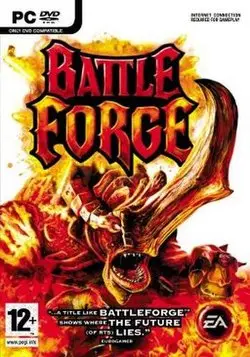
BattleForge
 PC
PC 1C-SoftClub
 Electronic Arts
BattleForge (2009) stands as one of the most critical, hyper-innovative, and structurally daring turning points in the history of the real-time strategy genre. Following the market fatigue of traditional base-building RTS clones and the parallel global growth of physical trading card games like Magic: The Gathering, the future of mechanical genre hybridization was highly uncertain.
German developer EA Phenomic (the mastermind studio behind the SpellForce series) stepped in under the Electronic Arts publishing banner. Faced with the intense task of redefining how an RTS player interacts with their military assets, Phenomic delivered a stellar, highly unorthodox chapter on March 24, 2009, that beautifully bridged intense real-time tactical control with the custom deck-building mechanics of a collectible card game.
The Mythological Canvas of Nyn
BattleForge completely severed ties with traditional grounded military operations or sci-fi interstellar sandboxes. Instead, it established a tightly constructed, rich fantasy lore continuity: The World of Nyn.
The game’s shifting landscapes and historical eras are strictly governed by silent, passive gods and their ancient conflict against underground-dwelling Giants. Players do not control a mortal faction; they assume the mantle of a Skylord—immortal, dreamless, incorporeal entities residing in the magical floating city known as the Forge of Creation. Deprived of the ability to dream for themselves, Skylords possess the unique supernatural power to weave mortal dreams, history, and legends into physical reality. Through the Forge, they magically conjure historical spells, fortresses, and creatures to battle the corrupt, blighted “Twilight” hordes across massive 1, 2, 4, or 12-player cooperative PvE campaign scenarios and ranked PvP arenas.
The Core Evolution: Base-Free Strategy & The Power Matrix
EA Phenomic boldly turned away from classic RTS macro-management to engineer a fast-paced, action-focused tactical engine that entirely discarded traditional base construction:
- The Leap to Zero Base-Building: The game entirely discarded physical resource harvesting lines, lumber camps, and factory queues. Players do not wait for a barracks to slowly train an individual squad. Instead, your entire military force is contained within a 20-card customizable Deck.
- Instant Cardinal Summoning: Units, spells, and defensive towers are cast instantaneously onto the 3D grid directly from your active hand, provided you have a valid line of sight near a friendly unit or structural zone.
- The Dual-Resource Bound: Field positioning and unit scaling are governed by a strict matrix of Power Wells and Monument Orbs. Capturing neutral Power Wells generates a persistent flow of Energy required to pay for card casting costs. However, high-tier cards require upgrading specialized map Monuments to specific colored elemental Orbs (Tiers 1 through 4), transforming standard map territorial control into an absolute power threshold puzzle.
“A player cannot simply save up energy to drop a massive endgame dragon in the first minute of a match. You must physically fight your way across the map, build three to four Monuments, and color-code your orbs to match your deck’s requirements.” — Original EA Phenomic System Design
Elemental Asymmetry & Splashing Colors
To maximize strategy variance, BattleForge engineered four core elemental card disciplines, which were later expanded to support multi-element hybrid archetypes and legendary cards. Every single faction alignment possesses a mandatory, entirely exclusive combat philosophy:
- Fire (The Kinetic Annihilators): Emphasizes high raw physical damage, aggressive line-piercing metrics, and mass-destruction area-of-effect spells. Fire decks rely on pure offensive velocity, utilizing high-damage shock units and ticking combustion loops to melt enemy defenses before opening themselves up to retaliation.
- Frost (The Unyielding Fortress): Focuses heavily on passive damage mitigation, architectural structures, and crowd control. Frost players excel at structural territory defense—deploying protective barrier shields, freezing invading enemy squads in place via icy status effects, and maintaining unbreakable defensive lines.
- Nature (The Symbiotic Vanguard): Relies on high physical health pools, gradual healing-over-time incantations, and crowd manipulation. Nature utilizes rapid unit growth mechanics, roots enemies to the ground to disrupt transport lanes, and forces organic unit adaptations to out-sustain opponents in long-form wars of attrition.
- Shadow (The Corrupted Reapers): The ultimate high-risk, high-reward faction. Shadow players specialize in dark manipulation, utilizing life-leech metrics, sacrifice mechanics, and self-inflicted damage to unlock game-breaking combat surges. They can willingly delete their own low-tier squads to instantly trigger high-damage explosions or harvest souls to fund hyper-expensive end-game demons.
The Tactical Faction Matrix
The table below demonstrates how the four elemental pillars break down across the tactical combat layout:
| Elemental Power | Orb Color | Primary Core Strategic Profile | Signature Battlefield Utility |
| Fire | Red | Hyper-aggression, structural destruction, and offensive spell line wiping. | High-damage blasts, panic debuffs, and target melting. |
| Frost | Blue | Deep fortification, crowd-control freezing, and damage absorption. | Structural shields, slowing single targets, and heavy defense. |
| Nature | Green | Symbiotic group healing, force multiplication, and terrain crowd control. | Healing over time, rooting transport lanes, and rapid rejuvenation. |
| Shadow | Purple | Corpse harvesting, tactical unit sacrifice, and high-damage micro-surges. | Life-stealing, explosion triggers via friendly fire, and high-risk utility. |
The Predatory Collapse & The Skylords Reborn Renaissance
The real-world history of BattleForge serves as one of the most polarizing and heavily documented case studies in the history of strategy game monetization. At its 2009 launch, the game operated under a rigid microtransaction loop. Players had to buy randomized digital card booster packs using real-world money via “BattleForge Points” to acquire high-tier rare or ultra-rare units. While EA quickly pivoted the client into a “Play 4 Free” model later that year, the crushing cost of competing against premium paying decks severely fractured the casual player base. On October 31, 2013, EA officially pulled the plug and shut down the centralized authentication servers, leaving the game entirely dead and unplayable.
However, the game experiences an extraordinary, fully redemptive renaissance through Skylords Reborn (2020). This monumental, community-run, non-profit volunteer project completely reconstructed the dead server backend code from scratch.
Operating under a strict, sanctioned, zero-monetization policy with Electronic Arts, Skylords Reborn has completely removed all predatory real-money microtransactions. The entire pool of 383 classic cards, along with brand-new community-designed maps, fully voiced seasonal quests, balanced PvP ranked leaderboards, and modern achievements, is natively accessible entirely through in-game gameplay dedication. Fully updated to run flawlessly under modern 64-bit multi-core operating systems like Windows 10 and Windows 11, the revived client scales into crisp 1440p and native 4K display formats without a single technical hitch, preserving a beautifully unique genre hybrid for modern strategy purists.
Release History
- Official Retail Launch (North America): March 24, 2009 (Published by Electronic Arts)
- The Play 4 Free Transition: May 26, 2009 (Client transitioned to free-to-play with reduced starter cards)
- The Official Server Sunset: October 31, 2013 (EA officially terminated the master game client)
- The Community Revival (Skylords Reborn): December 18, 2020 (Full fan-made revival launch completely stripping out microtransactions and restoring server operations).