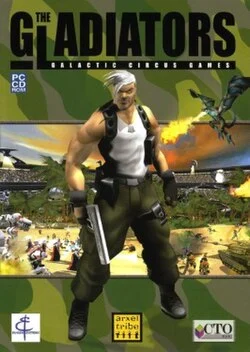
The Gladiators: Galactic Circus Games
 72
★ /10
72
★ /10
 PC
PC
 Eugen Systems
 Russobit-m, Tri Synergy, Wanadoo
The Gladiators: Galactic Circus Games (2002) stands as one of the most critical, eccentric, and fiercely creative turning points in the history of real-time tactical action strategy. Following the market exhaustion of conventional base-building resource grinds and the subsequent structural stagnation of late-90s real-time strategy clones, the future of fast-paced tactical management was highly uncertain.
Parisian developer Eugen Systems stepped in, launching their debut major title with an unyielding rejection of traditional base management. Faced with the intense task of creating a brand-new intellectual property in a market dominated by titans like Warcraft III and Command & Conquer: Generals, Eugen delivered a stellar, highly unorthodox chapter that beautifully bridged pulp comic-book aesthetics with unprecedented tactical environmental mechanics.
A Comic-Book B-Movie Universe
The Gladiators completely severed ties with grounded military operations or serious sci-fi landscapes. Instead, it established a fresh, tightly constructed, cheesy Euro sci-fi continuity heavily inspired by the style of vintage Heavy Metal comics and Flash Gordon serials.
The story tracks the misadventures of Major Greg D. Callahan, a 1970s United States Marine Corps astronaut volunteer who gets sucked directly through a newly discovered black hole. He awakens trapped in an alien solar system where disputes are resolved inside the “Deathbowl”—a massive, brutal, gladiatorial circus arena operated for the entertainment of a bloodthirsty crowd and governed by a cynical stadium announcer. Recruited by the alien Princess Lydia to serve as her champion to secure her late father’s crown, Callahan must lead his troops to storm hostile fortifications and win a planet-wide broadcasted championship against ruthless alien rivals.
The Core Evolution
Eugen Systems boldly threw out standard real-time strategy tropes to engineer an action-oriented, fast-paced tactical engine that entirely discarded traditional base construction:
- The Leap to the Card and Spawn Economy: The game completely abandoned physical harvesting lines like mining ore or cutting lumber. Instead, players start each mission with a fixed allotment of troops and must navigate the map to collect “Joker Cards”. These cards award raw tactical score points, which can be cashed in at captured map Spawn Zones to instantly call down military reinforcement drops mid-match.
- The Ray-Traced Line of Vision: Combat calculation discarded standard abstract fog of war. The engine utilized a real-time ray-trace system to calculate individual unit sight lines based on literal map topography. Troops can physically hide inside dense vegetation and leaves to stage lethal, invisible ambushes where they can actively view incoming enemies while remaining completely unseen.
- Interactive 3D Vertical Geometry: The entire battlefield environment is treated as an active mechanical asset. Every single building, tree, and environmental object can be completely destroyed to carve shortcuts or flush out cowering enemies. Crucially, units can physically scale and climb on top of intact buildings to secure a crushing high-ground elevation advantage.
A Multi-Cultural Arena Clash
The game tracks three wildly distinct civilizations across an 18-mission split single-player campaign, each controlled by a distinct gladiator hero boasting exclusive abilities:
- The Humans (Major Greg D. Callahan): The classic projectile powerhouses. Callahan acts as an oversized field hero wielding a heavy silver pistol. The human army rejects plasma or lasers in favor of traditional, high-velocity kinetic ballistic weaponry—relying on standard combat marines, dense automated bullet sprays, heavy armor tanks, and devastating air strikes to flatten fortifications.
- The Galactic / Cyborgs (General Maximix): A cold, steel-plated cybernetic army featuring highly menacing robotic designs. Maximix utilizes high-tech energy arrays, tracking laser cannons, metal-clawed close-quarters shock troops, and hyper-mobile flying jetpack infantry built to completely bypass ground-level ambushes and vertical map obstacles.
- The Fantasy / Demonic (Fargass “The Magician”): An organic, dark-fantasy horde faction invoking the power of ancient spells. Fargass’s army relies on spawning overwhelming numbers of high-velocity mythical monsters, long-range alien archers, and deploying active magical power-ups (like localized armor and speed buffs) to overwhelm high-tech weapon lines.
The Tactical Loadout Matrix
The table below showcases how the game balances its rock-paper-scissors counter logic across its three diverse civilization archetypes:
| Civilizational Faction | Signature Hero Unit | Core Tactical Roster Role | Unique Field Passive |
| The Humans | Major Greg D. Callahan (High-damage pistol specialist) | Kinetic line containment and long-range ballistic shell suppression. | Highly optimized for building defense, bunker holds, and dense brush ambushes. |
| The Galactic Robots | General Maximix (Scary cybernetic commander) | Hyper-mobility, bright fat laser arrays, and vertical air dominance. | Units possess exceptional line-of-sight tracking and ignore basic movement penalties. |
| The Fantasy Monsters | Fargass “The Magician” (Powerful spellcaster) | Close-quarters swarming, magical area buffs, and stealth cloaking. | Rapid melee damage scaling and crowd manipulation via active power-ups. |
The Modern Standard
While the game remains a deeply nostalgic childhood memory for strategy fans who fell in love with its over-the-top visual gore, bright laser effects, and roaring arena crowd sound bites, its preservation status remains incredibly volatile. Unlike Eugen Systems’ later historical catalog (like R.U.S.E. or Act of Aggression), The Gladiators has never received an official digital remaster wrapper or modern storefront launch.
Currently, the title is entirely classified as abandonware. The original 2002 execution code relies on archaic Direct3D and SafeDisc configurations that conflict severely with contemporary 64-bit operating systems. Strategy communities attempting to run the game under Windows 10 or Windows 11 are hit with critical memory errors, broken mouse-tracking exceptions, and severe graphical rendering crashes upon applying the classic Patch 1.2.
To play it safely on contemporary desktop setups, purists must manually source the original retail CD-ROM or demo files and run them using deep-level compatibility emulators like dgVoodoo2 alongside custom CPU core affinity configuration overrides—preserving it strictly as a hidden, hard-to-reach masterpiece of early 2000s strategy history.