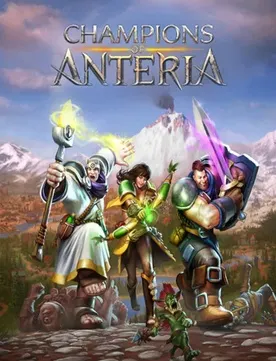
Champions of Anteria
 67
★ /10
67
★ /10
 PC
PC Ubisoft
Where to buy

Champions of Anteria is a tactical real-time strategy and action role-playing video game developed by Ubisoft Blue Byte and published by Ubisoft. Released on August 30, 2016, for Microsoft Windows, the title is historically notable for its protracted development lifecycle, having been completely re-engineered and rebranded after originally being announced as an entry in The Settlers series.
Abandoning traditional city-building and economic logistics pipelines, Champions of Anteria operates as a hybrid squad-tactics game combining turn-based geopolitical territory management, persistent base building, and real-time combat utilizing a tactical pause system and an elemental logic matrix.
Technical Specifications
| Attribute | Details |
|---|---|
| Developer | Ubisoft Blue Byte |
| Publisher | Ubisoft |
| Creative Director | Mihnea Dragoman |
| Engine | Custom 3D Engine |
| Platform | Microsoft Windows |
| Release Date | August 30, 2016 |
| Genre(s) | Tactical real-time strategy, Action role-playing |
| Mode(s) | Single-player |
Gameplay
Champions of Anteria is structured around three interlocking gameplay components: a turn-based strategic world map, a persistent capital stronghold, and real-time tactical combat missions.
World Map and Campaign Progression
The overarching campaign plays out across a macro-progression map divided into 26 distinct territories. Operating on a turn-based daily timeline similar to Rise of Nations, players and automated rival factions are permitted to execute one military action per turn. Players expand their influence by launching offensive raids onto adjacent neutral or hostile sectors.
Rival factions continuously level up their home sectors independently, launching automated counter-invasions onto player-controlled landmasses. If a player’s territory is assaulted, they must deploy a defensive mission within one in-game day to repel the threat or forfeit the region. To permanently knock out a rival faction, players must conquer their heavily fortified capital base, which is guarded by a specialized boss unit. Territories can be augmented with Upgrades, including trading posts to amplify Gold generation and fortifications to stall enemy armies.
Stronghold Metagame
The game features a simplified municipal base-building system confined strictly to the player’s capital city. This mode serves as the primary progression anchor.
Players unlock localized districts to place manufacturing structures that generate raw materials over time. The economy operates like a spatial puzzle, as specific buildings confer passive production multipliers or structural interference loops based on their geometric proximity to neighboring foundations. The gathered materials are funneled into crafting tiers, allowing the player to manufacture potions, high-tier armor plating, specific weapon profiles, and auxiliary gadgets required to sustain characters during active missions.
Real-Time with Pause Combat
When launching a raid or executing a defense mission, the player selects a active task force consisting of exactly three characters out of the five available Champions. The combat engine is designed around isometric micro-management reminiscent of multiplayer online battle arenas (MOBAs) and tactical games like Warhammer 40,000: Dawn of War II.
Combat relies heavily on the Active Pause System. At any millisecond during combat, players can temporarily freeze the timeline to assess the battlefield, distribute healing items, change direction vectors, and queue up character movement or specific weapon tracking commands before resuming action.
The Elemental Matrix
The core tactical depth of the combat maps relies on a strict, interlocking Elemental Wheel composed of five cosmic forces: Water, Fire, Earth (Metal), Nature, and Lightning. Every hostile monster, elite boss, and playable Champion is hardcoded to a mandatory elemental affinity.
Combat effectiveness operates on a clockwise rock-paper-scissors circular logic pattern where each element inflicts massive damage parameters against the system immediately succeeding it, while suffering immense damage reduction against the element preceding it counter-clockwise:
Water⟶Fire⟶Metal⟶Nature⟶Lightning⟶Water
Character Roster
The game’s narrative follows a lighthearted, comedic tone as a band of returning native champions attempt to liberate the kingdom from the undead legions and chaotic factions controlled by the dark wizard Kalen Daark. The baseline roster features five playable characters, each managing a distinct ability pipeline:
- Vargus (The Warrior): A heavy melee frontliner aligned with the Fire element. He serves as the primary tank, absorbing damage and generating threat vectors to protect fragile allies.
- Anslem (The Monk): A holy spellcaster aligned with the Lightning element. Anslem utilizes standardized physical strikes to continuously build a localized power resource pool, which is expended to cast high-impact area-of-effect offensive bolts and group shields.
- Nusala (The Archer): A fast-tracking ranged rogue aligned with the Nature element. Nusala’s baseline combat loop involves stacking physical arrows onto a targeted foe before detonating the markers simultaneously to trigger massive single-target kinetic puncture bursts.
- Oryn (The Elementalist): A utility support mage aligned with the Water element, focusing on lane healing, defensive freezing fields, and barrier tracking.
- Sanaa (The Forge Master): A heavy control technician aligned with the Metal/Earth element, using specialized traps and mechanical constructs to dictate crowd movement.
Free DLC Expansion
- Tarn, The Beastmaster: Released as a free post-launch content update, Tarn added a sixth champion choice to the selection pool. Operating with a unique Rage resource meter, Tarn builds combat momentum via close-quarters martial arts, utilizing hybrid elements of Metal and Nature to manipulate frontlines.
Development History and Rebranding
The production history of Champions of Anteria serves as a prominent case study in video game industry pivots. The project was originally unveiled at Gamescom 2014 under the title The Settlers: Kingdoms of Anteria, positioned as the official eighth entry in the historic The Settlers franchise. Blue Byte intended the design to revitalize the series by grafting automated, few-unit action role-playing dungeons directly onto a persistent The Settlers Online-style city builder.
In September 2014, Ubisoft launched a highly publicized Closed Beta for the title. The reception from long-time series purists was overwhelmingly hostile. Fans expressed severe dissatisfaction with the removal of classic supply chains and free-roaming carrier networks, going so far as to launch public petitions demanding the game’s total cancellation. Reviewers and players complained that the hybrid structure compromised both genres, delivering a slow city builder tethered to a clunky, repetitive dungeon crawler.
Following the critical backlash, Ubisoft abruptly yanked the title from its release schedule, entering a period of complete silence. Creative Director Mihnea Dragoman later noted that the development team realized the project had moved too far away from the core identity of the series, stating, “There was no point in tricking the players by calling it a Settlers game.”
Consequently, the studio systematically stripped out the Settlers intellectual property. The economic supply lines were entirely discarded, and the assets were re-engineered. The title was refocused into a standalone, combat-driven single-player tactical strategy game, officially launching in 2016 under its new identity: Champions of Anteria.
Reception and Modern Status (2026)
Upon its 2016 rollout, Champions of Anteria received mixed to average reviews from mainstream video game publications. Review aggregator Metacritic computed a composite score of 67/100, while its Steam user rating settled at a polarized 49% approval rating.
Critics highly commended the expressive, colorful visuals and praised the mechanical execution of the Active Pause elemental wheel, finding it a clever spin on tactical micro-management. However, the title faced sharp criticism for its lack of identity. Strategy reviewers observed that the game sat in an awkward middle ground; it was too simplistic to succeed as a robust 4X kingdom builder, yet lacked the responsive mechanical precision required to stand out as a high-quality action role-playing game or MOBA clone. Severe pathfinding errors and repetitive layout designs across the randomized combat maps further bogged down the mid-game loop.
Modern Digital Status
As of 2026, Champions of Anteria remains preserved as a legacy standalone single-player title available via Steam and the Ubisoft Store. The title incorporates older implementations of Denuvo anti-tamper architecture alongside its standard Ubisoft Connect launching wrapper.
While the title has received no formal system patches since its launch lifecycle, the 64-bit application functions cleanly under contemporary Windows 10 and Windows 11 hardware configurations out-of-the-box. It handles native 1080p and 1440p widescreen desktop formats without UI scaling errors, serving as a distinct historical curiosity documenting Blue Byte’s most radical genre-blending experiment.