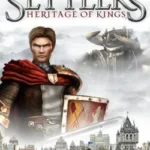
The Settlers: Heritage of Kings
 58
★ /10
58
★ /10
 PC
PC ND Games
 Ubisoft

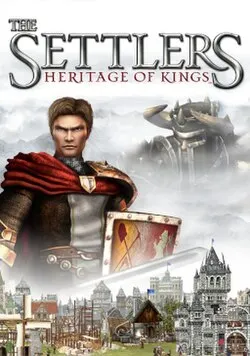
The Settlers: Heritage of Kings (originally released in German-speaking territories as Die Siedler: Das Erbe der Könige) is a real-time strategy (RTS) video game developed by Blue Byte and published by Ubisoft. Released in November 2004 for Microsoft Windows, it is the fifth major installment in The Settlers series.
The game marks the most radical and highly polarizing structural pivot in the history of the franchise. Shifting away from the series’ signature “German-style” slow-paced city building, macroeconomic supply loops, and physical unit logistics, Heritage of Kings was designed as a fast-paced, traditional military real-time strategy game heavily influenced by contemporary titles like Warcraft III and Age of Empires.
Furthermore, the game discarded the franchise’s traditional 2D isometric visual style, utilizing Criterion Software’s RenderWare engine to transition the series into full 3D graphics.
Technical Specifications
| Attribute | Details |
| Developer | Blue Byte |
| Publisher | Ubisoft |
| Producer | Benedict Grindel |
| Lead Programmer | Thomas Häuser |
| Engine | RenderWare (True 3D graphics framework) |
| Platform | Microsoft Windows |
| Release Date(s) | • DE: November 25, 2004 • UK: February 18, 2005 • NA: February 22, 2005 |
| Genre(s) | Real-time strategy |
| Modes | Single-player, Multiplayer (LAN / Uplay / Steam) |
Gameplay Overhaul
The baseline design philosophy of The Settlers: Heritage of Kings stripped out the microscopic resource refinement chains that defined its predecessors (such as feeding miners bread to harvest iron ore to melt into bars for armories). Instead, the economics were flattened into a global resource pool model.
Pooled Logistics and Serf Management
The game completely abandoned physical transport systems, meaning materials no longer needed to be carried from structure to structure by individual workers. Wood, Stone, Iron, Clay, and Sulfur are gathered by hired Serfs and instantly credited directly to the player’s central Keep or Storehouse upon extraction.
Serfs act as the primary workforce, functioning as autonomous builders and repair crews. During construction loops, the required materials are automatically subtracted from the global bank, entirely bypassing the risk of transit traffic jams.
The Motivation and Overtime System
To balance the simplified economy, Blue Byte introduced a localized Worker Motivation Matrix. The productivity and extraction efficiency of civilian workers are tied directly to their personal comfort and stamina.
Players must manage a balancing act by building sufficient housing space, farms, and taverns near active extraction zones. Furthermore, players can manually order a structure to execute Overtime to double material outputs; however, sustained overtime heavily tanks the workers’ motivation. To counter this morale decay, players must spend gold currency (Thalers) to erect decorative monuments, fountains, and places of worship to artificially boost happiness parameters.
Squad-Based Military and Hero Abilities
Combat shifted into micro-intensive, squad-based real-time tactics. Military forces are divided across traditional infantry and cavalry lines—subdivided into Swordsmen, Spearmen, Archers, Light Cavalry, and Heavy Cavalry—alongside deployable, high-impact siege Cannons built at localized Foundries.
Units are drafted into fixed, multi-man squads that fight under the leadership of unique Hero Units. Heroes boast massive individual health pools and active, cooldown-based special abilities—such as tracking cloaked units, granting localized armor boosts, or discharging area-of-effect shockwave slams to turn the tide of real-time skirmishes.
Plot and Setting
The game’s narrative drops the quirky, lighthearted tone of previous titles to present a dark-fantasy political thriller layout. The plot centers on Dario, a young villager who discovers he is the rightful heir and biological son of the Old King of a once-prosperous, now fractured empire.
The realm has been systematically subjugated and plunged into tyranny by Kerberos, a ruthless warlord commanding the dark legions of the Shrouded People. Guided by his mentor Helias, Dario must travel across diverse regional biomes—ranging from marshlands and sweltering deserts to treacherous frozen mountains—to unify regional factions, construct sprawling fortresses, and rally a grand rebel coalition to storm Kerberos’s central stronghold, successfully reclaiming his ancestral crown.
Playable Factions and Asymmetric Research
While multiplayer and skirmish setups feature a single mechanically unified human framework, faction diversity is achieved through Hero Customization and the distinct construction configurations of specialized technology buildings:
- The University Layer: The absolute heart of tech progression. Players utilize researchers to open up advanced technologies across three separate branches: Science, Mechanics, and Military. Unlocking specific nodes (such as the Matchlock or Rifled Barrel) permanently updates unit profiles, increasing reloading speeds, upgrading physical armor thresholds, or granting access to high-tier gunpowder weapons.
- The Refinery Matrix: To optimize the intake of the five primary resource pools, players construct specialized secondary refining yards (such as Sawmills or Brickworks). These structures do not refine raw materials into separate assets; instead, they act as mechanical multipliers, passively increasing the global gathering speed of nearby serf extraction zones while hosting unique structural armor upgrades.
Content Expansions
The commercial footprint of the title prompted Blue Byte and Ubisoft to deploy two major standalone expansion disks to build upon the updated engine architecture:
1. Heritage of Kings: Expansion Disc
Released in March 2005 (German title: Das Erbe der Könige – Nebelreich), the first expansion adds a fresh 9-mission campaign taking place several years after Kerberos’s defeat, forcing Dario to investigate a mysterious construction freeze on a critical geopolitical bridge project.
Mechanically, the expansion integrated a bridge-building framework, a map editor utility, and introduced two transformative rogue-style utility units:
- The Scout: Possesses immense visual line-of-sight metrics. They can throw localized torches onto the map to clear the fog of war permanently for a set duration, allowing players to actively track enemy reinforcement columns.
- The Thief: The ultimate asymmetric sabotage unit. Thieves are completely invisible to standard enemy troops unless detected by a Scout. They are the only units capable of stealing resources directly from hostile storehouses, defusing planted traps, and blowing up physical bridges to freeze enemy transport lanes.
2. Heritage of Kings: Legends Expansion Disc
Released in September 2005 (German title: Das Erbe der Könige – Legenden), the final expansion pack heavily focused on expanding multiplayer and single-player skirmish depth. It added four separate historical mini-campaigns totaling 17 fresh missions, 18 multiplayer arenas, an enhanced map editor, and a highly requested Procedural Random Map Generator that drastically increased the replayability of custom matches.
Reception and Modern Preservation
Upon its mid-2000s rollout, The Settlers: Heritage of Kings received mixed to polarized reviews. While mainstream strategy reviewers praised the high-quality 3D visual fidelity of the RenderWare engine and lauded the fluid squad combat balancing, core franchise purists deeply criticized the mechanical shift.
The complete removal of complex logistical transport lines and item-refinement chains caused many to argue that the game had stripped away the unique identity of The Settlers, turning it into a generic real-time strategy clone.
The History Edition Standard
On January 22, 2019, Ubisoft officially deployed The Settlers: Heritage of Kings – History Edition as a standalone digital preservation title and as part of the The Settlers: History Collection bundle.
This version functions as the modern digital benchmark. Fully integrated and maintained via Steam and Ubisoft Connect, the History Edition natively bundles the base game and both official expansions into a singular unified client launcher.
The underlying source code was re-engineered to run flawlessly under modern 64-bit multi-core configurations on Windows 10 and Windows 11 completely out-of-the-box. It adds full adjustable widescreen layout support (scaling into native 1080p, 1440p, and 4K display formats without distortion) and fixes legacy network hooks to natively support modern online multiplayer matchmaking, preserving the franchise’s most experimental chapter for strategy historians.