Lords of EverQuest
 62
★ /10
62
★ /10
 PC
PC
 1C Company, Sony Online Entertainment,
  Ubisoft
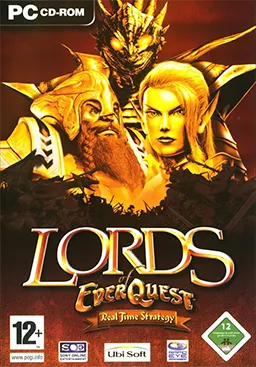
Lords of EverQuest is a fantasy real-time strategy (RTS) video game developed by Rapid Eye Entertainment and published by Sony Online Entertainment (SOE). Released on December 1, 2003, for Microsoft Windows, the title is a strategic spin-off set within the established universe of the widely successful EverQuest massively multiplayer online role-playing game (MMORPG) franchise.
The game is set in the fictional world of Norrath approximately 10,000 years prior to the events of the original MMORPG timeline, documenting an ancient era of massive continental wars. Heavily influenced by contemporary strategy hybrids such as Warcraft III: Reign of Chaos, Lords of EverQuest synthesizes traditional base construction, resource collection, and army recruitment loops with a deep, persistent character role-playing framework, emphasizing persistent multi-mission unit leveling and hero-centric tactical gameplay.
Technical Specifications
| Attribute | Details |
| Developer | Rapid Eye Entertainment |
| Publisher | Sony Online Entertainment |
| Engine | Custom 3D RTS Engine |
| Platform | Microsoft Windows |
| Release Date | December 1, 2003 |
| Genre(s) | Real-time strategy, Tactical |
| Modes | Single-player, Multiplayer (Discontinued) |
Gameplay Mechanics and RPG Hybridization
Lords of EverQuest operates on standard real-time strategy macro-mechanics while incorporating systems modeled directly on fantasy table-top and role-playing logic. Players establish military forward operating bases, capture resource nodes, and manage a single, unified currency: Platinum, which is manually mined from crystalline deposits scattered across the maps.
The “Lords” Hero System
The core design revolves around powerful commander hero units known as Lords. There are 15 distinct Lords available across the game’s factions.
Lords possess massive health attributes, unique weapon profiles, and individual experience pools. As a Lord kills hostile forces, they level up mid-match, automatically unlocking a specialized, class-based spellbook containing active incantations—such as localized healing arrays, stealth detection sweeps, or catastrophic offensive magic blasts. Furthermore, Lords feature persistent, multi-tiered inventories, enabling them to discover and equip magical armor components, stat-boosting rings, and enchanted weapons left behind by defeated neutral boss monsters.
Inter-Mission Unit Persistence
The game’s most significant mechanical departure from contemporary RTS norms is the Veterancy and Unit Carry-Over framework. Like the Lords, standard infantry, cavalry, and support troops gather individual experience points from combat engagements. Units that accumulate enough experience scale through levels, naturally expanding their physical damage outputs, movement metrics, and total health bars.
Crucially, any standard combat unit that successfully survives a single-player campaign mission is permanently saved to the player’s overarching profile. At the initialization of a subsequent campaign chapter, the player can use a specialized summoning pool to draft these exact, high-level veteran units directly back onto the field with all their accumulated levels and status parameters completely preserved, entirely bypassing the typical production limits of generic base building.
Plot and Setting
The narrative takes place during the ancient “Age of Enlightenment” on the continent of Antonica, millennia before the geopolitical borders of the primary MMORPG are drawn. The overarching plot is set off by a massive political crisis: the sudden, violent assassination of a prominent High King who held a fragile global peace together.
Following his death, longstanding racial prejudices and territorial disputes ignite a multi-front war of succession. The single-player component features three independent, non-linear campaigns consisting of 36 interlocking missions total. The story shifts perspectives across the three competing political coalitions, tracking their search for hidden mystical artifacts, structural sieges, and clandestine maneuvers to secure absolute dominion over Norrath.
Playable Factions
The game features three asymmetric factions available for custom local skirmishes and online multiplayer networks, each compiling four distinct EverQuest fantasy races under a unified military alignment:
| Faction Alliance | Race Roster Composition | Primary Combat Doctrine | Core Magical Archetype |
| The Dawn Brotherhood | Humans, Dwarves, Barbarians, Halflings | High structural defense, heavy plate armor, and traditional frontline melee cohesion. | Divine Paladins and Holy Clerics. |
| The Elddar Alliance | High Elves, Wood Elves, Frogloks, Koada’Dal | High visual line-of-sight metrics, long-range archery support, and mobile guerilla tactics. | Nature Druids and Arcane Rangers. |
| The Shadow Realm | Dark Elves (Teir’Dal), Iksar, Ogres, Trolls | Brutal physical close-quarters damage, mass recruitment, and health regeneration loops. | Dark Necromancers and Shadow Knights. |
Reception and Legacy
Upon its initial winter 2003 commercial rollout, Lords of EverQuest received mixed to average reviews from mainstream video game publications. Review aggregator Metacritic calculated a composite score of 62/100.
Critics highly lauded the game’s lore accuracy, praising the rich implementation of authentic EverQuest character classes, spell hierarchies, and creature designs, which highly resonated with fans of the core MMORPG. The innovative system of carrying regular units over across single-player missions was also singled out as a clever mechanical twist on the genre.
Conversely, the game faced intense criticism for its heavy, derivative reliance on the Warcraft III framework, with reviewers arguing that it lacked enough mechanical originality to step out from its competitor’s shadow. Strategy purists further criticized the game’s erratic unit pathfinding matrices, unbalanced faction modifiers, and a rigid camera tracking perspective that limited macro-situational awareness during massive, multi-unit battlefield engagements.
Digital Abandonware and Preservation Status (2026)
Following Sony Online Entertainment’s restructuring and the eventual dissolution of Rapid Eye Entertainment, the franchise’s strategy branch was completely archived. As of 2026, Lords of EverQuest is classified as classic abandonware. The title has never received an official digital re-release on modern PC distribution platforms like Steam or GOG.com. The proprietary centralized multiplayer matchmaking matching networks hosted on the original LordsOfEverQuest.com domain were permanently shut down over two decades ago, restricting the game entirely to single-player campaigns and offline local area network (LAN) play.
The game’s legacy 2003 codebase is highly volatile on modern computing architectures. Attempting to execute the vanilla CD-ROM application on modern Windows systems triggers immediate Direct3D emulation errors, resolution exceptions, and severe desktop rendering artifacting.
To bypass these limitations, modern retro gaming archivers utilize third-party API wrapper wrappers such as dgVoodoo2 to translate legacy DirectX 9 calls into contemporary graphics pipelines. These community shims effectively eliminate graphical lag, correct cursor tracking offsets, and allow the game’s 3D assets to scale smoothly into native 1080p and 1440p widescreen display formats under modern 64-bit multi-core Windows 10 and Windows 11 desktops, preserving the title for real-time strategy historians.