 84
84  PC,
PC,  PS4,
PS4,  PS5,
PS5,  Xbox One,
  Xbox Series X/S
 Blizzard Entertainment
Blizzard Entertainment
Blizzard Entertainment


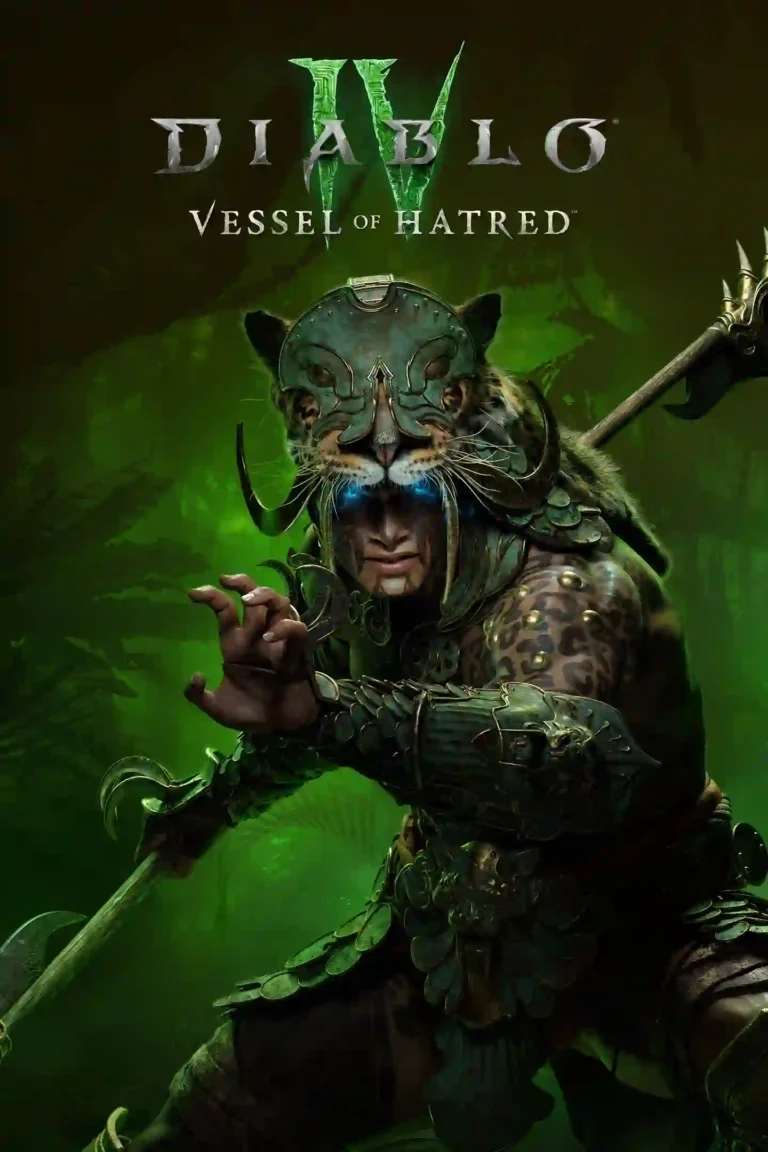
Diablo IV: Vessel of Hatred is a dark-fantasy action role-playing hack-and-slash video game expansion pack developed by Blizzard Entertainment. Released on October 8, 2024, for Microsoft Windows, PlayStation 4, PlayStation 5, Xbox One, and Xbox Series X/S, it is the first major mainline expansion pack for 2023’s Diablo IV.
Directed by Brent Gibson, the expansion serves as a critical course correction and structural reimagining for Diablo IV. Beyond introducing a massive new jungle biome and an entirely original character class—the martial-arts-focused Spiritborn—the expansion launched alongside permanent base-game updates that overhauled the leveling caps, itemization matrices, and endgame difficulty frameworks.
As of 2026, Vessel of Hatred stands as the foundational bridge that set up the massive mechanical overhauls of the subsequent 2026 expansion, Diablo IV: Lord of Hatred.
Technical Specifications
| Attribute | Details |
| Developer(s) | Blizzard Team 3, Blizzard Albany |
| Publisher | Blizzard Entertainment |
| Game Director | Brent Gibson |
| Composers | Ryan Amon, Ted Reedy |
| Platform(s) | Microsoft Windows, PlayStation 4, PlayStation 5, Xbox One, Xbox Series X/S |
| Release Date | October 8, 2024 |
| Genre(s) | Action role-playing, Hack and slash, Dungeon crawler |
| Mode | Shared-world Multiplayer (Online Only) |
The Spiritborn Class: Apex Predator of the Jungle
The headline inclusion of Vessel of Hatred is the Spiritborn, an entirely original class to the Diablo franchise. Hailing from the ancient cultures of the southern jungles, the Spiritborn is designed as an agile, high-velocity martial artist utilizing physical glaives, polearms, and quarterstaves.
The Guardian Spirit Matrix
Driven by a dedicated resource pool called Vigor, the Spiritborn’s skill tree differs from generic classes by allowing players to attune their combat styles to four distinct Spirit Guardians. Each guardian functions as a ghostly avatar that alters elemental damage and mechanical properties, allowing for deep hybridization:
| Spirit Guardian | Archetype / Playstyle | Primary Damage Type | Core Mechanical Specialty & Utility |
| The Jaguar (Rezoka) | Hyper-Aggressive DPS | Fire | Focuses on extreme attack velocity, stacking Ferocity buffs to slash enemies at high speeds. |
| The Gorilla (Womba) | Armored Tank / Bruiser | Physical | Prioritizes survivability, physical crowd control, and generating massive barrier shields to absorb kinetic impacts. |
| The Eagle (Kwatli) | Evasive Marksman | Lightning | Optimizes aerial mobility, precise execution, high critical strike chance, and lightning traversal. |
| The Centipede (Balazan) | Debuff / Siphon Utility | Poison | Relies on ticking damage-over-time, life-leeching, and spreading debilitating venom clouds across dense packs. |
The Region of Nahantu
The expansion expands the global overworld of Sanctuary by unlocking Nahantu, a massive, dense tropical wilderness zone located south of Kehjistan. For franchise historians, Nahantu serves as an explicit revisit to the Torajan Jungles and Kurast—the historic setting of Diablo II’s Act III.
The map design shifts completely away from the dreary, snowy wastes of the base game’s Fractured Peaks, populating the screen with hyper-dense, vivid jungle canopies, vine-choked temple ruins, and glowing tribal settlements.
The zones introduce specialized structural challenges, unique Strongholds, and a brand-new rogue enemy faction known as the Hollowed—grotesque, plant-mutated humanoids and toxic insectoid beasts born directly from the festering corruption of Mephisto’s soulstone.
Expanded Systems & Cooperative Endgame
Vessel of Hatred introduces foundational multiplayer and companion mechanics engineered to deepen the endgame ecosystem:
1. Hireable Mercenaries
The expansion restores the beloved persistent companion system from Diablo II: Lord of Destruction. Players can discover and recruit a roster of four distinct Mercenaries, including Subo the Bounty Hunter and Raheir the Shield Bearer.
Mercenaries feature custom progression trees, allowing them to accompany solo players out in the field as direct battle assistance. Furthermore, players can bind a Mercenary as a Reinforcement, hardcoding parameters where the companion will automatically warp onto the screen to cast a specific high-tier skill whenever the player clicks a designated hotkey.
2. The Dark Citadel (Co-op Raid)
The expansion introduces a first-of-its-kind feature to the franchise: The Dark Citadel, a dedicated, multi-faceted PvE cooperative endgame dungeon.
Designed explicitly to mandate group party mechanics, the Citadel completely strips away brainless hack-and-slash clicking. Clearing its wings requires distinct, synchronized co-op puzzle execution—such as forcing one group of players to physically hold down pressure gates or reflect energy barriers while their teammates navigate a lethal gauntlet to dismantle an elite boss shield.
Narrative Synopsis: The Corruption of Neyrelle
The narrative acts as a direct continuation of Diablo IV’s base campaign finale. Following the defeat of Lilith, the young, one-handed Horadrim disciple Neyrelle takes the terrible burden of safeguarding the soulstone of Mephisto (The Lord of Hatred). Fearing that the remaining heroes will succumb to its madness, she flees across the sea alone to find a hidden means to permanently destroy the Prime Evil.
The player’s Wanderer tracks Neyrelle’s trail deep into the unexplored overgrowth of Nahantu. The campaign is formatted like an intellectual and psychological horror thriller: as Neyrelle sails down the river networks toward the ancient vaults of Akarat, Mephisto’s essence physically leaks from the stone, slowly melting her mind and manifesting gruesome hallucinations that cause the surrounding wildlife to mutate into hellish abominations.
The story chronicles the Wanderer’s desperate alliance with the Spiritborn clans to intercept Neyrelle before the Lord of Hatred can hollow out her soul to forge a fresh physical vessel.
Legacy and Current Preservation Status (2026)
Upon its late 2024 launch, Vessel of Hatred received highly favorable reviews for its gameplay design and class execution, particularly praising the fluid movement speed of the Spiritborn, though its narrative cliffhanger received minor criticisms for leaving the plot unresolved.
Integration with Lord of Hatred
As of May 2026, Vessel of Hatred has been completely absorbed into Blizzard’s unified live-service pipeline. Following the April 2026 launch of the franchise’s second massive expansion, Diablo IV: Lord of Hatred, the entire content suite of Vessel of Hatred—including access to the Nahantu maps and the Spiritborn class—is natively packaged alongside all standard digital editions of the 2026 expansion bundle.
The application runs smoothly at 4K resolutions on modern 64-bit multi-core Windows 11 PCs and current home console systems. It is fully optimized via integrated Party Finder systems, allowing modern players to easily queue for the Dark Citadel or tackle the scaling difficulty tiers of the current Season of Reckoning.
Diablo news
More news
Diablo 5 Announced: Release Window, Story, and What We Know

World of Warcraft: Forever Previewed Alongside BlizzCon 2026 News
Diablo Animated Series in Development at Netflix
BlizzCon 2026 Opening Ceremony: Every Major Announcement