Diablo II
 88
★ /10
88
★ /10
 PC
PC
 Blizzard Entertainment
,
Blizzard Entertainment
Blizzard Entertainment,  Sierra,
  Softclub
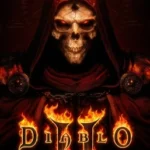
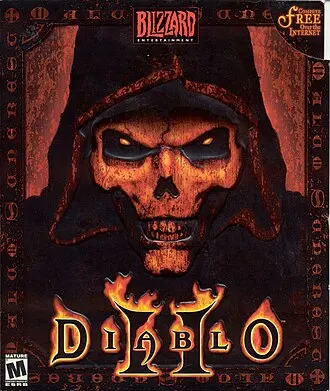
Diablo II is a dark-fantasy action role-playing hack-and-slash video game developed by Blizzard North and published by Blizzard Entertainment. Released on June 29, 2000, for Microsoft Windows and Classic Mac OS, the title is the direct sequel to 1996’s Diablo.
Designed by David Brevik, Max Schaefer, and Erich Schaefer, the game is widely celebrated as one of the greatest video games ever created. It serves as the definitive archetype that popularized the modern action RPG (ARPG) genre, establishing design tropes centered around randomized itemization matrices, branch-based skill trees, and highly addictive online matchmaking networks via Battle.net.
While the game’s lifecycle was drastically expanded by its official 2001 expansion pack, Diablo II: Lord of Destruction (LoD), and received a high-definition 3D remaster titled Diablo II: Resurrected in 2021, the classic 2000 version (frequently categorized by the community as “Legacy D2” or “D2 Classic”) remains highly active. Its longevity is sustained by an open file architecture that supports a thriving, massive modding landscape.
Technical Specifications
| Attribute | Details |
| Developer | Blizzard North |
| Publisher | Blizzard Entertainment |
| Designers | David Brevik, Max Schaefer, Erich Schaefer |
| Composer | Matt Uelmen |
| Engine | Custom 2D Pseudo-3D Isometric Engine (Direct3D / 3dfx Glide API) |
| Platform(s) | Microsoft Windows, Classic Mac OS, OS X |
| Release Date | June 29, 2000 |
| Genre(s) | Action role-playing, Hack and slash, Dungeon crawler |
| Modes | Single-player, Multiplayer (LAN / TCP/IP / Battle.net) |
Gameplay Architecture
Diablo II is presented from an isometric perspective, utilizing a sophisticated 2D engine that tracks character sprites across rolling, pseudo-3D plain grids. Players command a single hero through vast, procedurally generated outdoor landscapes and underground dungeons, slaughtering legions of demons to harvest randomized equipment and gather gold coin currency.
The Tiered Loot and Inventory Matrix
The driving mechanism of the gameplay loop is the highly complex Loot Prefix/Suffix System. Equipment drops are dynamically generated across distinct rarity tiers: Normal (White), Socketed/Ethereal (Grey), Magical (Blue), Rare (Yellow), Set (Green), and Unique (Gold).
Items feature randomized mathematical properties—such as boosting resistances, accelerating attack velocities, or granting passive skills.
Managing this loot utilizes an unguided Grid Inventory “Tetris” System. Items occupy varying spatial boundaries inside a finite chest box (e.g., a heavy plate mail costs 6 vertical slots, whereas a small ring costs 1 slot).
To streamline production, players rely on the Horadric Cube, a mystical quest item carried in the inventory that acts as a manual mobile transmutation forge. Players drop specific ingredient recipes inside the Cube—such as combining three identical low-tier gems into a single pristine high-tier gem—to generate advanced crafting components.
Structural Progression via Acts
The game’s narrative sandbox maps its campaign across four distinct, sprawling geographic Acts, each acting as an insulated regional sector with individual merchant hubs:
- Act I: The Rogue Encampment: Gothic, rain-drenched moors and stone monasteries overrun by corrupted rogues, beasts, and the demoness Andariel.
- Act II: Lut Gholein: A massive desert oasis city flanked by barren sands, hidden tombs, and ancient arcane sanctuaries, culminating in a battle against Duriel.
- Act III: Kurast: A dense, humid jungle biome plagued by toxic swarms, religious fanatics, and subterranean temple complexes guarding Mephisto.
- Act IV: The Pandemonium Fortress: A bleak, volcanic frontline bastion located inside Hell itself, requiring players to clear the Chaos Sanctuary to break the seals of Diablo.
The Core Character Classes
The base game offers five distinct playable character classes. Each class manages three unique, branch-based Skill Trees containing active combat abilities and passive modifiers:
- The Amazon: A master of physical ranged weapons, utilizing separate trees for Bows/Crossbows, Javelins/Spears, and Passive/Magic skills to dominate battle lines from afar.
- The Necromancer: A dark spellcaster who specializes in army micromanagement. He expends enemy corpses to summon massive battalions of skeletons and golems, deploys offensive bone spells, and casts curses to cripple monster resistances.
- The Paladin: A holy warrior optimizing heavy defensive shields and close-quarters combat. His exclusive mechanic revolves around toggling active Offensive and Defensive Auras that grant localized stat buffs to himself and surrounding multiplayer party members.
- The Sorceress: A fragile elemental glass cannon. She relies entirely on her mana reserves to cast devastating area-of-effect spells across three dedicated schools: Fire, Lightning, and Cold (the latter of which inflicts a crowd-controlling freeze mechanic that slows enemy movement velocities).
- The Barbarian: A heavy close-quarters physical powerhouse. He features the unique passive ability to dual-wield two-handed swords simultaneously, implements leap attacks to clear terrain gaps, and uses localized Battle Cries to temporarily boost the health attributes of his allies.
(Note: The official Lord of Destruction expansion pack augmented this selection pool by adding two additional classes: the Assassin and the Druid).
Narrative Architecture & Audio
The overarching storyline unfolds as an epic political and theological horror thriller, tracking the wake of the Dark Wanderer. The Wanderer is revealed to be the tragic hero from the first game who drove Diablo’s corrupted soulstone directly into his own forehead in a failed bid to contain the demon’s essence. Succumbing entirely to the Lord of Terror’s influence, the Wanderer travels east across Sanctuary, leaving a cataclysmic trial of structural destruction and demonic outbreaks in his path.
The player’s new hero pursues the Wanderer to prevent him from liberating his prime evil brothers: Mephisto (The Lord of Hatred) and Baal (The Lord of Destruction). The campaign scenarios are uniquely narrated via cinematic cutscenes through the perspective of Marius, a fragile, drug-addled asylum patient who was helplessly drawn into the Wanderer’s company.
The game’s dark, oppressive tension is deeply amplified by composer Matt Uelmen’s ambient soundtrack. Blending acoustic 12-string guitars, haunting horn crescendos, and jarring industrial percussion loops, the music masterfully maintains a sense of creeping dread across the wilderness.
Legacy Software Overhauls (Patches 1.10 – 1.14d)
Blizzard North and Blizzard’s classic teams supported the original codebase through decades of balancing updates, establishing two era-defining software milestones:
“Patch 1.10 didn’t just balance the game; it fundamentally reinvented how players mapped out their character builds for the endgame.” — Retro Strategy Analysis Archive
- Patch 1.10 (2003): Recognized as the most transformative update in the game’s history. It introduced the Skill Synergy System, hardcoding parameters where investing hard points into early-game skills automatically grants passive damage multipliers to late-game abilities. This patch also introduced high-tier Runewords (such as Enigma, which grants the Sorceress’s exclusive Teleport skill to any class), scaled the difficulty of Hell mode, and implemented the challenging Pandemonium Event (Uber Quest) endgame encounter.
- Patch 1.14d (2016): The final official engine patch deployed by Blizzard for the legacy client. It focused entirely on architectural system health, stripping out obsolete third-party dependencies to ensure the 2000 client executed cleanly under Windows 7, 10, and modern OS platforms while updating anti-cheat wrappers.
The Modern Modding Renaissance
While contemporary audiences frequently play the modern 3D Diablo II: Resurrected remaster, the legacy 2000 client continues to thrive due to its completely open, text-editable data structure (.mpq and .txt files), which allows developers to bypass the structural limitations of the official remaster.
                [Original Diablo II Codebase]
                             |
       +---------------------+---------------------+
       |                                           |
[PlugY Overhaul]                            [Project Diablo 2]
• Infinite Stash Pages                      • Custom Live-Service Seasons
• Single-Player Muling                      • PoE-Inspired Endgame Maps
• Shared Bank Systems                       • Item Corruption Matrices
Project Diablo 2 (PD2)
The most prominent community-driven live-service mod. Operating on a rolling 4-to-6-month ladder reset schedule, Project Diablo 2 launched its 13th competitive season (“Betrayal”) on April 24, 2026.
PD2 functions as an active continuation of Lord of Destruction, treating development as if Blizzard North had never ceased operations. It introduces a comprehensive endgame Mapping System inspired by Path of Exile, adds item Corruptions (allowing players to risk destroying an item for a chance to roll powerful world-tier modifiers), balances underused skills, and hosts a dedicated centralized web trading index.
Alternative Major Modifications
- Median XL: A radical total conversion mod that completely rewrites the engine’s skill architecture, replacing all original abilities with entirely new combat spells, custom graphic tracking particles, and highly difficult layout trials.
- PlugY (Survival Preservation): A specialized single-player modification that leaves base gameplay mechanics untouched while engineering a massive quality-of-life fix: providing infinite stash pages and a shared multi-character vault system. This mod is the standard foundation for “Holy Grail” completionist historians who attempt to physically collect and record every single Unique and Set item drop in the game.
Architectural Compatibility Tools
Executing the vanilla 2000 client out-of-the-box on contemporary hardware can trigger severe Direct3D crashes, visual color bleeding artifacts, and cursor acceleration errors.
To safely bypass these issues, modern retro gamers employ community-engineered display wrappers such as Sven’s Glide Wrapper or D2GL (a modern OpenGL wrapper). These tools map legacy graphics calls into contemporary pipelines, allowing the classic 800 $\times$ 600 pixel resolution art to render smoothly on modern multi-core desktops with accurate aspect ratio tracking.
Diablo news
More news
Diablo 5 Announced: Release Window, Story, and What We Know

World of Warcraft: Forever Previewed Alongside BlizzCon 2026 News
Diablo Animated Series in Development at Netflix
BlizzCon 2026 Opening Ceremony: Every Major Announcement