 PC
PC PS 1
PS 1 Blizzard Entertainment
Where to buy

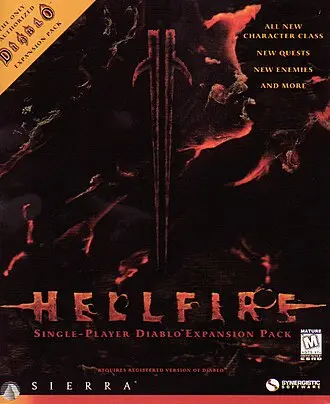
Diablo: Hellfire is a dark-fantasy action role-playing video game expansion pack developed by Synergistic Software (a division of Sierra On-Line) and published by Sierra On-Line. Released on November 24, 1997, it is the first and only official expansion pack for the original 1996 title Diablo.
The production history of Hellfire is historically unusual due to its complex corporate background. The expansion was greenlit and produced by Sierra’s parent company, Davidson & Associates, over the explicit objections of Blizzard Entertainment. Blizzard North, which was actively deep in production on Diablo II, subsequently placed strict structural boundaries on Synergistic’s development team—forbidding them from implementing formal Battle.net online integration, altering core multiplayer balance, or letting expansion features directly carry over into native multiplayer lobbies.
Because it was created by an external, third-party development group rather than internal Blizzard staff, its narrative and additions are considered explicitly non-canon to the overarching Diablo universe timeline.
Technical Specifications
| Attribute | Details |
| Developer | Synergistic Software (A Sierra On-Line division) |
| Publisher | Sierra On-Line |
| Designers | Kirt Lemons, Donald Tsang, Peter Watje, Jim Edwards, Mike McMillen |
| Engine | Custom 2D Pseudo-3D Isometric Engine (Direct modification of the base game client) |
| Platform | Microsoft Windows |
| Release Date | November 24, 1997 (North America) |
| Genre(s) | Action role-playing, Hack and slash, Dungeon crawler |
| Modes | Single-player (Multiplayer officially disabled at v1.01 retail) |
Gameplay & New Content Mechanics
Diablo: Hellfire integrates directly over a player’s preexisting Diablo installation directory. The expansion behaves like an optional, off-the-beaten-path tangent module; players can access the entirely new dungeons at their leisure via Tristram, or completely ignore them to complete the base 16 floors under the classic ruleset.
The Monk Archetype
The focal point of the expansion is the introduction of a fourth baseline character class: The Monk. The Monk shifts standard physical combat balance away from heavy weapons towards agile dexterity maneuvers. He is heavily optimized for quarterstaff weaponry and bare-fisted martial arts strikes, boasting a unique structural mechanic where unarmed strikes automatically hit multiple surrounding targets simultaneously.
To offset his high close-quarters output, the Monk is prohibited from wearing heavy plate mail, taking massive armor penalties if dressed in high-tier physical protection. His exclusive skill is Search, an active tracking utility that highlights all items dropping on the surrounding dark floor layout for easy gathering.
Expanded Item Matrix
- Runes: Players can find explosive magical traps known as Runes. These can be placed on the floor grid as static tactical defenses; when a monster walks across the tile, the rune detonates to inflict localized elemental damage.
- Oils: Introduced specialized consumables called Oils. When applied to weapons or gear, oils permanently boost base item durability, attack velocity statistics, or direct damage multipliers.
- New Weapon Modifiers: Introduces modern magical suffixes and prefixes—such as Jester’s (which randomizes weapon damage scales between 1% and 500% with every individual hit) and Decay (which maximizes physical damage but causes the item to lose durability at an accelerated rate).
Town Jogging Quality-of-Life
Addressing one of the most prominent consumer complaints regarding the 1996 baseline client, Hellfire introduces a dedicated software toggle allowing characters to fast-walk (jog) when navigating the surface town of Tristram. This drastically reduces the tedious transit time spent walking between the cathedral gates and vendors like Adria or Griswold.
The command.txt Hidden Content Matrix
During development, Synergistic implemented several test classes, joke events, and unfinished features. While explicitly disabled and stripped from the retail interface, the developers left the underlying code blocks active in the codebase.
By manually creating an unguided, zero-byte plain text document named command.txt and dropping it directly into the installation directory, players can force the engine to execute hidden parameters, unlocking deep Easter eggs:
Plaintext
cowquest;theoquest;bardtest;barbariantest;nestart;cryptart;
“The
command.txtfile transformed Hellfire from a basic content pack into a legendary piece of early PC gaming folklore. It allowed players to hack their own game safely, modifying the internal registry to extract hidden classes that were meant to be left on the cutting room floor.” — Strategic Archival Retro Review
Unlocking these undocumented parameters grants direct access to the following hidden assets:
- The Bard Class (
bardtest): A unique, highly adaptable class that uses the female Rogue’s physical sprite sheets. The Bard has balanced baseline tracking statistics across strength, magic, and dexterity. Her defining mechanic is the unique ability to dual-wield one-handed weapons simultaneously, letting players equip two swords or axes to double attack frequencies, at the expense of holding a shield. - The Barbarian Class (
barbariantest): A raw physical frontliner that uses the male Warrior’s visual model. The Barbarian is built for heavy shock tactics; his Magic stat is hardcoded to a fixed maximum cap of 0, meaning he cannot cast magic spells under any circumstances without gear boosts. To compensate, he can wield immense two-handed swords and great axes with a shield equipped, has native stun resistance, and features an active Rage skill that spikes character physical damage thresholds for 12 seconds. - The Complete Nut / Cow Quest (
cowquest): Replaces the standard NPC Lester the Farmer with a bizarre, unhinged individual dressed head-to-toe in a cartoonish Cow Suit. He delivers a satirical quest titled “The Jersey’s Jersey,” tasking the hero with diving into the new levels to recover his stolen brown suit. Completing the task rewards the player with the Bovine Plate, a unique set of heavy armor that shifts the player’s text dialogues to cow puns. - The Little Girl Quest (
theoquest): Activates a specialized side-scenario delivered by a new child NPC named Celia. She tasks the hero with entering the dungeons to locate her lost teddy bear, Theodore, which has been stolen by an elite monster pack.
Narrative & New Environments
The side-narrative initializes when a crazed local sorcerer accidentally breaks the ancient containment wards binding an advanced, rogue demonic entity known as Na-Krul. To re-establish structural containment, the hero must explore 8 entirely fresh subterranean levels partitioned evenly across two distinct, grotesque environmental biomes:
1. The Hive (Levels 1–4)
Accessed by detonating a specialized Rune Bomb asset over a strange, pulsating organic growth located north of Tristram. The Hive represents a sharp stylistic departure from Gothic structures, rendering levels as a disgusting, pulsing alien insectoid nest covered in mucous matrices, narrow passage channels, and biological walls. The level populates fields with fast-moving toxic hornets, scuttling ash demons, and heavy flesh-beasts, culminating in a duel against an elite mini-boss known as The Defiler.
2. The Demon Crypt (Levels 5–8)
Accessed by locating an ancient, shattered burial plate behind the graveyard of Tristram Cathedral. The Crypt is designed as an ancient, highly opulent resting chamber built from heavy marble stone tiling, tomb structures, and grand candelabras. The floors are heavily guarded by elite armored liches, dynamic hell hounds, and skeletal lords.
On the final floor, players confront Na-Krul inside a locked structural vault. Outside the vault sits a sequence of magical text levers; pulling the levers in a specific geometric order forcefully strips away Na-Krul’s physical armor and drops his base health bars before the boss fight starts. If the player bypasses the puzzle and opens the door raw, Na-Krul yells a stream of mocking dialogue lines, attacking at maximum power parameters.
History & Modern Digital Preservation (2026)
GOG and Battle.net Integration
For decades following its 1997 release, Hellfire was excluded from official Diablo retail bundles and official Blizzard “Battle Chest” distributions due to the historic corporate bad blood surrounding its creation.
However, the preservation landscape changed when GOG.com digitally restored the original Diablo. In response to massive fan demand, Blizzard permitted GOG to package Diablo: Hellfire as a free, fully integrated digital add-on with every standard purchase of the core game. This milestone was followed by Blizzard officially launching Diablo on its modern, centralized Battle.net Store, which also natively bundles the Hellfire installation files directly out-of-the-box.
The DevilutionX Source Port Definitive Standard
While the digital storefront versions maintain the vanilla 1997 code structure, running the legacy application can trigger mouse tracking hitches, color palette bleeding bugs, and desktop resolution scaling failures on modern displays.
As of 2026, real-time tactics and action RPG historians rely universally on DevilutionX as the definitive preservation standard for playing Hellfire. Developed via complete reverse-engineering of the game’s executable files, DevilutionX functions as a native, cross-platform engine shell that fully supports both Diablo and the Hellfire expansion natively.
Running Hellfire via DevilutionX implements significant architectural overhauls:
- Native Resolution Engine: Automatically scales the original isometric pixel art up to crisp 1080p, 1440p, and native 4K displays with full ultra-widescreen layout tracking.
- Native Hidden Content Restoration: Eliminates the archaic requirement of manually coding a
command.txtfile; the port adds the Bard and Barbarian classes, alongside the hidden Cow and Celia quests, directly into the character creation and campaign menus by default. - True Multiplayer Restoration: While Sierra’s official v1.01 patch permanently broke multiplayer functions for vanilla Hellfire due to Blizzard’s lack of support, DevilutionX fixes the underlying network bugs. It fully restores multi-user cooperative lobbies over TCP/IP and integrated peer-to-peer matchmakers, letting players explore the alien Hive and the Demon Crypt together with smooth modern performance.
Diablo news
More news
Diablo 5 Announced: Release Window, Story, and What We Know

World of Warcraft: Forever Previewed Alongside BlizzCon 2026 News
Diablo Animated Series in Development at Netflix
BlizzCon 2026 Opening Ceremony: Every Major Announcement