Star Trek: Armada
 PC
PC Activision
 ak tronic Software & Services GmbH
Where to buy

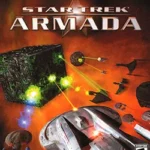
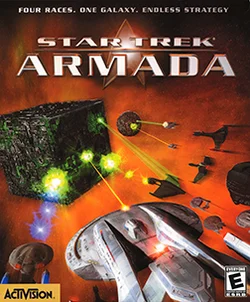
Star Trek: Armada is a sci-fi real-time strategy (RTS) video game developed and published by Activision. Released in March 2000 for Microsoft Windows, it is the first installment in the Star Trek: Armada series.
The game is set in the late 24th century of the Star Trek universe—primarily drawing aesthetics, ship classes, and characters from Star Trek: The Next Generation, Star Trek: Deep Space Nine, and Star Trek: Voyager. Players oversee fleet construction, base infrastructure, and resource extraction, directing large-scale tactical space battles between four prominent Alpha and Beta Quadrant civilizations.
Technical Specifications
| Attribute | Details |
|---|---|
| Developer | Activision |
| Publisher | Activision |
| Engine | Custom 3D Strategy Engine |
| Platform | Microsoft Windows |
| Release Date | • NA: March 27, 2000 • EU: April 1, 2000 |
| Genre | Real-time strategy |
| Modes | Single-player, Multiplayer |
Gameplay
Star Trek: Armada operates on standard real-time strategy macro-mechanics, but adapts them to simulate the specific physics and combat logic of the Star Trek franchise. Players build specialized spatial installations, extract raw stellar materials, and command fleets of starships across a two-dimensional plane utilizing 3D asset models.
Resource and Logistics Architecture
The economic pipeline relies on three primary variables to fund base growth and fleet mobilization:
- Dilithium: The primary physical currency of the game. It is harvested by deploying specialized mining ships to extract ore from static Dilithium Moons scattered across the map.
- Crew: Representing the active manpower pool of your empire. Crew points act as a cap on how many starships can be operated simultaneously. Base stations automatically regenerate crew reserves over time, and individual starships require continuous crew allocations to maintain firing efficiency, repair speeds, and shields.
- Officers: A secondary resource pool derived from building specialized Starfleet Academies or racial equivalents. Officers are consumed to deploy advanced, tier-4 capital starships and to utilize high-impact special abilities.
Structural Combat Systems
Starship survivability is governed by three separate internal layers: Shields, Hull Integrity, and Crew Population. Energy weapons must deplete an opponent’s passive shield matrix before they can deal permanent structural damage to the physical hull.
Critically, players can execute Boarding Actions. By utilizing transporter rooms, a player can beam away a portion of their own crew onto a disabled or shields-down enemy vessel. If the invading force successfully eliminates the hostile crew remaining on board, the player gains absolute tactical control over the enemy starship, enabling the cross-faction utilization of foreign technologies.
Plot and Setting
The game’s narrative occurs around Stardate 53550.8, placing it shortly after the conclusion of the Dominion War and the events of the film Star Trek: Insurrection. The single-player component is structured as a single, interwoven narrative composed of 20 missions split sequentially across four faction-specific acts, culminating in a final unified “Omega” campaign.
Single-Player Campaigns
- Federation (Captain Jean-Luc Picard): Captures the sudden arrival of the USS Premonition, a starship hailing from a dystopian future timeline. Its commander warns Picard of an impending, coordinated Borg invasion.
- Klingon Empire (Chancellor Martok): Focuses on internal political fracturing. Martok must quell a civil uprising led by a rogue faction attempting to seize the High Council while repelling cloaked Romulan instigators.
- Romulan Star Empire (Admiral Sela): Follows clandestine operations to infiltrate the Alpha Quadrant. The Romulans capture the USS Premonition to exploit its temporal technology, leading to an uneasy alliance to counter a greater threat.
- Borg Collective (The Borg Queen): Tracks the direct invasion of the Alpha Quadrant. The Borg successfully assimilate a critical cloning facility and unearth an ancient, hyper-destructive weapon infrastructure left behind by a precursor civilization known as the Sargon.
- Omega Campaign: A multi-faction coalition effort grouping the remaining Federation, Klingon, and Romulan forces together inside a final sector to dismantle the Borg’s temporal gateway and prevent a galaxy-wide assimilation event.
Playable Factions
The game features four asymmetrical empires, each boasting custom research modules, station assets, and highly specialized capital ship utilities:
- United Federation of Planets: Focuses on high shield capacity, tactical utility, and crowd manipulation. Their signature capital ships include the Sovereign-class and Galaxy-class. Special weapons feature the Saucer Separation ability (splits a ship into two distinct tactical targets) and the Chain Reaction Pulsar, a heavy energy pulse that bounces between multiple adjacent hostile targets, escalating in damage with each progressive strike.
- Klingon Empire: Prioritizes raw hull thickness, high-velocity kinetic torpedos, and aggressive boarding metrics. Relying heavily on active Cloaking Devices to execute sudden ambushes, their heavy ships (such as the Negh’Var-class) utilize specialized boarding claws to launch shock-troops across deep distances and ion cannons that temporarily disable enemy propulsion units.
- Romulan Star Empire: Specializes in visual deception, espionage, and long-range asymmetric harassment. Alongside standard cloaking capabilities, Romulan D’deridex-class warbirds and support ships can deploy Psychic Scream fields that panic enemy crew metrics, shields-down spy sensors, and high-impact stasis fields that lock enemy fleets out of real-time actions completely.
- Borg Collective: Emphasizes massive resource consumption, automation, and total combat assimilation. The Borg reject standard shield mechanics to favor unmatched hull regeneration loops. Their signature Borg Cubes utilize active assimilation beams that physically drain an enemy’s crew pool mid-fight, turning hostile pilots into fresh drones to repair the Cube’s structural systems.
Reception and Legacy
Star Trek: Armada received generally mixed to favorable reviews from mainstream strategy critics upon its 2000 rollout. Review aggregator GameRankings tracked a composite score of 77%.
Publications highly praised the authentic integration of the Star Trek license, lauding the inclusion of original television cast members—including Patrick Stewart reprising Jean-Luc Picard, Michael Dorn as Worf, and J.G. Hertzler as Chancellor Martok—to anchor the campaign voice-over lines. Critics also highlighted the boarding action mechanic as a highly innovative twist on the RTS genre. Conversely, traditional strategy reviewers criticized the game’s strict 2D plane tracking pathfinding as overly simplistic and noted that the multiplayer component suffered from serious stability issues at launch.
Digital Re-Release and Modern Preservation (2026)
For nearly two decades following its retail lifecycle, Star Trek: Armada was classified as abandonware due to complex licensing expirations between Activision and CBS/Paramount. However, on December 13, 2021, GOG.com officially re-released Star Trek: Armada and its sequel digitally.
As of 2026, the game experiences an active archival renaissance under digital storefront distribution. The modern GOG package natively incorporates a custom compatibility wrapper wrapper that strips out old legacy CD-ROM check exceptions and addresses the Direct3D rendering errors that caused the vanilla client to immediately crash on modern multi-core environments.
Supported further by the community-maintained Unofficial Patch v1.3 Project, contemporary players running the title under Windows 10 and Windows 11 can natively access fully scaled widescreen resolution matrices (including 1080p and 1440p). This community patch further resolves legacy networking bugs, allowing multiplayer skirmishes to execute via direct IP connections over modern internet infrastructure.