Star Trek: Armada II
 65
★ /10
65
★ /10
 PC
PC Activision
Where to buy

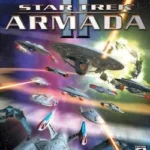
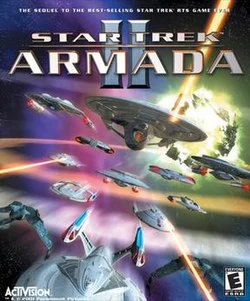
Star Trek: Armada II is a sci-fi real-time strategy (RTS) video game developed by Mad Doc Software and published by Activision. Released in November 2001 for Microsoft Windows, it is the direct sequel to the 2000 title Star Trek: Armada and the first of three major Star Trek sequels developed by Mad Doc Software during Activision’s tenure with the franchise license.
Set in the late 24th century of the Star Trek universe six months after the conclusion of its predecessor, the game chronicles a multi-front galactic crisis involving the United Federation of Planets, the Klingon Empire, the Romulan Star Empire, the Cardassian Union, the Borg Collective, and the extra-dimensional Species 8472. Armada II expands upon the foundational real-time tactical combat of the original game by introducing true three-dimensional altitude manipulation, fleet formations, a revamped economic framework, and two entirely new playable civilizations.
Technical Specifications
| Attribute | Details |
| Developer | Mad Doc Software |
| Publisher | Activision |
| Director | Ian Lane Davis |
| Composer | Danny Pelfrey |
| Engine | Storm3D |
| Platform | Microsoft Windows |
| Release Date | • NA: November 19, 2001 • EU: December 1, 2001 |
| Genre | Real-time strategy |
| Modes | Single-player, Multiplayer |
Gameplay Mechanics and Overhauls
Star Trek: Armada II preserves the core gameplay loop of the original game—tracking ship crew metrics, hull integrity, and shield values—while introducing major technical overhauls to simulate grand-scale fleet maneuvers.
Three-Dimensional Tactical Formations
While the original title locked combat tracking entirely to a flat two-dimensional plane, Armada II utilizes the Storm3D engine to introduce a Z-axis altitude mechanic. Players can adjust the physical height profile of individual starships to bypass enemy defensive perimeters, execute multi-level ambushes, or arrange strike forces in specialized 3D tactical formations.
The game permits players to cluster up to 16 starships into cohesive, unified task forces using a variety of geometric presets—including line, wedge, sphere, and column configurations—which dynamically alter weapon trajectories and fleet defense ratings.
Economic Expansion and Trade
The resource infrastructure was re-engineered by expanding the traditional loop of Dilithium, Crew, and Officers with a fourth currency: Latinum. Latinum is generated exclusively by constructing specialized cargo vessels to establish trade routes with neutral, automated Ferengi Commerce Stations scattered across the map. Accumulated Latinum is primarily spent to fund the research of late-game technology trees, trade for emergency raw materials, and activate high-tier prototype starship auxiliary systems.
Plot and Campaign Structure
The single-player component contains 30 missions distributed evenly across three linear narrative acts. The story picks up shortly after the Dominion War, tracing a cascading chain of regional invasions.
Act I: The United Federation of Planets
Commanding Starfleet forces alongside Captain Jean-Luc Picard and the USS Enterprise-E, the player serves as a first-responder to a resurgent Borg insertion deep within the Alpha Quadrant. Upon repelling the invasion, Starfleet unearths a massive Transwarp Portal leading directly into the Delta Quadrant. Picard spearheads an offensive campaign through the gateway to neutralize the staging grounds, only for the portal’s subsequent destruction to leave the Federation fleet marooned on the opposite side of the galaxy.
Act II: The Klingon Empire
Taking advantage of the sudden absence of prime Starfleet defensive forces, the Cardassian Union launches a massive surprise offensive to reclaim lost regional sectors. Klingon Chancellor Martok discovers that a rogue faction led by Gul Kentar has allied secretly with the Romulan Star Empire. Kentar is revealed to be building a Quantum Singularity Ship capable of ripping rifts into alternative dimensions to forcefully harvest alien warships. Martok executes a swift, aggressive counter-campaign, culminative in the complete invasion and occupation of Cardassia Prime.
Act III: The Borg Collective
Trapped in the Alpha Quadrant due to the transwarp network fracturing, the isolated Borg Queen discovers that Gul Kentar’s dimensional rifts have permanently triggered an invasion by Species 8472 from fluidic space. With her collective communication arrays severed, the Queen must aggressively assimilate local planetary civilizations and starship crews to forcefully harvest the technology and tachyon particles required to rebuild a gateway home. The campaign culminates in a tenuous, desperate alliance between the remaining Borg and Starfleet survivors to push Species 8472 out of normal space.
Playable Factions
Armada II expands the asymmetry of the series by introducing two additional civilizations, bringing the total playable roster to six distinct factions for skirmish and multiplayer modes:
| Faction Civilization | Core Architectural Specialty | Iconic Class Vessel | Unique Active Tactical Capability |
| United Federation | Shield reflection and advanced long-range structural support. | Sovereign-class Cruiser | Saucer Separation: Splits the primary hull into two distinct combat targets to divide enemy fire. |
| Klingon Empire | High close-range kinetic output and stealth cloaking maneuvers. | Negh’Var-class Battleship | Ion Cannon Cannonade: Discharges heavy spatial bursts to temporarily strip shields and stall enemy propulsion. |
| Romulan Empire | Long-range espionage, sensor spoofing, and stasis containment. | D’deridex-class Warbird | Psychic Scream: Emits an emotional wave field that drains the active crew metrics of targeted ships. |
| Borg Collective | Total crew assimilation, hull regeneration, and mass-fusion combinations. | Borg Cube / Tactical Cube | Fusion Matrix: Allows eight standard Borg Cubes to physically dock mid-match, fusing into a single colossal Fusion Cube. |
| Cardassian Union | High-impact stationary defense grids and weapon upgrades. | Kulinor-class Dreadnought | Quantum Singularity Blast: Rips a miniature localized spatial gravity well to continuously pull and damage enemy formations. |
| Species 8472 | Biological organic structures and complete immunity to standard crew assimilation beams. | Behemoth Bioship | Fluidic Transmutator: Uses bio-energetic nodes to melt captured scrap hulls directly into raw biological resources. |
Reception and Legacy
Tom Clancy’s EndWar and other contemporary strategy titles of the early 2000s competed fiercely with Star Trek: Armada II, which received mixed to generally favorable reviews upon launch. Critics widely praised the inclusion of authentic series voice actors—including Patrick Stewart reprising Jean-Luc Picard, J.G. Hertzler as Martok, and Alice Krige reprising her cinematic role as the Borg Queen. The addition of the Cardassians and Species 8472, along with the 16-ship tactical formation tools, was highly lauded for adding significant mechanical depth over the 2000 original.
However, the game faced scrutiny from real-time strategy purists who argued that the 3D Z-axis altitude manipulation felt clumsy due to camera tracking constraints inherent to the engine design. Reviewers also noted that multiplayer balancing was severely skewed toward the Borg and Species 8472 at launch.
Digital Re-Release and Modern Preservation
Following Activision’s departure from the Star Trek software license in 2003, Star Trek: Armada II sat in an extended period of legal and retail distribution limbo. This abandonment ended on December 13, 2021, when GOG.com officially launched a remastered digital edition of both Armada titles.
The modern GOG digital distribution version natively implements a custom DirectDraw configuration wrapper wrapper, entirely resolving the memory allocation errors and Storm3D engine-level crashes that historically prevented the game from executing on modern multi-core operating systems.
The preservation ecosystem is strongly supported by the community-maintained Unofficial Patch v1.3 project alongside total conversion modifications such as Fleet Operations and the Star Trek: Armada II Upgrade Project. These fan-driven frameworks update the code to natively support contemporary widescreen and ultra-widescreen desktop resolutions (including 1080p, 1440p, and 4K display formats) on Windows 10 and Windows 11 systems out-of-the-box. This infrastructure further updates legacy multiplayer connectivity, replacing outdated matching protocols with direct-IP and virtual private network (VPN) wrappers to keep community skirmishes active.