Star Trek: Voyager – Elite Force
 86
★ /10
86
★ /10
 PC
PC PS 2
PS 2 Activision
Where to buy

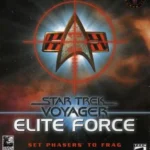
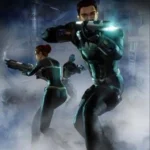
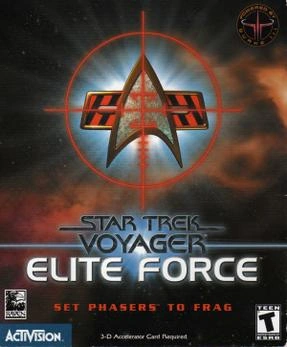
Star Trek: Voyager – Elite Force is a 2000 first-person shooter developed by Raven Software and published by Activision. Released initially for the PC (and later ported to the PlayStation 2 in 2001), it is a landmark title in licensed video games. Built on the highly modified Quake III Arena engine, it was the first game to prove that the cerebral, diplomatic world of Star Trek could successfully be translated into a fast-paced, critically acclaimed first-person shooter.
Core Concept and Story
Set precisely during the sixth season of the Star Trek: Voyager television series, the game seamlessly weaves itself into the established canon.
The U.S.S. Voyager is suddenly ambushed and pulled into a mysterious, highly volatile starship graveyard known as the “Delta Quadrant Forge.” The ship is heavily damaged, its warp core is offline, and it is surrounded by hostile, scavenging alien races. Realizing that standard security personnel are not equipped to handle these extreme boarding actions and hazardous away missions, Captain Kathryn Janeway approves the creation of the “Hazard Team.”
You play as Ensign Alexander (or Alexandria) Munro, the second-in-command of this elite squad. (Unlike the sequel, the original game allowed you to choose Munro’s gender at the start of the campaign). Your job is to lead your squad through hostile alien vessels, scavenge for parts to repair Voyager, and figure out a way to escape the Forge.
Gameplay and Features
Raven Software masterfully blended their expertise in high-octane arena shooters with the authentic look and feel of the Star Trek universe:
- The Borg and the I-Mod: The game features an incredibly tense section where you must infiltrate a Borg cube. True to the show, the Borg will ignore you until you become a threat, at which point they will adapt to your weapon frequencies. To counter this, the Hazard Team invents the Infinity Modulator (I-Mod), a weapon that constantly shifts its frequency to prevent the Borg from adapting, making it one of the most satisfying guns in the game.
- The Federation Arsenal: Weapons felt distinct and highly lethal. Your standard phaser regenerated ammo (preventing you from ever being completely unarmed), but you also utilized the devastating Compression Rifle, the alien Arc Welder, and explosive photon bursts.
- Authentic Voice Acting: The game was elevated massively by its audio. Almost the entire main cast of the television show reprised their roles to voice their digital counterparts, including Kate Mulgrew (Janeway), Jeri Ryan (Seven of Nine), and Tim Russ (Tuvok). This made the in-between mission briefings on the bridge feel exactly like an interactive episode of the show.
- Arena Multiplayer: Because it was built on the Quake III engine, the game shipped with a blisteringly fast, incredibly popular multiplayer mode. It was essentially Quake with a Star Trek skin, allowing players to rocket-jump around the holodeck while playing as Borg drones, Klingons, and Hirogen hunters.
The Legacy and “Virtual Voyager”
Elite Force was a massive critical and commercial success. Reviewers praised it for capturing the exact tone of the show while delivering tight, excellent shooting mechanics.
It was so successful that Raven Software released an expansion pack a year later. Alongside new multiplayer maps, the expansion included the legendary “Virtual Voyager” mode. This allowed players to put their weapons away and freely walk around a highly detailed, 3D recreation of the entire starship, interacting with the crew, reading logs in the captain’s ready room, and playing arcade games in the holodeck.
Quick Note
Star Trek: Voyager – Elite Force is widely considered the gold standard for Star Trek gaming.
In short: It took the legendary, fast-paced engine of Quake III and dressed it perfectly in a Starfleet uniform, delivering an authentic, high-stakes action adventure that felt like playing through a lost two-part episode of the television series.
Star Trek: Voyager – Elite Force is a 2000 first-person shooter developed by Raven Software and published by Activision. Released initially for the PC (and later ported to the PlayStation 2 in 2001), it is a landmark title in licensed video games. Built on the highly modified Quake III Arena engine, it was the first game to prove that the cerebral, diplomatic world of Star Trek could successfully be translated into a fast-paced, critically acclaimed first-person shooter.
Core Concept and Story
Set precisely during the sixth season of the Star Trek: Voyager television series, the game seamlessly weaves itself into the established canon.
The U.S.S. Voyager is suddenly ambushed and pulled into a mysterious, highly volatile starship graveyard known as the “Delta Quadrant Forge.” The ship is heavily damaged, its warp core is offline, and it is surrounded by hostile, scavenging alien races. Realizing that standard security personnel are not equipped to handle these extreme boarding actions and hazardous away missions, Captain Kathryn Janeway approves the creation of the “Hazard Team.”
You play as Ensign Alexander (or Alexandria) Munro, the second-in-command of this elite squad. (Unlike the sequel, the original game allowed you to choose Munro’s gender at the start of the campaign). Your job is to lead your squad through hostile alien vessels, scavenge for parts to repair Voyager, and figure out a way to escape the Forge.
Gameplay and Features
Raven Software masterfully blended their expertise in high-octane arena shooters with the authentic look and feel of the Star Trek universe:
- The Borg and the I-Mod: The game features an incredibly tense section where you must infiltrate a Borg cube. True to the show, the Borg will ignore you until you become a threat, at which point they will adapt to your weapon frequencies. To counter this, the Hazard Team invents the Infinity Modulator (I-Mod), a weapon that constantly shifts its frequency to prevent the Borg from adapting, making it one of the most satisfying guns in the game.
- The Federation Arsenal: Weapons felt distinct and highly lethal. Your standard phaser regenerated ammo (preventing you from ever being completely unarmed), but you also utilized the devastating Compression Rifle, the alien Arc Welder, and explosive photon bursts.
- Authentic Voice Acting: The game was elevated massively by its audio. Almost the entire main cast of the television show reprised their roles to voice their digital counterparts, including Kate Mulgrew (Janeway), Jeri Ryan (Seven of Nine), and Tim Russ (Tuvok). This made the in-between mission briefings on the bridge feel exactly like an interactive episode of the show.
- Arena Multiplayer: Because it was built on the Quake III engine, the game shipped with a blisteringly fast, incredibly popular multiplayer mode. It was essentially Quake with a Star Trek skin, allowing players to rocket-jump around the holodeck while playing as Borg drones, Klingons, and Hirogen hunters.
The Legacy and “Virtual Voyager”
Elite Force was a massive critical and commercial success. Reviewers praised it for capturing the exact tone of the show while delivering tight, excellent shooting mechanics.
It was so successful that Raven Software released an expansion pack a year later. Alongside new multiplayer maps, the expansion included the legendary “Virtual Voyager” mode. This allowed players to put their weapons away and freely walk around a highly detailed, 3D recreation of the entire starship, interacting with the crew, reading logs in the captain’s ready room, and playing arcade games in the holodeck.
Quick Note
Star Trek: Voyager – Elite Force is widely considered the gold standard for Star Trek gaming.
In short: It took the legendary, fast-paced engine of Quake III and dressed it perfectly in a Starfleet uniform, delivering an authentic, high-stakes action adventure that felt like playing through a lost two-part episode of the television series.