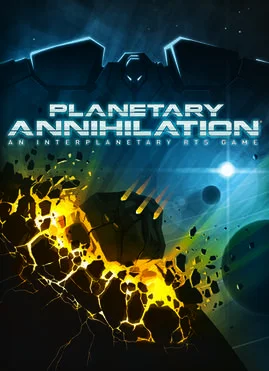
Planetary Annihilation
 62
★ /10
62
★ /10
 PC
PC
Where to buy

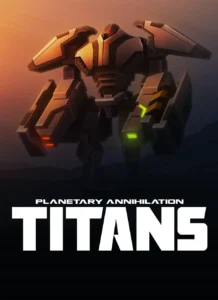
Planetary Annihilation is a real-time strategy (RTS) video game originally developed by Uber Entertainment and currently maintained by Planetary Annihilation Inc. The development team included several industry veterans who previously worked on the acclaimed strategy titles Total Annihilation and Supreme Commander. Following a highly successful crowdfunding campaign in 2012, the game was officially released on September 5, 2014. A massive standalone expansion, Planetary Annihilation: TITANS, was released on August 18, 2015, adding structural terrain levels, specialized units, and massive Titan-class war machines.
The game is distinguished by its rejection of traditional flat, rectangular maps in favor of procedurally generated, fully 3D spherical planetary systems. Players engage in multi-front warfare across entire planets, moons, asteroids, and gas giants, utilizing macroscopic logistics and kinetic celestial mechanics to achieve victory.
Technical Specifications
| Attribute | Details |
| Developer(s) | Uber Entertainment (2014–2018) Planetary Annihilation Inc (2018–present) |
| Publisher(s) | Uber Entertainment (2014–2018) Planetary Annihilation Inc (2018–present) |
| Director / Designer | Jon Mavor |
| Composer | Howard Mostrom |
| Engine | Custom 64-bit Server-Client Architecture |
| Platform(s) | Microsoft Windows, macOS, Linux |
| Release Date(s) | Planetary Annihilation: September 5, 2014 Planetary Annihilation: TITANS: August 18, 2015 |
| Genre(s) | Real-time strategy |
| Modes | Single-player (Galactic War), Multiplayer |
Gameplay
Planetary Annihilation features a macroscopic “streaming economy” modeled directly after Total Annihilation and Supreme Commander. Instead of standard transactional bulk purchasing, players manage two continuous resource vectors: Metal (extracted from terrain vents) and Energy (generated via structural power grids). Construction and assembly factories continuously pull a progressive streaming drain on these resources over time, requiring players to balance production velocity with active resource generation.
Spherical Sandboxes and the Orbital Layer
Matches are hosted on procedurally generated planetary systems containing up to several celestial bodies. Combat forces are divided across four traditional branches—Land, Air, Naval, and Intelligence—and maneuver across a fully continuous 3D sphere with no map boundaries.
The game expands vertically via the Orbital Layer, a specialized combat plane surrounding each planet. Units stationed in this layer support interplanetary travel, satellite reconnaissance, orbital drops, and kinetic orbital-to-ground strikes, allowing players to establish staging points to invade entirely separate worlds.
The Commander Lifecycle
Every player begins a match with a single, massive mechanoid known as The Commander. The Commander serves as a powerful mobile factory capable of building base foundations, reclaiming wreckages, and defending against early raiders with an integrated heavy energy weapon. The survival of the Commander is the primary victory condition; its destruction triggers a massive thermonuclear explosion that instantly eliminates the controlling player from the match.
Interplanetary Warfare and Celestial Mechanics
To bridge the spatial distance between different celestial bodies, players can construct the Unit Cannon, a massive structural installation capable of shooting loaded ground units directly through deep space into hostile territory.
Furthermore, the game integrates physics-based celestial mechanics as an active offensive strategy. By capturing a moon or an asteroid, players can construct heavy rocket installations called Halley Engines. Actively triggering these structures allows a player to alter the celestial body’s orbit, charting a kinetic vector path to slam the moon directly into an opponent’s home planet—permanently destroying the target world and all localized units.
The TITANS Expansion
Released as a standalone client, Planetary Annihilation: TITANS introduced significant updates to the base game, including multi-level terrain mapping, a specialized bounty mode, and 21 fresh units. The defining addition was the Titan-Class Tier, composed of hyper-expensive, colossal end-game units:
“Titans represent the pinnacle of military mobilization on Nyn, capable of single-handedly altering planetary stalemates through raw kinetic and elemental dominance.” — Community Manual Overview
- Atlas: A massive, heavily armored bipedal ground mechanoid that crushes opposing army groups underfoot and detonates violently upon structural collapse.
- Ares: A monolithic, hover-based super-tank designed to absorb frontal pressure while outputting continuous line-purging plasma shells.
- Zeus: An air superiority command ship that unleashes heavy chain-lightning arcs to clear localized air and ground squads.
- Helios: A colossal orbital ring platform that discharges planetary-cracking laser beams while serving as a mobile spatial teleporter for allied ground battalions.
- Ragnarok: A specialized, non-mobile structural Titan designed to dig directly into a planet’s core, intentionally splitting and detonating the entire world to force a mutual draw.
History and Modern Status (2026)
Crowdfunding and Launch
In August 2012, Uber Entertainment launched a Kickstarter campaign for Planetary Annihilation with an initial funding goal of $900,000. The campaign concluded spectacularly, raising over $2.2 million from 44,000 backers. Despite praise for its ambitious scale, the 2014 initial vanilla release faced criticism for performance bottlenecks and the absence of features promised during crowdfunding. The 2015 TITANS expansion successfully corrected these omissions, drastically stabilizing player sentiment.
Acquisition by Planetary Annihilation Inc
In August 2018, a compilation of original development staff and core Kickstarter backers formed a brand-new corporate entity called Planetary Annihilation Inc. This studio officially purchased the complete intellectual property and master source code rights from Uber Entertainment, transitioning the franchise into a community-led, pro-consumer lifecycle. The classic base version of the game was officially retired from digital sales to focus entirely on maintaining and expanding the unified TITANS client architecture.
Active Maintenance and Current Lifecycle (2026)
As of 2026, Planetary Annihilation: TITANS remains highly active and widely respected as a premier grand-scale strategy title. Running natively on a modern 64-bit engine shell with fully optimized server-side processing, the client comfortably hosts massive multiplayer skirmishes featuring thousands of active units without experiencing the memory leaks or pathfinding crashes common to older strategy engines.
The developer team continues to roll out frequent balance and compatibility updates under its Community Commanders initiatives—including active LABS testing updates running through mid-2026, which introduced advanced UI adjustments, structural energy reworks, and modern Linux beta enhancements. The franchise has proven highly influential; in late 2023, the creative team officially announced Industrial Annihilation, a spin-off title blending the classic real-time strategy elements of the Annihilation series with deep factory-building simulation loops.