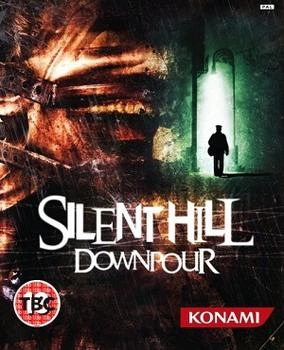
Silent Hill: Downpour
 64
★ /10
64
★ /10
 PS 3
PS 3 Xbox 360
 Konami Digital Entertainment
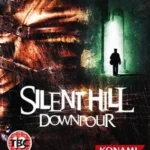
Silent Hill: Downpour is a 2012 psychological survival horror game developed by the Czech studio Vatra Games and published by Konami. Released in March 2012 for the PlayStation 3 and Xbox 360, it represents the final mainline, traditional console release in the franchise before its massive, decade-long hiatus. It is widely remembered as a highly ambitious, deeply flawed entry that attempted to steer the series away from movie tie-ins and back toward personal, psychological storytelling.
Core Concept and Story
The game deliberately pivots away from the classic Silent Hill iconography. There is no Pyramid Head, no cult of The Order, and no rusty, blood-soaked hospitals. Instead, the game’s central theme is water, representing guilt, washing away sins, and drowning in one’s past.
You play as Murphy Pendleton, an inmate serving time in a maximum-security prison for stealing a police cruiser (and hiding a much darker, violent secret). While being transferred to a different facility, the prison transport bus crashes violently into a ravine on the outskirts of Silent Hill. Murphy survives and escapes into the misty woods, only to find himself trapped in the southeastern region of the cursed town—an entirely new, unexplored district that hasn’t been featured in previous games. As Murphy tries to find a way out, the town manifests his deep-seated guilt and forces him to confront the violent events that led to his incarceration.
Gameplay and Features
Downpour attempted to modernize the franchise by introducing a semi-open world and completely overhauling how the town’s Otherworld functioned:
- The Dynamic Weather System: Water is your biggest enemy. Instead of transitioning into darkness, the town is frequently battered by torrential, localized rainstorms. The harder it rains, the more aggressive and numerous the monsters become. Players must constantly seek shelter indoors to wait out the storms or risk being overwhelmed.
- Semi-Open World and Side Quests: This is arguably the game’s greatest achievement. The southeastern region of Silent Hill is massive and open for exploration. For the first time, players could discover and complete deeply unsettling, optional side quests—such as investigating domestic disturbances in abandoned apartments, collecting stolen items for a ghostly vagrant, or tracking down missing children.
- Breakable Weapons: The combat is intentionally clunky and desperate. Murphy cannot carry an arsenal of firearms. Instead, he must rely on whatever he can find in the environment—chairs, rocks, fire axes, or pitchforks. Because every melee weapon has a strict durability meter and breaks quickly, players are forced into a constant, frantic scramble to find new weapons mid-fight.
- The Void Chases: Rather than a slow, atmospheric shift into a rusted alternate dimension, Downpour’s Otherworld sequences function as high-speed panic attacks. The environment twists into an MC Escher-style labyrinth of endless staircases and water slides, and Murphy is relentlessly pursued by an instantly fatal, glowing red anomaly known as “The Void,” forcing you to run blindly through closing doors to survive.
Reception and The Technical Shortfalls
Upon its release, Silent Hill: Downpour received highly Mixed reviews and divided the fanbase.
On a positive note, fans praised Vatra Games for trying something original. The side quests were heavily lauded, and composer Daniel Licht (best known for scoring the TV show Dexter) stepped in for Akira Yamaoka and delivered a beautifully haunting, mandolin-heavy soundtrack.
However, the game’s execution was deeply marred by severe technical and design issues. At launch, the game suffered from atrocious framerate drops, screen tearing, and constant stuttering, making the already clunky combat feel genuinely awful to play. Furthermore, the monster design was universally criticized; instead of the deeply symbolic, grotesque flesh-monsters of the Team Silent era, Murphy mostly fights generic, brawling humanoid men and shrieking women, which heavily detracted from the psychological horror.
(Additionally, the inclusion of a nu-metal theme song by Korn during the game’s intro was heavily mocked by purists as feeling completely out of place for the franchise).
Quick Note
Silent Hill: Downpour is a deeply flawed but genuinely ambitious attempt to reinvent the franchise.
In short: Its combat is frustrating, its monsters are incredibly generic, and its technical performance is famously poor. But if you can look past the “Eurojank,” its brilliant weather mechanics, fantastic side quests, and dedication to telling a completely standalone, water-logged psychological mystery make it a fascinating and underappreciated chapter in the series’ history.