Mass Effect
 91
★ /10
91
★ /10
 PC
PC PS 3
PS 3 Xbox 360
 1C-SoftClub
 Electronic Arts
 Microsoft Game Studios
Where to buy

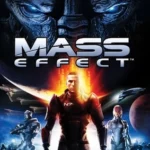
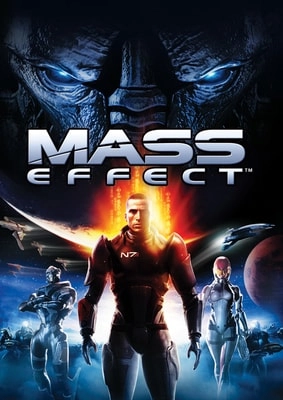
Mass Effect is a 2007 science fiction action role-playing game developed by BioWare and published by Microsoft Game Studios. Released for the Xbox 360 on November 20, 2007, with Windows and PlayStation 3 versions following in 2008 and 2012, it launched the Mass Effect trilogy and introduced the series’ protagonist, Commander Shepard.
Conceived from the outset as the first chapter of a planned three-game arc under director Casey Hudson, Mass Effect established the template the franchise would follow for over a decade: a cinematic space opera built around branching, fully voiced dialogue, a customizable squad, and a galaxy that visibly remembers the player’s choices. It went on to spawn two direct sequels, an animated film, novels and comics, and in 2021 a remaster as part of Mass Effect Legendary Edition.
Technical Specifications
| Attribute | Details |
|---|---|
| Developer | BioWare |
| Publisher | Microsoft Game Studios (Xbox 360, 2007) · Electronic Arts (PC and PS3 releases) |
| Director | Casey Hudson |
| Lead Writer | Drew Karpyshyn |
| Composer(s) | Jack Wall, Sam Hulick, Richard Jacques, David Kates |
| Engine | Unreal Engine 3 |
| Platform(s) | Xbox 360, Microsoft Windows, PlayStation 3 |
| Release Date(s) | Xbox 360: Nov 20, 2007 • Windows: May 28, 2008 • PS3: Dec 4, 2012 |
| Genre | Action role-playing, Space opera |
| Mode | Single-player |
The Citadel, the Geth, and the First Human Spectre
Set in the year 2183, Mass Effect puts players in command of the SSV Normandy, a prototype stealth frigate jointly developed by humanity’s Systems Alliance and the turian hierarchy. The story follows Commander Shepard, a human soldier nominated to become the first human Spectre — an elite operative answering directly to the Citadel Council, the body that governs relations between the galaxy’s major species.
An investigation into an attack on the colony of Eden Prime leads Shepard to Saren Arterius, a rogue turian Spectre who has allied himself with an army of synthetic soldiers known as the geth. As the trail widens, Shepard uncovers evidence of the Reapers — an ancient machine race that, according to a 50,000-year-old cycle, returns periodically to annihilate every advanced civilization in the galaxy. Convincing a skeptical, politically gridlocked Council of this threat while racing Saren across known space forms the spine of the campaign.
The Dialogue Wheel and the Paragon/Renegade System
One of Mass Effect‘s most influential contributions to the genre was its conversation system. Instead of picking lines from a static text menu, players navigate a radial wheel of response options during fully voiced, cinematically staged conversations — a level of presentation that was highly ambitious for 2007, and one that required BioWare to record two complete performances of Shepard’s dialogue, for a male (Mark Meer) and female (Jennifer Hale) version of the character.
Underneath this wheel sits the Paragon/Renegade morality system. Diplomatic, honest, or by-the-book responses accumulate Paragon points, while blunt, aggressive, or ruthless choices build Renegade points. Crossing certain thresholds unlocks unique “Charm” or “Intimidate” options that can talk a hostile NPC down or pry loose information unavailable any other way — meaning the same scene can play out very differently depending on the kind of Shepard the player has built. Both the wheel interface and the Paragon/Renegade framework became BioWare signatures, carried forward into Dragon Age, the rest of the Mass Effect trilogy, and beyond.
Exploration: The Mako and Uncharted Worlds
Outside the main story, Mass Effect encouraged players to plot a course across an interactive galaxy map and touch down on uncharted planets using the Mako, a six-wheeled all-terrain rover. These worlds ranged from small, hand-built side-mission sites to sprawling, often barren landmasses meant for exploration and mineral scanning — giving the game an open, frontier-like feel that its more streamlined sequels would largely abandon.
Combat paired cover-based third-person shooting with a class-based RPG framework: six classes — Soldier, Engineer, Adept, and three hybrids — governed access to combat powers, tech abilities, and biotics, while weapon proficiency was gated behind skill investment rather than open to everyone. The Mako itself became one of the most divisive elements of the original release, praised for the sense of scale it gave to planetary exploration and notorious for its loose, occasionally uncontrollable handling.
Legendary Edition: Playing Mass Effect Today
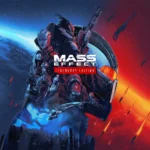
In May 2021, BioWare and Electronic Arts released Mass Effect Legendary Edition, a remaster of all three trilogy games bundled with nearly all of their previously released story DLC. Of the three, the original Mass Effect received by far the most extensive overhaul:
- Combat: removed weapon-proficiency penalties for “untrained” weapon types, added proper aim assist and a dedicated melee button, and rebalanced weapons and enemy encounters to feel closer to Mass Effect 2 and 3.
- The Mako: reworked physics, an alternate control scheme, and a speed boost to address the original vehicle’s infamous handling.
- Visuals and quality of life: updated lighting, textures, and character models (with Mass Effect 1 benefiting the most of the three games), a cleaned-up HUD, drastically reduced loading times, and a unified 1–30 leveling curve alongside an optional “Classic” mode for players who want the original 1–60 progression.
- Story: Mass Effect 3‘s Extended Cut ending is now the default across the trilogy.
Not everything made the trip, however — Legendary Edition omits the trilogy’s multiplayer modes and the Mass Effect: Pinnacle Station DLC, which BioWare said could not be restored due to lost source files. For most players approaching the series in 2026, Legendary Edition — available on Steam, Xbox, and PlayStation — is the practical way to experience the first game, smoothing over many of the rough edges that defined its 2007 release while keeping the original story and dialogue intact.
Awards and Legacy
Mass Effect launched to widespread critical acclaim and a strong run through that year’s award season: it was named Role-Playing Game of the Year at the 2008 Interactive Achievement Awards, took home five wins at the 2007 NAVGTR Awards (including Original Role-Playing Game of the Year and Writing in a Drama), and earned a BAFTA nomination for Best Story and Character in 2009.
Beyond the trophies, its lasting significance lies in what it represented for BioWare: the studio’s first major franchise built on a wholly original universe, after years spent working within licensed settings such as Star Wars (Knights of the Old Republic) and Dungeons & Dragons (Baldur’s Gate, Neverwinter Nights). The galaxy, species, and political institutions it introduced carried the series through two direct sequels and a spin-off, Mass Effect: Andromeda, and remain the foundation EA and BioWare continue to build on with the franchise’s next mainline entry.