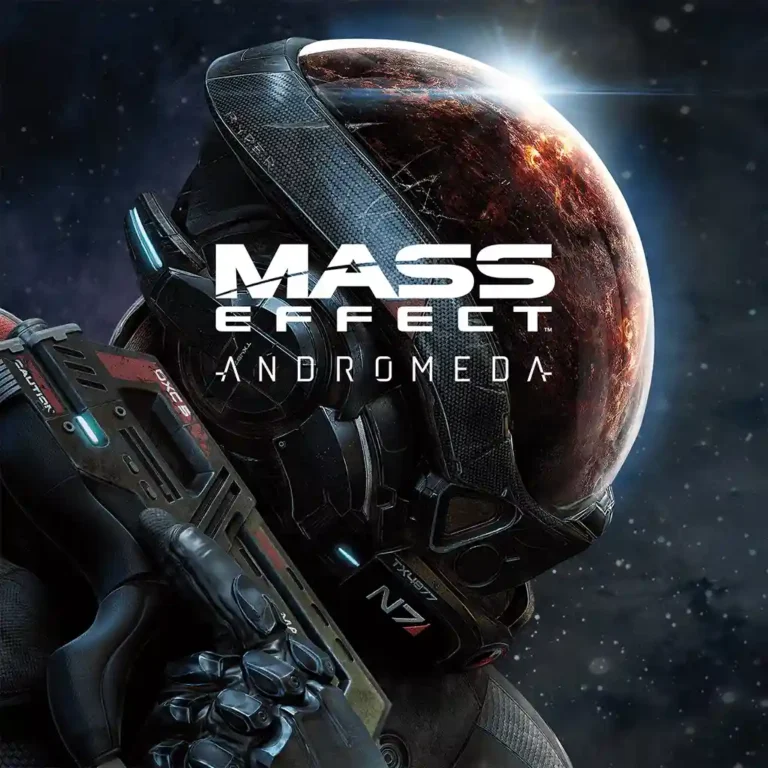
Mass Effect: Andromeda
 71
★ /10
71
★ /10
 PC
PC PS4
PS4 Xbox One
 Electronic Arts
Where to buy



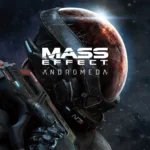
Mass Effect: Andromeda is a 2017 action role-playing game developed by BioWare and published by Electronic Arts. Released on March 21, 2017, for PlayStation 4, Xbox One, and PC, it is the fourth major entry in the Mass Effect series and the first set outside the Milky Way — leaving behind Commander Shepard and the events of the original trilogy entirely.
The game launched to middling reviews and immediately became the subject of widespread mockery over its facial animations, culminating in EA and BioWare abandoning all planned post-launch story content within five months of release. Nine years on, it remains the most divisive entry in the franchise — and the one most actively being re-evaluated.
Technical Specifications
| Attribute | Details |
|---|---|
| Developer | BioWare (primarily BioWare Montreal) |
| Publisher | Electronic Arts |
| Director | Mac Walters |
| Lead Designer | Ian S. Frazier |
| Composer | John Paesano |
| Engine | Frostbite 3 |
| Platform(s) | PlayStation 4, Xbox One, Microsoft Windows |
| Release Date | NA: March 21, 2017 · PAL: March 23, 2017 |
| Genre | Action role-playing, Third-person shooter |
| Mode(s) | Single-player, Multiplayer co-op |
A New Galaxy, A New Ryder
Mass Effect: Andromeda is set six hundred years after the events of the original trilogy, and in an entirely different part of the universe. Rather than a sequel, it functions as a fresh start: the Andromeda Initiative, a multi-species colonization project, has sent a fleet of arks across the intergalactic void to settle the Andromeda Galaxy. Players control either Scott or Sara Ryder, a Pathfinder-in-training who inherits their father’s role as the expedition’s lead explorer after an early crisis derails the mission.
The premise trades Shepard’s wartime command structure for something more exploratory: the Ryders are inexperienced, the galaxy is unknown, and the primary task is making planets habitable rather than stopping a known enemy. The antagonists — the Kett, a militaristic alien species practicing forced genetic assimilation of other races — and the remnants of a vanished civilization called the Remnant are both entirely new creations, with no ties to the Reapers or the Citadel. The setup gave BioWare room to build a new universe without the weight of established lore, while also removing the decade of character investment that made the original trilogy’s stakes feel immediate.
Development: Five Years, a New Engine, and a Troubled Production
Mass Effect: Andromeda was in development for roughly five years — longer than any previous entry — but most of that time was consumed by problems rather than content. The central issue was the shift from Unreal Engine 3, which BioWare had used across all three original games, to Frostbite 3, EA’s in-house engine developed by DICE for the Battlefield series. Frostbite was not designed for RPGs: it lacked basic systems BioWare needed, such as inventory management, dialogue trees, and cinematic camera tools, which the team had to build from scratch. According to reporting published after the game’s release, BioWare Montreal spent a significant portion of development time fighting the engine rather than building the game, and the project’s scope and direction shifted multiple times before it shipped.
The production was led for much of its development by BioWare Montreal — a studio that had previously worked primarily in a support role on the original trilogy — with late-stage help from the Edmonton and Austin branches. Mac Walters, who had been lead writer on Mass Effect 2 and 3, came in as director in the final stretch. The last year of development was, by multiple accounts, a crunch-heavy race to ship a product that still needed substantial work.
Combat: The One Thing Everyone Agrees On
The area where Mass Effect: Andromeda most clearly succeeds — and where critical and player consensus is almost uniformly positive — is its combat. The Frostbite engine, whatever its other costs, enabled a more physically dynamic battle system than anything in the original trilogy: Ryder can boost-jump to reach elevated cover, dash horizontally at speed, and mix abilities from multiple skill trees simultaneously rather than being locked to a single class.
The removal of fixed character classes in favor of a freeform skill system let players switch between combat, tech, and biotic specializations at will, creating more experimental and fluid playstyles than the trilogy allowed. Enemy variety and AI behavior were considered improvements over the trilogy’s later entries. Several critics who were otherwise negative about the game singled out the shooting mechanics as the best the franchise had ever produced — an assessment that has largely held up.
Launch, The Animation Controversy, and the Metacritic Score
EA made Mass Effect: Andromeda available five days early to EA Access subscribers, which turned out to be a significant mistake. The early access window coincided with a weekend of social media activity focused on the game’s facial animations — particularly a set of expressions that looked blank or unnatural in close-up dialogue sequences — and the resulting memes spread widely before the game was officially out. By the time reviews published, the conversation was already shaped by those images.
The game launched the same week as three titles that would each become defining entries in their respective genres: The Legend of Zelda: Breath of the Wild, Horizon Zero Dawn, and Nier: Automata. The comparison was not favorable. Mass Effect: Andromeda received a Metacritic score of 72 on PS4 (its most-reviewed platform), the lowest for any BioWare game to that point, with most critics landing around 7/10 — a “fine but disappointing” tier that is particularly damaging for a franchise with two predecessors scoring 94 and 89.
The criticisms beyond the animations clustered around inconsistent writing, a weaker supporting cast relative to the trilogy, uneven pacing in the open-world structure, and a main villain who didn’t register with the same force as Saren or the Illusive Man. The exploration of planetary surfaces was praised for ambition but criticized for repetitive mission design — most planets followed a similar loop of activating Remnant vaults and seeding outposts.
Abandoned: No DLC, No Sequel, BioWare Montreal
What followed the mediocre launch response was swift and largely final. Within weeks, BioWare scaled back BioWare Montreal from a full development studio to a support role, redistributing most of its staff to other projects. By August 2017 — five months after release — BioWare confirmed that patch 1.10 would be the last update, and that no single-player story DLC was planned. This was the first time in the franchise’s history that a mainline Mass Effect game received no post-launch story content, breaking a pattern established by Bring Down the Sky, Lair of the Shadow Broker, and Citadel.
Among the abandoned plans was a DLC arc centered on the Quarian Ark — a story thread deliberately left unresolved in the main campaign, clearly intended as a post-launch expansion. Former BioWare executive Mark Darrah later indicated that outside pressure — widely interpreted as referring to EA — was responsible for pulling the team off Andromeda’s content to work on Anthem and other projects. Plans for a direct sequel to Andromeda were also shelved, though BioWare never officially announced one had existed.
BioWare Montreal was formally absorbed into BioWare proper and ceased to exist as an independent studio.
Nine Years On: Reappraisal and Current State
By 2026, Mass Effect: Andromeda occupies an unusual position. The launch-period narrative — broken animations, abandoned franchise, studio fallout — is well documented and hasn’t changed. What has shifted is how people who play the game now, without the 2017 context, tend to describe it.
Reviews posted to Steam in 2024 and 2025 are notably more positive than the launch-era consensus. Players coming in without the hype of an anticipated sequel, without the direct comparison to Breath of the Wild and Nier: Automata, and with all the post-launch patches applied, tend to land around a “decent open-world RPG with excellent combat and uneven writing” verdict rather than the “franchise-killing disappointment” framing that dominated the conversation in 2017. A subreddit thread simply titled “Opinion on Mass Effect: Andromeda” currently draws more organic search traffic than the game’s Wikipedia article — a sign that people are still actively working out what they think.
The game is available on PC via Steam and EA App, and regularly goes on steep sale. There is no remaster, no DLC, and no sequel on the horizon — what exists in its current patched state is the complete and final version of the experience. For players interested in the Mass Effect universe who have finished the Legendary Edition and want more, it remains the only other option until BioWare’s next mainline entry arrives.