Imperivm: Great Battles of Rome
 PC
PC
Where to buy

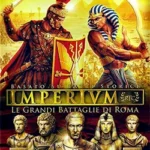
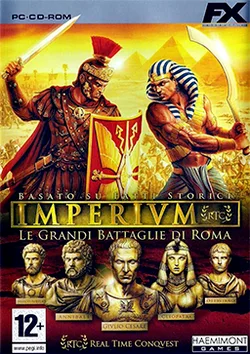
Imperivm: Great Battles of Rome (originally released in Italy and Spain as Imperivm III: Le grandi battaglie di Roma and Imperivm III: Las grandes batallas de Roma, and also known as Imperivm RTC: Great Battles of Rome) is a real-time strategy (RTS) and real-time tactics (RTT) video game developed by the Bulgarian studio Haemimont Games and co-published by FX Interactive. Released in May 2005 for Microsoft Windows, the game serves as the third major entry in the Celtic Kings / Imperivm strategy franchise, expanding directly upon the systems of 2002’s Celtic Kings: Rage of War and 2003’s Nemesis of the Roman Empire.
The game represents the peak of Haemimont’s specialized “Real-Time Conquest” (RTC) gameplay framework, emphasizing macro-level territorial annexations, historical scenarios, and customized tactical micro-management. It discards traditional base construction and construction queues in favor of pre-built, capture-centric infrastructure distributed across vast geometric maps.
Technical Specifications
| Attribute | Details |
|---|---|
| Developer | Haemimont Games |
| Publisher | FX Interactive |
| Engine | Custom 2D Isometric Engine |
| Platform | Microsoft Windows |
| Release Date | December 21, 2004 |
| Genre(s) | Real-time strategy, Real-time tactics |
| Modes | Single-player, Multiplayer |
Gameplay Architecture: The RTC Model
The defining strategic blueprint of Imperivm: Great Battles of Rome is its absolute focus on tactical troop mobility over mundane peon micro-management. Players cannot erect custom bases or defensive walls; all structures are permanent fixtures built directly into the map typography and must be captured to yield localized military and economic advantages.
The Food Matrix and Supply Lines
The economic engine manages two distinct, completely decentralized resources: Gold and Food.
- Gold: Collected automatically via real-time population taxation inside the central vaults of major Walled Cities. It is spent to fund technological breakthroughs, buy unit upgrades, and recruit armies.
- Food: Continuously farmed inside rural Villages. Food is highly critical, as outposts and traveling military columns continuously consume physical rations over time to sustain their operations.
Because resource pools are completely localized, players must employ automated Pack Mules to ferry food from agricultural villages to fortified border keeps. Armies operating deep in enemy territory carry finite rations in their personal inventories; if these reserves drop to absolute zero, units face acute starvation, which caps their physical health bars to minimums and leaves them highly vulnerable during real-time combat.
Advanced Hero System and Formations
Combat scaling and army cohesion rely heavily on the Hero System, which was extensively upgraded for this third installment. Heroes act as powerful combat commanders that gain individual levels, handle stat-boosting equipment, and clear map shrines to cast localized tactical perks.
The Unit Attachment Cap
A single Hero can attach a massive block of up to 50 standard soldiers directly to their personal command circle. Attached units match the Hero’s movement velocity, march in formation, and automatically inherit a percentage of the general’s experience level as a direct passive damage and defense modifier. By grouping multiple Generals together, massive task forces can be ordered simultaneously across the map.
Tactical Formations
Heroes can arrange their attached armies into four distinct geometric presets, granting distinct bonuses based on the unit composition:
- Square Formation: Maximizes defensive coverage across all flanks, reducing damage taken from surrounding attacks.
- Block Formation: Optimizes melee cohesion and forward shock velocity, ideal for a dense frontline push.
- Line Formation: Maximizes horizontal line-of-sight and projectile paths, heavily benefiting armies composed primarily of ranged archers or skirmishers.
- Center Cavalry: Boosts tracking speed and charge momentum, prioritizing fast-moving flank maneuvers.
Playable Civilizations
The game includes highly distinct, asymmetric historical cultures (with Rome uniquely split across two separate chronological timelines), bringing the total selection pool to seven civilizations:
- Imperial Rome: Focuses on heavy discipline, advanced engineering upgrades, and unyielding Praetorian legions.
- Republican Rome: Emphasizes massive manpower loops, aggressive training regimes, and pushes the Hero attachment cap from 50 up to 70 units.
- Egypt (Aegyptus): Specializes in wealth generation, high-mobility chariot lines, and powerful religious priests capable of casting devastating crowd-control miracles.
- Britannia: Relies on dense forest camouflage, exceptional guerilla skirmishing, and high physical health thresholds.
- Germania: Prioritizes brutal shock attacks, mass barbarian waves, and fast health-regeneration loops mid-combat.
- Gaul (Gallia): The classical balanced culture, combining fast movement speeds with druidic rituals to sustain long-range operations.
- Iberia (Hispania): Focuses on terrain tracking, visual evasion, and health-leeching kinetic damage arrays.
- Carthage (Carthago): Emphasizes wealth accumulation, mercenary recruitment networks, and heavy war elephant formations.
Game Modes
Rome’s Greatest Battles
The primary single-player narrative mode. Rather than standard fictional stories, it consists of highly accurate, pre-built historical scenarios documenting Rome’s defining military confrontations. Players can experience scenarios ranging from the Battle of Zama (the conclusion of the Second Punic War) to Julius Caesar’s campaigns in Gaul and the defense of the empire against barbarian incursions.
Strategic Mode
A custom skirmish setup supporting up to eight players or AI over Local Area Network (LAN) or online networks across enormous geometric maps.
Modern Remaster: The HD Edition
Following nearly two decades as a beloved cult strategy classic, the game’s codebase was officially modernized. On August 16, 2021, Imperivm RTC – HD Edition “Great Battles of Rome” was launched on Steam by Dinamic Software and Imperivm World.
As of 2026, the HD Edition functions as the definitive modern standard for the title. The remaster updates the old 2D isometric executable to run natively under contemporary 64-bit multi-core configurations on Windows 10 and Windows 11 completely out-of-the-box. It natively scales the game maps into sharp, high-definition widescreen resolutions (supporting 1080p, 1440p, and native 4K display monitors) with zero interface or asset stretching.
Furthermore, the HD Edition incorporates full Steam Deck verification and includes a dedicated, updated global online matching network via dedicated servers, bypassing obsolete legacy direct-IP wrappers to preserve the classic Real-Time Conquest meta for competitive strategy historians.