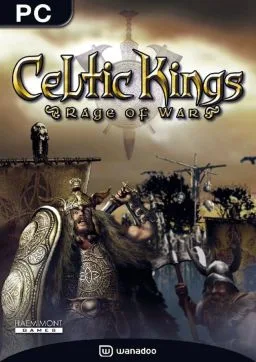
Celtic Kings: Rage of War
 82
★ /10
82
★ /10
 PC
PC
 Russobit-m, Strategy First, Wanadoo


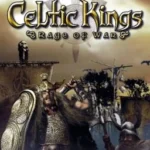
Celtic Kings: Rage of War (released in Italy and Spain as Imperivm: La guerra gallica and Imperivm: La Guerra de las Galias) is a real-time strategy (RTS) and role-playing video game developed by the Bulgarian studio Haemimont Games and published by Strategy First and Wanadoo Edition. Released in August 2002 for Microsoft Windows, the game is the debut entry in the Celtic Kings strategy franchise.
Set during the historic Gallic Wars and Julius Caesar’s military campaigns in Gaul, the game combines large-scale tactical battlefield management with character-driven isometric role-playing elements. Rather than relying on traditional base construction, players focus on capturing existing towns, managing decentralized logistics networks, and utilizing hero commanders to direct massive formations of soldiers.
Technical Specifications
| Attribute | Details |
| Developer | Haemimont Games |
| Publisher(s) | Strategy First (NA), Wanadoo Edition (EU), FX Interactive (Italy/Spain) |
| Engine | Custom 2D Isometric Engine |
| Platform | Microsoft Windows |
| Release Date(s) | • AU: August 19, 2002 • NA: August 21, 2002 • EU: October 2, 2002 |
| Genre(s) | Real-time strategy, Role-playing game |
| Modes | Single-player, Multiplayer |
Gameplay Mechanics
Celtic Kings: Rage of War features a mechanical framework that bridges macroeconomic logistics with isometric character progression. The game removes the ability to construct or destroy buildings. All structures—such as Strongholds, Villages, Outposts, and Shipyards—are hardcoded onto the map geometry and must be forcefully captured or defended via localized siege actions.
Decentralized Logistics and The Food Matrix
The economic engine manages two distinct resources: Gold and Food. Unlike traditional real-time strategy mechanics, resources are completely decentralized and tied to individual structures rather than a global treasury pool:
- Gold Production: Automatically accumulated via taxation inside the central vaults of large Strongholds. It is spent to draft fresh military forces, train units, and fund structural research upgrades.
- Food Production: Continuously gathered via agricultural farming inside rural Villages. Food is highly critical for population replenishment and sustaining the physical health of military units.
Because resources are localized, players must employ Pack Mules and supply ships to physically ferry goods from production zones to frontline fortresses. Units deployed far out in the field consume food directly from their inventories or nearby mules.
“Military forces operating without a persistent supply of food will eventually starve. While starvation does not kill the unit directly, it permanently drops their physical health bar to critical minimums, rendering them incredibly fragile in real-time combat.” — Original Game Systems Manual
Loyalty and Siege Mechanics
Every structural asset contains a variable Loyalty Rating. To conquer an enemy or neutral stronghold, players must march military forces up to the gates to command a capture loop. The structure’s loyalty steadily drops over time if hostile forces outnumber defenders within proximity. Once loyalty hits absolute zero, the base surrenders, automatically flipping its operational alignment and resource stores to the conqueror.
To break heavy defensive thresholds, up to ten military units can band together to manually assemble a stationary Catapult. Catapult artillery units cannot move once constructed, but they deal massive kinetic damage to structural defenses, forcing the garrison units inside to retreat or face elimination.
Hero Formations and RPG Progression
Combat efficiency is heavily tethered to the Hero System. Heroes are hyper-powerful commander units featuring individual experience pools, levels, and equipment slots. They can locate hidden mystical artifacts (such as the Finger of Death or Horn of Victory) from ancient ruins or temples to invoke localized spells or stat boosts.
Crucially, a Hero can attach up to 50 standard military units directly to their personal command circle. Units bound to a Hero can march in tight military formations (Line, Wedge, Column) and coordinate their travel velocities. Units under a Hero’s command also inherit a portion of the leader’s experience level as a passive combat power modifier. Units can also be manually trained inside strongholds up to a standard maximum cap of Level 12, though the training process temporarily drains their physical health bar.
Game Modes
Adventure Mode
The primary narrative single-player campaign acts like an isometric hack-and-slash role-playing game. The story tracks Larax, a young Gallic tribesman whose entire life is shattered after a ruthless raid by the nomadic Teutons destroys his home village and kills his wife.
Consumed by grief, Larax swears a blood oath, pledging his body and soul to Kathubodua, the ancient Celtic Goddess of War, to exact his revenge. The campaign unfolds chronologically like an epic political thriller, tracing Larax’s solo quests as he evolves from an isolated warrior into a massive general caught between Vercingetorix’s resistance and Julius Caesar’s expanding Roman legions.
Strategic Mode
The game’s standard skirmish and multiplayer mode supports up to eight players over Local Area Network (LAN) or direct-IP networks across massive map layouts scaling up to 32,000 $\times$ 32,000 pixels. Players select a custom starting bonus and focus purely on tactical map annexation.
Playable Factions
The strategy layers present two highly distinct, asymmetric playable cultures alongside a non-playable neutral tribal faction:
| Faction / Culture | Economic & Structural Doctrine | Signature Field Asset | Faction Combat Trait |
| The Romans | High structural fortification, advanced military training, and heavy technological research. | Praetorians, Gladiators, and Priests | High individual defense plating and specialized micro-formations. |
| The Gauls / Celts | High population growth metrics, dependency on mass agricultural villages, and raw manpower numbers. | Viking Lords, Women Warriors, and Druids | High-velocity movement speeds and health-regeneration loops via mystical rituals. |
| The Teutons | Non-playable nomadic faction residing inside neutral tents scattered throughout the wilderness. | Teuton Raiders | Hyper-aggressive AI that attacks any unit crossing into their territorial boundary. |
Reception and Digital Preservation
Upon its initial launch in 2002, Celtic Kings: Rage of War received generally favorable reviews from mainstream video game publications. Review aggregator Metacritic calculated a composite score of 82/100, with GameSpot awarding the title an 8.4/10 and IGN presenting an 8.2/10. Critics highly commended the seamless hybridization of real-time strategy with role-playing progression parameters, praising the localized supply mule system for adding genuine logistical weight to long-range military sieges. Minor criticisms focused on basic unit asset varieties and subpar English voice-acting lines.
The title achieved immense commercial success in Southern Europe under the Imperivm moniker, collectively selling over one million retail units across Spain and Italy alone.
Modern Digital Status
Following its long retail shelf-life, Haemimont Games re-packaged the legacy codebase for modern digital distribution platforms. The game was launched on GOG.com in May 2009, with an official digital re-release following on Steam on September 5, 2019.
The game is natively maintained as a retro strategy classic under modern 64-bit multi-core desktop frameworks. The current Steam client launcher incorporates updated compatibility wrappers that address old legacy DirectDraw and DirectX 9 exceptions, allowing the 2D isometric environments to execute smoothly under Windows 10 and Windows 11 out-of-the-box. The title scales into sharp 1080p and 1440p monitor configurations without stretching, preserving the historic conquests of Gaul for modern strategy historians.