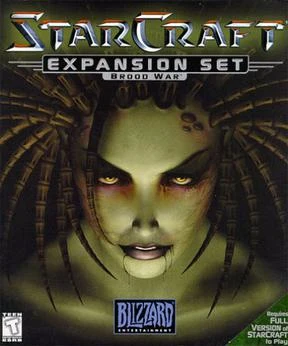
StarCraft: Brood War
 PC
PC
 Blizzard Entertainment, Saffire
Blizzard Entertainment,
Blizzard Entertainment, Saffire
Blizzard Entertainment,  Sierra
StarCraft: Brood War is a 1998 expansion pack for the legendary real-time strategy (RTS) game StarCraft. Developed by Blizzard Entertainment (with co-development assistance from Saffire) and published just eight months after the base game, it is widely considered the absolute gold standard for video game expansions. Brood War didn’t just tack on a few extra maps and missions; it introduced surgically precise unit additions that fundamentally altered the meta, inadvertently creating the most perfectly balanced asymmetrical competitive game in history.
The narrative picks up exactly where the original game’s massive cliffhanger left off. The Koprulu Sector is in absolute ruins. The Protoss homeworld of Aiur has been overrun by the Zerg, forcing the surviving Protoss to flee through a warp gate to the shadowy world of Shakuras, where they must forge an uneasy alliance with their outcast brethren, the Dark Templar. Meanwhile, the United Earth Directorate (UED)—the massive, heavily armed governing body of humanity back on Earth—arrives with a massive expeditionary fleet to violently take control of the sector. Operating in the shadows of this chaos is Sarah Kerrigan, the newly self-proclaimed “Queen of Blades,” who systematically manipulates both her enemies and allies to seize total control of the fractured Zerg Swarm.
Gameplay
While the core mechanics of mining Minerals and Vespene Gas remained untouched, Brood War introduced seven completely game-changing units that plugged the specific tactical weaknesses of each faction, shattering the stagnant late-game strategies of the original StarCraft.
Key gameplay additions include:
- The Terran Medic: Arguably the most important addition in the game. In original StarCraft, Terran infantry (Marines) were highly fragile and essentially useless in the late game. The Medic could continuously heal biological units, immediately birthing the legendary “Marine and Medic” (M&M) composition that allowed Terran players to relentlessly apply aggressive, map-wide pressure. The Terrans also received the Valkyrie, a heavily armored anti-air frigate that fired devastating volleys of splash-damage missiles.
- The Zerg Lurker: Evolved from the Hydralisk, the Lurker fundamentally changed Zerg ground control. The Lurker cannot attack while moving; it must burrow underground, where it becomes invisible and unleashes massive, straight-line waves of subterranean spines. This gave the Zerg much-needed siege capabilities and area denial, punishing massive infantry pushes. The Zerg also received the Devourer, a massive flying beast that sprayed acid to debuff enemy air fleets.
- The Protoss Arsenal: The Protoss arsenal expanded massively with the permanent addition of the Dark Templar, a permanently cloaked assassin that dealt devastating melee damage (which only appeared in the campaign of the base game). Two Dark Templar could merge to form the Dark Archon, a powerful caster that couldn’t attack but could mind-control enemy units. Finally, the Corsair gave Protoss a lightning-fast, splash-damage anti-air fighter capable of locking down enemy static defenses with its “Disruption Web” ability.
- High-Ground Advantage: Map topography became incredibly important in the Brood War meta. Units firing from low ground to high ground suffer a 47% chance to completely miss their shots, making defending ramps and establishing map control absolutely critical to survival.
Development and Legacy
Development of Brood War was rushed, taking place over a grueling few months in 1998. Blizzard initially outsourced much of the work to Saffire, a Utah-based studio, but eventually pulled the level design and balancing heavily back in-house to ensure it met their incredibly high standards.
Upon its release in November 1998, it received universal critical acclaim, with reviewers praising the staggering length and difficulty of the new 26-mission campaign, as well as the phenomenal orchestral soundtrack.
However, the true legacy of Brood War was forged in the PC Bangs (LAN cafes) of South Korea. The specific unit additions created an incredibly delicate, high-speed, rock-paper-scissors balance that rewarded astronomical Actions Per Minute (APM) and flawless tactical multitasking. Brood War essentially became South Korea’s national pastime. It spearheaded the creation of the Korean e-Sports Association (KeSPA) and dominated cable television networks (like OGN and MBC Game) for over a decade, with professional players battling in sold-out stadiums long before the rest of the world caught on to esports.
The game’s competitive balance is considered a “happy accident”—a masterpiece of code that is so intricately balanced on a razor’s edge that Blizzard famously refused to patch the game’s balance for over a decade out of fear of breaking it. Today, preserved perfectly within the 2017 StarCraft: Remastered release, Brood War remains the defining pillar of competitive RTS gaming.
Key Features:
- The Perfect Expansion — Experience the seven game-changing units (Medics, Lurkers, Dark Templar, etc.) that fundamentally perfected the three-way asymmetrical balance of the franchise.
- The Queen of Blades — Play through a massive, notoriously difficult 26-mission campaign focusing on Sarah Kerrigan’s brutal, manipulative rise to galactic dominance.
- The Esports Blueprint — Master the foundational mechanics of macro-booming, map control, and high-APM micro that birthed the modern professional gaming industry.
- New Environments — Wage war across completely new tilesets, including the twilight world of Shakuras, the frozen ice wastes of Braxis, and the shattered deserts of Korhal.
- Included in Remastered — The Brood War expansion is natively integrated into both the free classic version of the game and the 2017 4K StarCraft: Remastered edition.
Release Platforms:
- Microsoft Windows (PC) — November 30, 1998
- Mac OS — 1999
- Nintendo 64 (StarCraft 64) — June 2000 (Included alongside the base game)
- StarCraft: Remastered (PC, Mac) — August 14, 2017 (Currently available via the Battle.net launcher)
Starcraft news
More news
Blizzard Confirms New StarCraft Won't Be an Xbox Exclusive
New StarCraft Shooter: Release Window, Gameplay, and Key Details

BlizzCon 2026 Opening Ceremony: Every Major Announcement