Empire Earth II
 79
★ /10
79
★ /10
 PC
PC Sierra
 Softclub
Where to buy

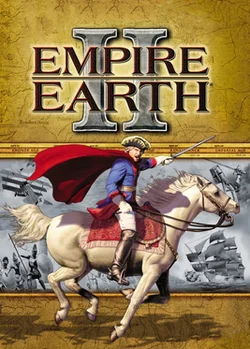
Empire Earth II is the massive, highly complex 2005 real-time strategy sequel developed by Mad Doc Software and published by Vivendi Universal Games.
After successfully handling the sci-fi expansion for the first game (The Art of Conquest), Mad Doc Software was handed the keys to the entire franchise. If the original 2001 game was a sprawling, chaotic sandbox of pure megalomania, Empire Earth II was its highly refined, deeply analytical successor. It took the core concept—guiding a civilization through 15 epochs, from the Stone Age to the Synthetic Age—and completely overhauled the underlying mechanics, introducing a staggering level of macro-management that made it one of the deepest RTS games of its era.
Gameplay and Massive Mechanical Overhauls
Empire Earth II fundamentally changed how map control, economics, and warfare functioned, making it feel distinctly different from its predecessor and its main rival, Age of Empires.
Key mechanical innovations included:
- The Territory System: Rather than a massive, open sandbox where you could build anywhere, the map was pre-divided into distinct territories (similar to a game of Risk). To control a territory and harvest its resources, you had to build a City Center or capture the enemy’s. Furthermore, each territory had a strict cap on how many buildings (like barracks or universities) could be constructed within it, forcing players to constantly expand to grow their army.
- The Citizen Manager: Recognizing that managing hundreds of peasants across 15 epochs was exhausting, Mad Doc introduced a brilliant automation system. The Citizen Manager was a dedicated UI screen where players could simply drag sliders to dictate what percentage of their population should be chopping wood, mining gold, or farming. The AI would then automatically route idle citizens to the correct tasks across your entire empire.
- Picture-in-Picture (PIP): A revolutionary interface feature for the time. Players had a small secondary camera window on their HUD. You could set a camera bookmark on a frontline battle, go back to managing your base on the main screen, and still watch the combat unfold in real-time in the PIP window.
- The Crown System: Excelling in specific fields—Military, Economic, or Imperial (expansion)—awarded players a temporary “Crown.” Holding a crown granted massive, civilization-wide buffs and a unique leader unit, encouraging players to specialize rather than just turtle.
- Dynamic Weather: The game featured heavily simulated seasons and weather. A sudden blizzard would physically slow down infantry movement and lower the flight ceiling for aircraft, while a heavy rainstorm could impact visibility and naval warfare.
- War Plans: In multiplayer or skirmish modes, players could open a tactical minimap, draw physical arrows and attack routes, and send these “War Plans” to allied players or AI. If the AI accepted the plan, they would actively coordinate their attacks with your drawings.
The Three Epic Campaigns
The single-player component stepped away from the mythological storytelling of the first game, focusing on a slightly more grounded (though eventually sci-fi) historical progression across three massive campaigns:
- The Korean Campaign: Covering early history, this campaign follows the foundation of the Korean nation, from the ancient tribal conflicts through the legendary Silla unification and the Imjin War against Japan.
- The German Campaign: Covering the Middle Ages through the Industrial Revolution, you follow the Teutonic Order, the Protestant Reformation, the rise of Prussia, and ultimately the unification of the German Empire under Otto von Bismarck.
- The American Campaign: A sprawling modern-to-sci-fi campaign. It begins with the Spanish-American War in 1898, follows the grueling trenches of World War I, and eventually pushes into the late 21st century, dealing with near-future espionage, cyborgs, and high-tech global conflicts.
Development and Legacy
Released in April 2005, Empire Earth II was highly praised by critics and hardcore strategy fans. While some players found the transition from the loose, free-form building of the original game to the strict “Territory System” a bit jarring, the sheer depth of the automation, the PIP camera, and the massive tech tree cemented it as a mechanical masterpiece of the genre.
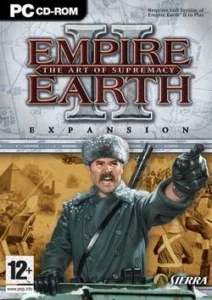
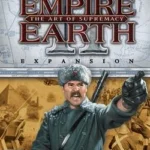
The following year, it received a robust expansion pack, The Art of Supremacy, which added new civilizations (like the French and Russians), African campaigns, and native tribal factions that could be assimilated into your empire.
Today, Empire Earth II is widely considered the absolute peak of the franchise. Because the highly anticipated 2007 sequel (Empire Earth III) was notoriously rushed, cartoonish, and fundamentally broken at launch, fans point to EE2 as the last great entry in the series. Flawlessly preserved via digital storefronts, it remains a dense, deeply rewarding epic for fans of macro-heavy history simulations.
Key Features:
- 15 Epochs of History — March your civilization from primitive club-wielders to laser-wielding synthetic cyborgs across thousands of years of technological evolution.
- The Territory System — Master a deeply strategic map-control system that forces continuous expansion and border defense.
- Revolutionary UI — Utilize the Picture-in-Picture camera to manage your economy while simultaneously monitoring frontline battles on the same screen.
- The Citizen Manager — Eliminate tedious micromanagement by automating your workforce with intuitive resource sliders.
- Dynamic Environments — Adapt your military strategies on the fly as blinding blizzards and torrential rainstorms drastically alter unit effectiveness.
Release Platforms:
- Microsoft Windows (PC) — April 26, 2005
- (Currently available on GOG.com as the Empire Earth II: Gold Edition, fully bundled with The Art of Supremacy expansion).