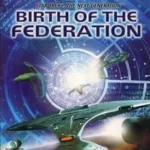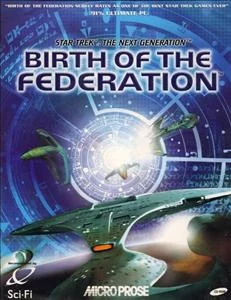
Star Trek: Birth of the Federation
 PC
PCStar Trek: Birth of the Federation (commonly abbreviated as BotF) is a turn-based space grand strategy 4X video game developed by MicroProse and published by Hasbro Interactive. Released in May 1999 for Microsoft Windows, the title stands as the definitive, foundational attempt to map the sprawling sociopolitical landscape of the Star Wars competitor, Star Trek: The Next Generation, onto a traditional 4X empire-building engine.
Borrowing structural elements from MicroProse’s own Master of Orion series, Birth of the Federation cast players as the supreme leader of one of the galaxy’s five major superpowers. The game is highly regarded by strategy historians for its deep integration of Star Trek lore, balancing high-stakes planetary diplomacy, sub-light logistics, covert intelligence wars, and a turn-based 3D tactical fleet combat engine that captured the cinematic scope of the franchise’s legendary starship clashes.
Technical Specifications
| Attribute | Details |
|---|---|
| Developer | MicroProse (Alameda Studio) |
| Publisher | Hasbro Interactive |
| Designers | David “Zeb” Cook, Glyn Anderson |
| Composer | Inon Zur |
| Engine | Proprietary 2D Galactic Interface / 3D Turn-Based Tactical Combat Engine |
| Platform | Microsoft Windows (95 / 98) |
| Release Date | May 25, 1999 |
| Genre(s) | Turn-based strategy, Space Grand Strategy, 4X |
| Mode(s) | Single-player, Multiplayer (LAN, Modem, Hotseat up to 5 players) |
The Five Asymmetric Galactic Empires
The core gameplay loop revolves around the competition between five dominant major powers. True to the source material, every faction features an asymmetric political ideology, distinct ship hull architectures, and gameplay-altering passive traits:
- The United Federation of Planets: The diplomatic and scientific juggernaut. The Federation excels at peaceful colonization and gains an immense relationship bonus when courting neutral worlds. However, they are bound by the Prime Directive; they cannot ruthlessly invade primitive alien cultures without suffering a catastrophic drop in domestic morale and planetary stability.
- The Klingon Empire: A militaristic society driven entirely by honor and conquest. Klingon ground troops and starships receive massive offensive combat bonuses. Their empire thrives on warfare—maintaining prolonged periods of peace actively decays their global planetary morale, whereas winning decisive space battles keeps their population ecstatically content.
- The Romulan Star Empire: The masters of shadow operations and subversion. Romulan vessels are natively equipped with Cloaking Devices, allowing them to traverse space lanes invisible to enemy sensors. They receive a massive bonus to Espionage and Sabotage, capable of destabilizing rival star systems from within.
- The Cardassian Union: A totalitarian, highly industrial police state. Cardassians command excellent manufacturing speeds and spy-networks optimized for Internal Security (Counter-Espionage). They ignore the ethical constraints of other factions, capable of forcefully enslaving conquered minor populations to artificially maximize industrial output.
- The Ferengi Alliance: A hyper-capitalist corporate syndicate driven entirely by the Rules of Acquisition. The Ferengi possess unmatched trading capabilities, harvesting massive financial wealth from economic treaties and commercial star lanes. Their neutral diplomatic status allows them to trade freely with competing empires even mid-war.
Minor Races & Strategic Diplomacy
The galaxy map is seeded with up to 30 independent Minor Races (such as the Vulcans, Bajorans, Acamarians, and Edo). Unlike major powers, minor races do not build interstellar conquest fleets; they remain anchored to their home systems, developing unique planetary cultures and technologies.
Interacting with these cultures represents a major strategic layer. Major empires can use Diplomacy to slowly bribe, protect, and court minor races into signing a treaty of friendship, eventually leading to full Affiliation and Membership within your empire. Peaceful integration rewards you with total sovereignty over their local industries and population pools.
Crucially, achieving full membership unlocks the minor race’s Specialized Structural Wonder. For example, integrating the Vulcans unlocks the Vulcan Science Academy, granting a permanent, massive percentage boost to your empire’s global research velocity, while welcoming the Betazoids projects an empire-wide counter-espionage shield.
The Five Resource Pillars & 3D Tactical Combat
Empire management is governed by balancing localized worker allocations across five distinct resource sectors: Food (prevents civilian starvation), Industry (accelerates shipbuilding and building construction), Energy (powers structural facilities and planetary shields), Research (advances the tech tree), and Intelligence (split into passive defense or offensive spy networks).
The Turn-Based 3D Fleet Overlay
When two opposing armadas occupy the same grid sector, Birth of the Federation transitions to a dedicated 3D Tactical Combat Screen. Combat is resolved through a unique turn-based planning phase followed by real-time cinematic execution.
Admirals issue specific spatial instructions to their task forces or individual starships: Charge, Evade, Ram, or Harry. You manually lock weapon targets and balance energy parameters—ordering ships to fire direct Phaser arrays to drop shields, or launch explosive Photon Torpedoes to shatter heavy hulls.
Once orders are locked, you hit the execute button, and the engine simulates the maneuver in a cinematic three-dimensional display, tracking weapon arcs, shield facings, and structural component damage loops.
Paths to Galactic Domination
To claim supreme victory over the alpha and beta quadrants, factions are limited to two uncompromising endgame metrics:
1. The Domination Victory (Military Hegemony)
The classic warlike solution. A player wins immediately by building overwhelming space armadas, invading fortified systems with troop transports, and systematically conquering or glassing the home worlds of all four major rival superpowers until their flag is the lone sovereign banner remaining on the map.
2. The Alliance Victory (Coalition Hegemony)
The diplomatic alternative. This path allows peaceful factions to win together by forming an unassailable interstellar coalition. To secure an Alliance victory, your empire and its signed, permanent allies must collectively conquer or politically assimilate a strict two-thirds majority of the galaxy’s total populated systems, establishing a unified galactic peace.
Modern Preservation & “Abandonware” Status (2026 Perspective)
As of May 2026, Star Trek: Birth of the Federation occupies a fascinating, highly complex position within retro strategy preservation circles. Because of intense, multi-tiered licensing gridlocks surrounding the Star Trek intellectual property (spanning the historical structural collapses and brand acquisitions of MicroProse, Hasbro, Atari, and Paramount), the game has never received an official commercial digital re-release. It is completely absent from mainstream digital storefronts like Steam and GOG.com.
Consequently, the game is classified as historic Abandonware, and its survival has been driven entirely by an incredibly dedicated community of independent programmers centered at the legacy portal Armada Fleet Command (armadafleetcommand.com).
The community actively maintains the definitive “BotF Multi-Installer” utility for modern systems. This open-source installer packages the original 1999 game directories with critical, community-vetted software patches that completely rewrite the game’s archaic code dependencies:
- The Memory Leak Fix: The original retail 1999 executable suffered from a notorious, severe memory leak that caused matches to consistently crash to the desktop once a game progressed past turn 150. The community patch thoroughly repaired this internal buffer issue, ensuring infinite endgame stability.
- Widescreen & UI Scaling Resynchronization: The legacy client was hardcoded strictly around a 640×480 or 800×600 pixel aspect ratio. Modern patches inject native DirectDraw wrappers (like dgVoodoo2) to allow the text menus, stellar maps, and 3D tactical ship meshes to render cleanly up to high-definition widescreen display boundaries.
- Total Conversion Overhauls: The preservation network continuously distributes massive, gameplay-altering total conversion mods—most notably the Ultimate Dominion Mod (UDMIII) and the Borg Space Mod—which inject entire new playable factions (like the Dominion or the Borg Collective), re-balance ship weapon formulas, and expand map sizes, keeping the 1999 MicroProse classic active, competitive, and perfectly playable on modern 64-bit Windows 11 architectures.