PowerMonger
 Amiga,
  Atari ST,
  PC,
PC,  Sega Genesis,
  SNES
SNES
 Electronic Arts
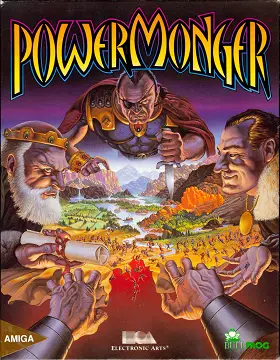
PowerMonger (1990) stands as an incredibly influential, fiercely ambitious, and historically criminally overlooked titan of the retro strategy landscape. Developed by the legendary minds at Bullfrog Productions (spearheaded by Peter Molyneux and Glenn Corpes) and published by Electronic Arts, the game served as the direct mechanical evolution of the studio’s seminal 1989 hit Populous.
While Populous gets all the credit for creating the “God Game” genre, PowerMonger did something arguably more radical: it arrived two full years before Dune II formalized the genre, operating as one of the earliest, truest real-time strategy (RTS) “country simulations” in PC history. By tossing out absolute deity control, it locked players into a gritty, deeply systemic simulation of military campaigning, resource economics, and logistical warfare.
The Narrative: The Mad Warlord’s Scale
The plot strips away holy omnipotence, dropping you straight into the mud as a deposed, ruthless feudal warlord. Forced out of your homelands, you are plopped onto a massive global map divided into up to 195 separate, interconnected regional territories.
Your goal is single-minded: systematically march from territory to territory, crush rival military houses, subjugate neutral towns, and forcefully tip the physical Scales of Power (represented by a literal set of balancing scales at the bottom of the UI) completely to your side to achieve total global domination.
The Engine: A Living, Breathing 3D Topography
For 1990, PowerMonger’s visual presentation was nothing short of wizardry. Corpes engineered a true 3D polygonal contoured terrain playing field. While characters, sheep, and trees remained flat 2D pixel sprites, the landscape itself possessed real vertical depth. Players could rotate the camera by 90-degree intervals, pan across valleys, and toggle through 8 distinct tiers of digital zoom to spy on enemy movements.
The Primitive Artificial Life System
The game is heavily celebrated for featuring a highly advanced, emergent “artificial life” engine that served as the foundational blueprint for Molyneux’s future obsessions (like Black & White).
- Autonomous Routines: Townspeople didn’t just stand around waiting for commands; they went about their daily lives entirely independently—chopping wood, shepherding sheep, farming wheat, making tools, and fishing in rivers based on seasonal cycles.
- The Query Feature: Players could select an interactive query magnifying tool and click on any individual sprite in the entire world to open a dossier detailing their name, age, vital health stats, hometown allegiance, current equipment, and dynamic loyalty rating.
- Macro Environmental Feedback: Actions explicitly altered the world map. If your army intensively deforested a woodland zone to manufacture weapons, the local weather patterns permanently mutated. This caused heavier rains or winter blizzards to drop in subsequent months, creating mud that realistically slowed down your army’s marching speed.
Gameplay Mechanics & The Command Matrix
Instead of dragging marquee boxes to select individual soldiers, PowerMonger utilized an icon-driven “bloc control” system. Your soldiers grouped dynamically around your main commander or recruited Captains, moving and executing orders via directional tracking lines.
Everything you ordered your army to do was dictating by a Trinity of Postures: Passive, Neutral, and Aggressive. Toggling your posture fundamentally mutated how your troops interacted with icons on the dash:
| Command Icon | Passive Posture Mode | Neutral Posture Mode | Aggressive Posture Mode |
| The Sword (Combat) | Spar with local forces or execute soft tactical skirmishes to minimize your own troop losses. | Standard engage; fight to break enemy formations with baseline losses. | Full Slaughter: Kill every living citizen, sheep, and defender in the town, turning it into a barren ghost town. |
| The Apple (Food) | Gently trade with locals or request small, voluntary donations of grain rations. | Demand baseline food taxes to feed your marching army. | Ransack Reserves: Complete plunder; strip the village of 100% of its food supplies, leaving the locals to starve. |
| The Flag (Recruiting) | Peacefully invite willing volunteers to join the militia. | Standard military draft of able-bodied local men. | Forced Conscription: Ruthlessly press-gang every man in the settlement into your ranks, tanking town loyalty. |
The “Homing Pigeon” Command Lag
As you conquered larger strongholds, neutral sub-commanders would join your cause. You could delegate troops to them, managing up to four separate armies concurrently across the map.
However, Bullfrog implemented a brilliant mechanical bottleneck: Command Lag. Your main army responded instantly because your avatar was physically there. But if you sent an order to a subordinate Captain on the other side of the mountain range, a tiny homing pigeon animation would flare up next to their portrait. The order would not be executed until the pigeon realistically flew across the map tiles to deliver the directive, forcing you to actively factor in communication time during multi-front wars.
Intelligent Auto-Equipment Allocation
Soldiers didn’t spawn with hardcoded class weapons. Instead, you ordered your army to Invent inside friendly towns. Depending on nearby natural resources (like wood or ore), your men would manufacture physical piles of gear on the ground.
When you ordered your army to equip themselves, the AI handled distribution automatically based on a strict efficiency hierarchy: soldiers would pick up Bows first, then Swords, and finally Pikes, with any surplus high-tier equipment like Catapults being physically carried by the Captain.
PowerMonger: World War I Edition (1991/1992 Expansion)
Due to the game’s massive commercial success, Bullfrog rolled out an incredibly bold, high-concept standalone data disk expansion pack that completely subverted the game’s medieval aesthetic:
[Medieval Fantasy Base Map] -> [WW1 Expansion Transformation] -> [1914 Total War Scenario]
The expansion pack introduced 175 brand new territories mapped directly across a stylized layout of Europe in 1914. While the core underlying system logic remained identical, the visual assets underwent a total aesthetic overhaul:
- Your feudal knights and officers now wore historical World War I military uniforms.
- Environmental sheep sprites were completely transformed into wild deer.
- The weapon crafting matrix was completely modernized: Swords became Rifles, Bows became long-range trench artillery, and slow-moving Catapults mutated into armored Tanks and flying Bi-planes that cruised across the 3D topography grid.
Release History & Platform Lifecycles
- Amiga / Atari ST (Original Launch): October 1990
- MS-DOS Port: 1992 (Featuring optimized, higher-speed 256-color VGA engine visuals)
- Sega Genesis / Super Nintendo (SNES): 1991–1993 (Highly commendable console ports that successfully mapped complex mouse logistics to console gamepads, with the SNES version natively supporting the SNES Mouse accessory)
- Sega CD Port: 1994 (Bundled in exclusive cinematic FMV live-action lore cutscenes)
- Modern Status: Unlike Populous or Syndicate, PowerMonger is currently in digital distribution limbo and is not available on Steam or GOG due to complex legacy licensing knotting. It remains beautifully preserved via the retro abandonware and Amiga/DOS emulation scene (such as DOSBox and WinUAE), cementing its legacy as a true, foundational stepping stone toward the modern real-time strategy landscape.