Populous
 Amiga,
  PC,
PC,  Sega Genesis,
  SNES
SNES
 Electronic Arts
Where to buy

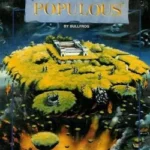
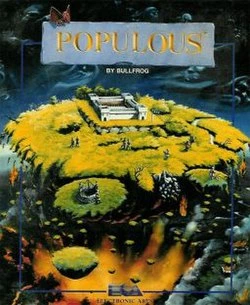
Populous (1989) isn’t just a strategy game; it’s the genesis of an entire genre. Developed by Bullfrog Productions and designed by the legendary, eccentric Peter Molyneux, this title officially introduced the world to the “God Game.” Instead of commanding squads of tanks or clicking on individual workers, Populous positions you as an omnipotent deity looking down on a grid-based, isometric world. Your goal is simple: cultivate your flock of faithful followers, grow your divine power, and utterly erase the rival god and their heretical believers from the face of the earth.
The Sandbox of Divinity: Terraforming for Life
The mechanical genius of Populous lies in its indirect control. You cannot tell your followers (called “Walkers”) where to go or what to build; they wander the landscape driven by their own basic AI. You influence them by altering the world itself.
- The Flat Earth Society: Walkers need flat land to settle down. If a follower encounters a rugged, hilly terrain, they can only build a flimsy, low-capacity tent. By spending your divine power to raise or lower the terrain, you create pristine, flat plains.
- The Breeding Loop: Once the land is flat, those tents automatically upgrade into sturdy log cabins, large houses, and eventually massive castles. Bigger buildings allow your followers to breed exponentially faster.
- The Mana Economy: Population is your currency. Your divine power (Mana) is generated directly by the collective faith and numbers of your civilization. To get more power to unleash miracles, you must act as a celestial real-estate developer, flattening out the earth so your people can multiply.
Divine Intervention: Miracles and Disasters
Once your civilization is thriving and your Mana pool is overflowing, you can stop landscaping and start smiting. Populous gives you an apocalyptic toolkit to sabotage the rival deity’s territory:
- Swamps: Place a patch of deadly bog directly in the path of enemy expansion. Any unit that steps into it is instantly swallowed up and killed.
- Earthquakes: Violently jolt the landscape, turning the enemy’s flat, highly developed metropolitan sectors into jagged, useless cliffs, destroying their economy in seconds.
- Volcanoes: The ultimate territorial denial tool. Spawns a massive mountain of rock and lava right in the center of an enemy city, completely ruining the elevation of the surrounding land.
- Floods: Raise the global water table, instantly drowning any settlements built too close to sea level.
The Papal Magnet and Armageddon
To guide your chaotic flock toward a definitive victory, the game introduces macro-level structural commands:
- The Leader (The Hero): By placing your divine marker (the Papal Magnet) over your most powerful settlement, you can combine your followers into a single, super-powered Leader. This champion marches across the map, automatically converting enemy followers or burning their houses to the ground.
- The Armageddon Button: When you grow tired of the slow-burn war of attrition, you can press the literal Armageddon button. This triggers a global event where all normal building ceases, the terrain locks, and every single surviving follower on the map gathers in the center for a massive, chaotic, battle-royale style clash to the death. Whichever god has the last follower standing wins the match.
Summary
Populous was a staggering technical and conceptual triumph for 1989. It took the gaming industry—which was used to rigid, linear platformers and text adventures—and handed it a living, breathing ecosystem. It proved that sometimes the most satisfying way to play a strategy game isn’t to micro-manage an army, but to gently shape the earth and watch the chaos unfold.
Release Platforms
- Amiga / Atari ST: 1989 (The legendary original versions)
- MS-DOS (PC): June 5, 1989
- Sega Genesis / Super Nintendo (SNES): 1990–1991 (Hugely successful console ports that proved the god-game UI could work on a gamepad)
- Modern Availability: Natively bundled today as part of retro packages on digital storefronts like GOG.