Populous DS
 60
★ /10
60
★ /10
 Nintendo DS
 Electronic Arts, Rising Star Games, Xseed Games
Populous DS (2008) is a fascinating portable reimagining that brought the foundational god-game franchise directly to the dual-screen era. Developed by Japanese studio Genki and published by Xseed Games and Electronic Arts, it serves as a hybrid remake. It pairs the core simulation engine of the 1989 original with the elementally themed deity system of Populous II, repackaging everything with a unique handheld flair.
What makes Populous DS particularly notable is how its core gameplay felt like a prophetic match for the console’s physical design, proving that terraforming a digital earth is infinitely more satisfying with a plastic stylus than a 1980s mouse.
Handheld Divinity: The Touchscreen Workspace
The dual-screen layout of the Nintendo DS solved the clunky UI navigation problems that had plagued classic console ports of the genre for years:
- The Division of Labor: The active gameplay, terraforming grid, and micro-management took place entirely on the bottom touch screen. Meanwhile, the top screen acted as your macro-display, showcasing your overall territory layout and the status of your global population.
- Tactile Terraforming: Players used the stylus to dynamically raise and lower the tile-based land. Tapping and dragging across the screen allowed you to rapidly iron out rugged terrain so your mindless little followers (called “peeps”) could automatically settle down and build increasingly advanced structures.
- Quality-of-Life Taps: Old-school macros—such as the “sprog” command (tapping on a house to manually force a citizen out to colonize a new sector)—were converted into simple, instantaneous stylus gestures.
The Five Elemental Pantheon
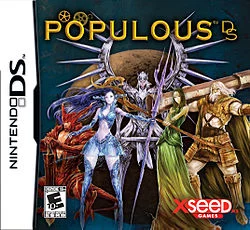
Instead of playing as a single, generic faceless entity, Populous DS split the game’s tactical sandbox across five distinct, elementally imbued gods, each locked in a holy war against a corresponding demonic rival:
- Earth God: The foundational defensive archetype, focusing on terrain stability and crater-punching Meteorite strikes.
- Water God: Commands the coastal lines, utilizing localized floods and a highly formidable, sweeping Typhoon miracle.
- Fire God: Pure asymmetric aggression, specialized in burning down enemy economic zones via columns of flame and lava-spitting Volcanoes.
- Wind God: High-mobility manipulation, calling upon lightning bolts and blinding Whirlwinds to scramble enemy troop formations.
- Harvest Goddess: A unique economic-forward deity who accelerates follower reproduction cycles, but must defend against a specialized Mushroom blight that spreads dynamically across the map.
Whimsical Biomes and the Easter Egg World
While the core strategy loop remained identical across stages—spawn villagers, flatten land for Mana, unleash a natural disaster, and trigger the game-ending Armageddon battle-royale—the game injected variety through its biome reskins:
- Climate conditions altered behavior; certain harsh environments caused your followers to die more quickly, while fairytale worlds boosted their Mana generation at the cost of fragile health bars.
- In a brilliant nod to corporate synergy, the game features an unlockable Nintendo-themed World. In this secret biome, your worshippers abandon traditional log cabins and instead erect structures explicitly modeled after retro and modern Nintendo hardware, spanning from the Famicom (NES) to the Wii.
The Strategy Critique
Despite the brilliance of its touchscreen translation, Populous DS received a mixed critical reception (holding a 60% on Metacritic).
While retro purists praised the responsive layout, modern reviewers noted that the 1989 core AI framework felt primitive by 2008 standards. The enemy AI was notoriously aggressive, instantly repairing terraformed damage before your miracles could even finish rendering. Furthermore, the game had a frustrating habit of interrupting high-speed matches with unskippable, pre-rendered CGI cutscenes every single time you cast a disaster, which killed the tactical pacing of its short, bite-sized matches.
Summary
Populous DS stands out as a clever, compact tribute to Peter Molyneux’s legacy. It didn’t push the genre forward, but it successfully proved that the “God Game” blueprint found its spiritual home on a touch screen. For strategy fans on the go, it provided a satisfying, portable sandbox of pocket-sized apocalypses.
Release Details
- Japan: February 21, 2008 (Published by Electronic Arts)
- North America: November 11, 2008 (Published by Xseed Games)
- Europe: February 27, 2009 (Published by Rising Star Games)