Empires: Dawn of the Modern World
 81
★ /10
81
★ /10
 PC
PC Activision
Where to buy

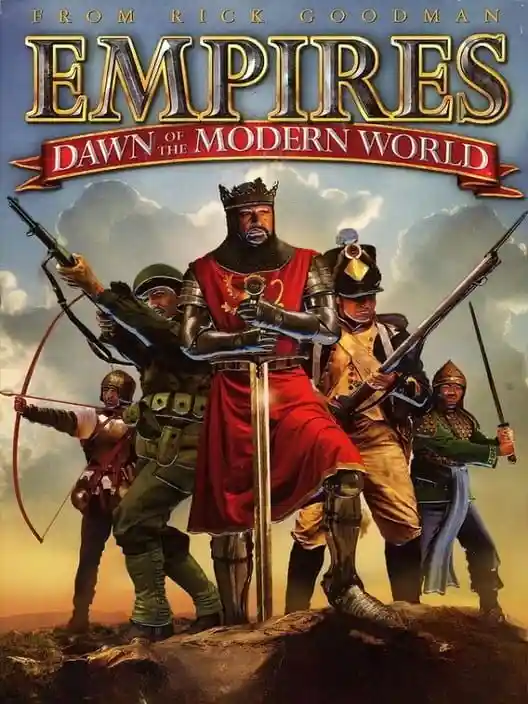
Empires: Dawn of the Modern World (2003) is a real-time strategy cult classic that represents the structural refinement of the “mega-timeline” RTS subgenre. Developed by Stainless Steel Studios—led by Rick Goodman, the legendary co-designer of Age of Empires and Empire Earth—the game was pitched as a direct answer to the players who loved history-spanning warfare but were tired of the mechanical bloat and identical-feeling factions of the era.
Quality Over Quantity: The Condensed Timeline
The studio’s previous hit, Empire Earth, famously let players fight across a staggering 14 distinct epochs (from grunting cavemen to laser-wielding robots). However, user feedback revealed that players found many middle ages to feel like filler.
In response, Empires compressed the timeline down to 1,000 years of human conflict, divided into five highly distinct eras:
- The Medieval Age (950 AD – 1300 AD)
- The Gunpowder Age (1300 AD – 1600 AD)
- The Imperial Age (1600 AD – 1900 AD)
- World War I (1914 AD – 1935 AD)
- World War II (1935 AD – 1945 AD)
By narrowing the scope, the developers ensured that stepping into a new era felt like a massive, game-changing paradigm shift rather than just a cosmetic upgrade.
Truly Asymmetric Civilizations & The “Evolution” Loop
Instead of featuring dozens of nations that were essentially mirror matches with different color palettes, Empires offered nine nations built with completely unique architectures, resource mechanics, and strategies.
The game handles this asymmetry through an innovative split-timeline evolution system:
- The Pre-Modern Eras (Medieval to Imperial): Players start by choosing from four sprawling empires:
- England: Highly automated. Their resource drop-off points automatically generate small stashes of wealth over time, making them excellent for beginner logistics.
- The Franks: Heavy cavalry powerhouses with robust defensive fortifications.
- China: A completely nomadic culture. Their barracks and town centers are mobile caravans, allowing players to lift up their entire economy and pack across the map.
- Korea: Highly technical, relying on specialized martial arts units and devastating early naval power.
- The Modern Eras (World War I & II): Upon advancing past the Imperial Age, players must permanently mutate their pre-modern faction into one of five specialized modern military powers: The United States, United Kingdom, Russia, Germany, or France. For example, a player starting as the pre-modern Franks can choose to transition into modern Germany (focusing on raw armor blitzes) or modern France (focusing on chemical warfare and guerrilla tactics).
Biographical Campaigns
The single-player component moves away from generic map domination to focus on three tightly scripted, story-driven campaigns following real-world historical legends:
- Richard the Lionheart: Tracks the medieval power struggles and military rebellions of the English crown.
- Admiral Yi Sun-sin: Centers on the Imjin War, tasking players with deploying legendary, heavily fortified Korean Turtle Ships to repel massive Japanese naval blockades.
- General George S. Patton: A fast-paced, combined-arms World War II campaign charting the Allied push from North Africa to the beaches of Normandy.
Action vs. Empire Builder Modes
To appeal to different RTS crowds, matches could be configured into two entirely different sub-genres:
- Action Mode: Features rapid resource gathering, faster unit movement speeds, and a smaller economic footprint, catering to players who prefer lightning-fast tactical micro-management and quick rush strategies.
- Empire Builder Mode: Expands the construction sandbox with larger population limits, slower resource extraction, and tougher defensive fortifications, allowing macro-oriented players to safely “turtle” and cultivate a massive metropolis.
Summary & Modern Availability
Empires: Dawn of the Modern World remains a masterclass in how to build a history-spanning RTS without sacrificing faction identity. It successfully paired the grandiose macro-economy of traditional city-builders with the visceral thrill of watching a line of medieval archers get abruptly modernized by a rogue squad of World War II King Tiger tanks.
Release Platforms
- Microsoft Windows (PC): October 21, 2003 (Original)
- Digital Re-release (GOG): Currently available as a DRM-free classic, fully updated and optimized to natively scale on modern systems.