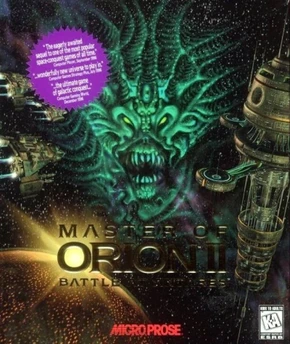
Master of Orion II: Battle at Antares
 84
★ /10
84
★ /10
 PC
PC

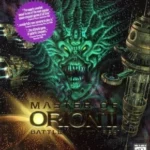
Master of Orion II: Battle at Antares (commonly abbreviated as MoO2) is a turn-based science-fiction strategy 4X video game developed by SimTex and published by MicroProse. Released on November 22, 1996, for Microsoft Windows and MS-DOS, with a Macintosh port following in 1997, it is widely regarded by strategy critics as the definitive masterpiece of space-based grand strategy.
Designed by Steve Barcia and Kenneth Burd, Master of Orion II significantly evolved the mechanical foundation of its 1993 predecessor. While the original game leaned heavily on abstract, high-level economic sliders, the sequel shifted its structural layout to mirror the granular citizen-management style of Sid Meier’s Civilization, adding deeper resource management, fully interactive tactical space battles, localized system leaders, and a hostile extra-dimensional threat.
Technical Specifications
- Developer: SimTex
- Publisher: MicroProse (Mac OS port: MacSoft)
- Lead Designers: Steve Barcia, Kenneth Burd
- Composer: Laura Barratt
- Engine: Proprietary 2D Isometric Engine
- Platform(s): MS-DOS, Microsoft Windows, Mac OS
- Release Date: November 22, 1996
- Genre(s): Turn-based strategy, 4X Space Grand Strategy
- Mode(s): Single-player, Multiplayer
The Point-Buy Race Customization System
While Master of Orion II retains the core roster of iconic alien factions from the first game (such as the intellectual Psilons, crystalline Silicoids, and aggressive feline Mrrshans), it completely revolutionized the setup phase by introducing a highly robust Custom Race Point-Buy System.
Players receive a fixed pool of 10 “Picks” (points) to manually engineer their own cosmic species. Stacking powerful asymmetric attributes costs points, while inheriting severe biological or societal penalties refunds points back into your building pool:
- Creative (-8 Picks): The most sought-after economic attribute. When a creative species researches a node on the technology web, they instantly unlock all technologies nesting within that level simultaneously, completely breaking the game’s standard research limitations.
- Subterranean (-6 Picks): Dramatically multiplies the maximum population capacity of all colonized planets, permitting highly dense, industrial worker populations on otherwise small worlds.
- Telepathic (-6 Picks): Allows your space fleets to instantly brainwash and capture enemy planets upon winning orbital battles, entirely bypassing the need to manufacture ground troop transports, while granting a massive boost to espionage defense.
- Feudal (+4 Picks) & Uncreative (+4 Picks): Harsh societal detriments used to harvest points. Uncreative species cannot choose their own research paths, leaving scientific discoveries entirely up to a randomized computer algorithm, while Feudal societies suffer a steep penalty to domestic science output allocations.
Core Gameplay Implementations
The game engine handles planetary growth and interstellar warfare through a series of interlocking, highly tactical loops:
1. Granular Citizen Management & Food Freighters
Planets discard basic sliders in favor of explicit population units assigned directly to one of three roles: Farming (producing food to sustain life), Industry (generating hammers for building queues), and Science (powering technology research).
Unlike the first game, population counts are restricted by strict agricultural realities. Empires must farm sufficient crops to prevent mass starvation. To sustain deep space mining operations on dead, volcanic worlds, players construct Freighter Fleets to actively ship surplus food from lush, agricultural breadbasket planets across coordinate sectors.
2. The Branching Tech Bottleneck
The research matrix features a strict choice bottleneck. Scientific progress is segmented into broad fields (such as Computers, Power, Chemistry, and Sociology) containing stacked research levels.
For standard civilizations, reaching a level forces a critical decision: you may select only one specific technology to actively discover from a pool of two or three options, while the unchosen blueprints are permanently locked away for the remainder of the match. To acquire the lost technologies, players must run high-risk intelligence networks to steal blueprints using Spies, or capture enemy vessels in combat to manually reverse-engineer their components via scrap salvaging.
3. Deep Tactical Space Combat
When space fleets clash, the engine transitions away from automated mathematical resolutions, launching a fully interactive, turn-based Tactical Combat Grid.
Players custom-design their vessels in the workshop using modular hulls (from tiny Scouts to massive Doom Stars), assigning specific firing arcs to weapon systems and managing complex shield facings.
During a tactical engagement, players manually route individual ships across hexes to exploit gaps in an enemy’s shield boundaries. Ships track advanced properties—including weapon turn radii, electronic countermeasure scrambling, and the ability to launch marine boarding shuttles to forcefully hijack and capture an opponent’s flagship mid-battle.
4. Galactic Leaders and Heroes
Throughout a match, legendary historical mercenaries, space captains, and political bureaucrats will approach your empire to offer their services in exchange for gold salaries.
Leaders are split between Officers (who physically attach onto active spaceships to vastly multiply combat accuracy, shield recovery times, or fleet movement speed) and Governors (who sit inside planetary star systems to permanently optimize tax revenues, lower industrial pollution, or boost localized agricultural yields).
The Antaran Threat & Paths to Victory
The subtitle of the game references its core narrative antagonist: The Antarans, an ancient, hyper-technological warrior species that was forcefully banished into an extra-dimensional pocket universe by the original masters of the galaxy eons ago.
The Antarans are a non-playable, intensely aggressive computer entity. Periodically, a dimensional rift will rip open across random coordinates, dispatching heavily shielded Antaran war fleets to violently raid human and AI colonies, glassing city infrastructure before slipping back into the void.
This extra-dimensional threat completely reshapes endgame parameters, forcing players to choose from three distinct paths to win the match:
- The Supreme Council Election: Achieving a peaceful diplomatic victory by securing a decisive two-thirds majority vote in the Galactic High Council, relying on high-yield trade relationships and alliances with foreign leaders.
- Total Galactic Military Conquest: The absolute eradication or subjugation of every single rival sovereign species active across the star map.
- The Inter-Dimensional Counter-Strike: Constructing a massive, high-energy Dimensional Portal wonder. This allows a player to march their elite space fleets straight out of the galaxy and directly into the Antaran pocket universe, launching a high-stakes siege against the Antaran homeworld to permanently wipe out the threat and claim supreme galactic victory.
Modern Preservation & The 1.50 Fan Patch (2026 Status)
As of May 2026, Master of Orion II is widely celebrated by strategy historians as the golden standard against which all modern space-based 4X games (such as Stellaris and Galactic Civilizations) are continuously measured. The title remains fully active, stable, and highly played under contemporary computer environments.
The game is natively distributed across mainstream digital storefronts—including Steam and GOG.com—under the compilation title Master of Orion 1 + 2 for a baseline price of $5.99. The digital package comes pre-wrapped inside an optimized, modern configuration of the DOSBox emulation container, executing out-of-the-box under modern 64-bit multi-core Windows 11 and current macOS platforms.
The game’s enduring performance in 2026 is heavily driven by the open-source community’s preservation work, most notably the continuous development of the Fan Patch 1.50 Framework. Operating in its definitive, highly polished 2026 iteration, the 1.50 patch seamlessly layers over original Steam and GOG directories as a non-destructive add-on.
The utility completely resolves over a dozen legacy system-crash bugs, cleans up multi-user network latency errors for active online multiplayer sessions, and optimizes the computer’s artificial intelligence scripting to be fiercely competitive.
Furthermore, it integrates essential modern quality-of-life additions—such as a dedicated global “Wait” hotkey to streamline massive end-game fleet actions with minimal clicking—allowing the brilliant tactical combat, Point-Buy custom races, and deep inter-dimensional warfare of MoO2 to render flawlessly on contemporary high-resolution widescreen displays.