 PC
PC


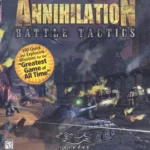
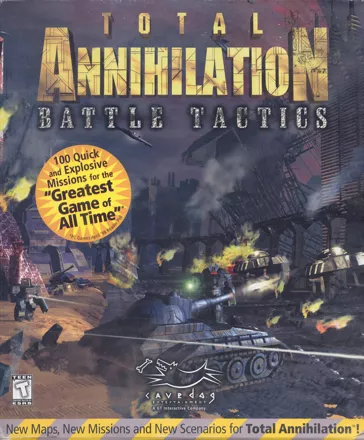
Total Annihilation: Battle Tactics is a real-time strategy (RTS) video game expansion pack developed by Cavedog Entertainment and published by GT Interactive. Released on June 30, 1998, for Microsoft Windows, it serves as the second official expansion pack to the critically acclaimed 1997 title Total Annihilation.
Unlike its predecessor, The Core Contingency, which expanded the baseline macro-economy and long-form narrative, Battle Tactics was designed under producer Kellyn Beck and designer Richard W. Smith without the involvement of series creator Chris Taylor, who had departed the studio. The expansion introduces 100 new single-player missions, four specialized tactical units, six multiplayer maps, and an experimental design approach that intentionally pivots the gameplay focus away from macroeconomic infrastructure building toward micro-intensive tactical combat management.
Technical Specifications
| Attribute | Details |
| Developer | Cavedog Entertainment |
| Publisher | GT Interactive |
| Producer | Kellyn Beck |
| Designer | Richard W. Smith |
| Engine | Total Annihilation Engine (True 3D terrain physics) |
| Platform | Microsoft Windows |
| Release Date | June 30, 1998 |
| Genre | Real-time strategy |
| Modes | Single-player, Multiplayer |
Gameplay Shift: The Tactical Pivot
The baseline design philosophy of the Total Annihilation series heavily prioritized a “streaming economy,” requiring players to actively balance real-time energy grids, metal collection rates, and manufacturing queues to avoid economic stalling (nanostalling). Early missions traditionally began with a single Commander unit and isolated resources, forcing players to methodically establish a fortified military base.
Battle Tactics intentionally subverted this convention by downplaying base construction and logistics lines.
Micro-Intensive Combat Rules
In a significant portion of the expansion’s scenarios, players spawn onto the map with a pre-assembled, unalterable block of combat units and are completely locked out of building factories, gathering raw materials, or deploying a Commander. Victory conditions shift entirely to utilizing the exact units provided to defeat entrenched hostile forces. This design tests the player’s capacity for real-time squad positioning, targeted flanking maneuvers, and direct micro-management under intense battlefield stress, effectively adapting the engine into a tactical puzzle game.
Campaign Structure and Environments
The expansion contains 100 single-player missions, divided symmetrically into 50 operations apiece for the Arm and Core factions. To cater to different player experiences and playtimes, the missions are structured across four non-linear campaign lengths:
- Very Short: Quick, puzzle-like scenarios composed of limited unit skirmishes designed to teach fundamental tactical positioning, fire focus, and cover exploitation.
- Short / Medium: Multi-front combat scenarios introducing minor reinforcement scripts and localized logistical choke points.
- Long: Sprawling, long-form battles featuring larger unit caps, hidden enemy ambushes, and complex defense scenarios across vast sectors.
Architectural Terrain and Visual Elements
Battle Tactics marked the first time in the franchise’s single-player history that campaign missions actively featured exotic map tilesets originally introduced in The Core Contingency:
- Crystal Worlds: Shimmering, neon-colored alien landscapes featuring fragile, highly volatile crystal formations that can be physically smashed to trigger area-of-effect explosions.
- Acid Worlds: Corrosion-heavy environments where acidic oceans inflict continuous structural damage onto any amphibious ground unit or naval vessel attempting a water crossing.
Unit Roster Additions
To complement the micro-tactical pacing of the scenarios, the expansion introduced four specialized combat units, engineered to manipulate battlefield control without relying on high metal expenditures:
| Faction | Unit Name | Classification | Primary Tactical Utility & Ability |
| Arm | Flea | Stealth Scout Kbot | An ultra-cheap, micro-sized bipedal scout bot possessing exceptional speed and low radar signatures, used for rapid map clearing and drawing enemy fire. |
| Arm | Stunner | Tactical EMP Missile Launcher | A mobile missile system that fires specialized electro-magnetic pulses designed to temporarily paralyze heavy enemy armor lines without destroying them. |
| Core | Roach | Crawling Thermonuclear Bomb | An automated, low-profile suicide kamikaze Kbot designed to slip beneath defensive laser turrets and detonate violently to clear fortified positions. |
| Core | Scarab | Tactical EMP Missile Launcher | The Core’s structural equivalent to the Stunner, firing high-impact EMP payloads to freeze Arm commander units and advanced mechanical blocks. |
Reception and Legacy
Total Annihilation: Battle Tactics received mixed to positive reviews upon launch, tracking lower than both the original game and The Core Contingency expansion. Aggregator GameRankings listed a composite score of 64/100, while GameSpot awarded the title a 6.9/10.
Critics were highly polarized by the removal of the streaming economy and base construction mechanics, arguing that eliminating the franchise’s unique approach to macroeconomics compromised what made Total Annihilation innovative. Reviewers also noted that the absence of series mastermind Chris Taylor resulted in uneven mission balancing; some scenarios labeled as “Easy” presented intense difficulty, while specific “Hard” encounters could be easily exploited by novice players. Conversely, some segments of the community welcomed the title as an experimental, fast-paced tactical diversion that prioritized pure combat action over base-building management.
Modern Digital Standard (2026)
As of 2026, Battle Tactics is natively preserved as a core component of the Total Annihilation: Commander Pack distributed digitally on Steam and GOG.com.
While running the vanilla 1998 executable on contemporary multi-core architectures triggers game-speed acceleration bugs and pathfinding anomalies, modern strategy purists use the community-maintained Unofficial Patch v3.9.02. This update resolves the DirectDraw rendering pipeline bugs under Windows 10 and Windows 11, enabling the expansion’s 100 tactical missions to scale into native 1080p, 1440p, and 4K widescreen monitor formats with flawless stability.