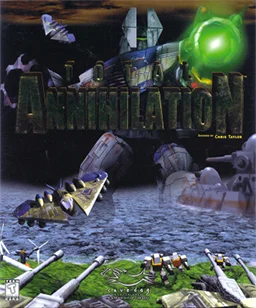
Total Annihilation
 86
★ /10
86
★ /10
 PC
PC


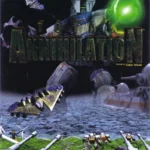
Total Annihilation is a 1997 real-time strategy (RTS) game developed by Cavedog Entertainment and published by GT Interactive. Designed by Chris Taylor, the game is widely considered one of the most groundbreaking and influential titles in the history of the RTS genre. Releasing just months before Blizzard’s StarCraft, Total Annihilation completely revolutionized strategy gaming by introducing true 3D physics, massive army scales, and a fundamentally different approach to resource management.
The narrative is set in the far future, detailing a catastrophic, 4,000-year galactic war between two massive factions: the Core and the Arm. The Core is a machine-based empire that mandated “patterning”—the process of transferring organic consciousness into immortal machines. The Arm is a rebel faction composed of humans who refused to give up their organic bodies, utilizing heavily armored mech-suits to fight back. The war has ravaged the galaxy to the point of total ruin, and the game begins as both factions launch their final, desperate offensives to completely annihilate the other.
Gameplay
While Total Annihilation looks like a traditional isometric RTS, its underlying engine was revolutionary. It calculated a true 3D environment where physics heavily dictated combat.
Key gameplay mechanics include:
- The Commander: Every match begins with a single, massive, heavily armored mech called the Commander. It is your most important unit—it builds your initial base, gathers resources quickly, and packs a devastating laser. However, if the Commander is destroyed, it unleashes a massive nuclear explosion, and in most game modes, its death results in an instant “Game Over.”
- Streaming Economy: Unlike other games where peons drop discrete chunks of gold into a town hall, Total Annihilation uses a “streaming” economy of Energy and Metal. Resources flow continuously into your storage and are drained continuously as you build. If your production rate outpaces your gathering rate, your construction speed simply slows down, allowing for massive, simultaneous build queues without needing the exact cost upfront.
- True 3D Physics and Terrain: Projectiles in the game have actual physics, trajectories, and arcs. A tank firing from the top of a hill has a longer range and a clearer line of sight than one at the bottom. Artillery shells can miss their targets and accidentally hit a cliff face, and explosions cast shockwaves that can push units around.
- Battlefield Reclamation: When units are destroyed, they leave behind burnt-out wreckage. This wreckage actually blocks line-of-sight and pathfinding, creating dynamic chokepoints. More importantly, construction units can reclaim the metal from this wreckage to fuel your war machine.
- Massive Scale: The game was famous for its sheer scale. While contemporary games capped armies at 100 or 200 units, Total Annihilation allowed players to command hundreds (and eventually thousands, via patches) of tanks, aircraft, submarines, and towering artillery pieces simultaneously.
- Radar and Sonar: Because maps were so massive, sightlines were limited. Players had to build radar towers and sonar stations to track enemy movements represented by red dots on the minimap, adding an element of electronic warfare and intelligence gathering.
Development and Legacy
Development of Total Annihilation was led by Chris Taylor, who wanted to build an RTS that broke away from the traditional, flat-board style of Command & Conquer and Warcraft. By utilizing 3D models for units and rendering a topological map, Cavedog created a game that felt tangibly real.
Another massive innovation was the game’s soundtrack. Composed by Jeremy Soule (who would later become legendary for scoring The Elder Scrolls V: Skyrim), Total Annihilation was the first RTS to feature a fully orchestral score, which dynamically shifted in intensity based on the amount of action happening on screen.
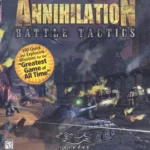
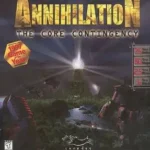
Upon its release in September 1997, Total Annihilation swept the gaming industry, winning numerous Game of the Year awards and beating out massive competitors. Cavedog supported the game exceptionally well, releasing free weekly units for download and launching two massive expansion packs: The Core Contingency (1998) and Battle Tactics (1998).
While Cavedog Entertainment tragically went bankrupt a few years later, Total Annihilation left an immortal legacy. Its highly accessible engine sparked one of the most prolific modding communities in PC gaming history. Furthermore, its core design philosophy directly birthed an entire sub-genre of massive-scale strategy games, leading to highly acclaimed spiritual successors like Chris Taylor’s own Supreme Commander (2007), Planetary Annihilation (2014), and the open-source modern juggernaut Beyond All Reason (BAR).
Key Features:
- The Streaming Economy — Master a brilliant, continuous resource system based on Metal and Energy production to fuel infinite war machines.
- Protect the Commander — Utilize the ultimate battlefield unit to build your base, while desperately defending it from enemy assassinations.
- Physics-Based Artillery — Take advantage of true 3D terrain, calculating firing arcs and line-of-sight to rain destruction over mountain ranges.
- Unprecedented Scale — Command navies, air forces, and mechanized armies numbering in the hundreds on massive terrestrial and oceanic battlefields.
- An Orchestral Masterpiece — Wage war to the sweeping, dynamic classical score composed by industry legend Jeremy Soule.
Release Platforms:
- Microsoft Windows (PC) — September 25, 1997
- Mac OS — 1998
- (Currently available as the “Commander Pack” via Steam and GOG.com, which includes both expansions)