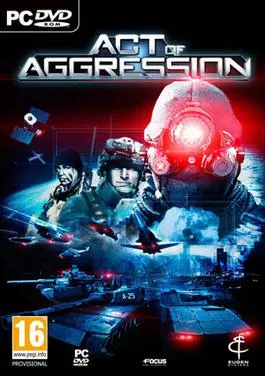
Act of Aggression
 71
★ /10
71
★ /10
 PC
PC Eugen Systems
 Focus Home Interactive
Where to buy

Act of Aggression (2015) stands as one of the most critical turning points in the history of the legendary real-time strategy and techno-thriller genre. Following the exhausting market fatigue of hyper-fast, micro-intensive multiplayer online battle arenas (MOBAs) and the subsequent stagnation of the classic military base-building formula, the future of the traditional RTS was highly uncertain.
Parisian developer Eugen Systems—renowned for their deep tactical mastery over the Wargame franchise—stepped in, boldly aimed to resurrect the “90s golden age of real-time strategy,” and focused development duties on a direct, heavy-macro spiritual successor to their 2005 classic, Act of War. Faced with the intense task of recapturing a deeply passionate community pining for the glory days of Command & Conquer: Generals, Eugen delivered a stellar, redemptive chapter that bridged nostalgic base cultivation with modern technological leaps.
The Grand Reset: A Techno-Thriller Universe
Act of Aggression completely severed ties with historical or sci-fi battlefields. Instead, it established a completely fresh, tightly constructed techno-thriller lore continuity: The Post-Crash World of 2025.
The game’s geopolitical landscapes, industrial operations, and military alignments are strictly governed by the fallout of the “Shanghai Crash”—a cataclysmic global economic collapse engineered by a shadowy cabal of corporate and private interests. The massive multi-faction campaigns play out like an interconnected political thriller, tracking a three-front ideological war between the conventional might of the US Armed Forces, the UN-backed covert multi-national task force known as Chimera, and the Cartel—the hyper-advanced private military corporate syndicate using state-of-the-art prototype weapon systems to completely destabilize and annex vulnerable global sovereign territories.
The Core Evolution: High-Macro Supply Chains & Human Capital
Eugen Systems deliberately looked back at classic base building anchors as their mechanical framework, discarding automated off-map unit summons and non-interactive economies. However, they heavily evolved the engine:
- The Leap to Triple-Resource Extraction: The base economy rejected simple single-currency designs. The game introduced a complex, localized physical harvesting matrix. Bases rely on expanding automated refinery networks to extract three independent materials directly from geographic deposits across the map grid: Oil (fuels basic unit assembly), Aluminum (required for mid-tier military structures), and Rare Earth Elements (the strict gatekeeper currency needed to buy endgame tech modules and experimental hardware).
- The Prisoner of War (POW) Capital Loop: Combat fields completely abandoned simple death tallies. Wounded infantry, ejecting pilots, and defeated crews do not vanish from the simulation; they become interactive assets on the ground. Players deploy dedicated transport infantry or combat medics to physically capture incapacitated enemy combatants, hauling them back to base stockades or capturing ambient map Banks to generate a persistent stream of bonus cash.
- The Physical Supply Line Constraint: Resource collection requires active spatial defense. Extracted ore and fuel do not instantly teleport to your global bank; they are physically loaded onto vulnerable, autonomous cargo trucks that must travel back along roads to your central warehouses, transforming economic logistics into primary targets for early-game harassment.
The Deep Meta: Faction Triad & Specialized Technology
To maximize tactical depth, Act of Aggression engineered extreme faction asymmetry across its technology grids:
- The US Army (Conventional Firepower & Veterancy): The traditional military absolute. They rely on proven real-world military hardware, deploying Strykers, M1A2 Abrams battle tanks, and Apache helicopters. Their unique mechanical trait centers around individual unit veterancy levels; surviving frontline squads gain massive, permanent stat boosts and weapon alterations, transforming veterans into ultimate blockades.
- Chimera (The UN Versatility Spearhead): A highly adaptable task force utilizing tailored tech modifications. Chimera structures and units can be individually upgraded mid-combat to fit shifting operational needs—allowing their multi-purpose vehicles to swap seamlessly between anti-air missile arrays or heavy anti-armor kinetic cannons on the fly.
- The Cartel (Subversive Stealth & Prototypes): A shadowy corporate syndicate leveraging hyper-advanced optical camouflage and experimental prototype weapons. They trade physical armor plating for visual cloaking fields, utilizing stealth helicopters, remote drone arrays, and energy weapon platforms to execute rapid, high-damage ambush strikes.
The Bifurcated Legacy: Original vs. Reboot Edition
In response to community feedback regarding the steep learning curve of the initial launch mechanics, Eugen Systems executed a massive structural pivot in 2016 by launching Act of Aggression – Reboot Edition. Rather than overwriting the base experience, the game was permanently bifurcated, giving players access to two completely different mechanical versions within a single client:
| Game Mechanic | Original Edition (2015 Layout) | Reboot Edition (2016 Overhaul Layout) |
| Economic Currency | Three-Tier Resource Matrix: Requires independent extraction of Oil, Aluminum, and Rare Earth Elements. | Streamlined Single-Resource: Merges basic operational costs into a single unified credit resource economy. |
| Base Expansion | Automated Supply Nodes: Base infrastructure scales via un-crewed macro-placement fields. | Playable Builder Units: Reverts to a classic RTS style where visible construction vehicles must drive to coordinates to erect buildings. |
| Logistics Infrastructure | Physical Cargo Carriers: Harvested resources must be physically transported by trucks along map roads to warehouses. | Instant Processing: Eliminates physical cargo trucks, allowing refineries to instantly credit resources to the player. |
| Aviation Mechanics | Strategic Airfields: Aircraft operate from dedicated off-map airstrips and execute targeted run maneuvers. | Direct Tactical Control: Air units can be directly controlled, ordered to hover, and managed like standard ground combat vehicles. |
The Modern Standard: The Complete Collection Meta
While its competitive esports landscape settled into a dedicated niche, Act of Aggression experiences a highly respected preservation and single-player/skirmish renaissance today. Fully packaged natively on modern storefronts as the definitive Reboot Edition, both execution shells are fully maintained and selectable at launch.
The modern standard completely reconstructs the engine stability. Operating on a robust 64-bit architecture, the game natively sidesteps the color-palette corruption and memory leak issues that cripple older modern-tactical RTS alternatives. Contemporary strategy communities leverage the client’s built-in, highly detailed texture scaling and widescreen rendering to lock matches into crisp 1440p and 4K display monitors under Windows 10 and Windows 11. This allows players to watch thousands of infantry squads, stealth tanks, and tactical ballistic missile interceptors clash in flawlessly sharp high-definition.
Release History
- Act of Aggression (Original Launch): September 2, 2015 (Published by Focus Home Interactive)
- Act of Aggression – Reboot Edition Overhaul: May 2016 (Released as a massive free update and definitive repackage for all owners)
- Modern Packaging: Natively preserved and distributed as a unified dual-version package available digitally on PC via Steam, GOG, and modern digital retail frameworks.