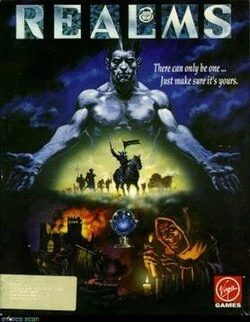
Realms
 Amiga
Amiga Atari ST
 PC
PC Virgin Interactive Entertainment
Realms (1991) stands as one of the most critical turning points in the history of the legendary real-time strategy and fantasy simulation franchise. Following the exhausting market fatigue of hyper-fast arcade conversions and the subsequent structural stagnation of the early Amiga wargaming formula, the future of the tactical genre was highly uncertain.
British publisher Virgin Games stepped in, bought the global publishing rights, and handed development duties to the English studio Graftgold Ltd. Faced with the intense task of salvaging a deeply passionate community after the highly polarizing experiments of contemporary micro-intensive clones like Powermonger, Graftgold delivered a stellar, redemptive chapter that bridged classic nostalgic mechanics with modern technological leaps.
The Grand Reset: A Brand New Universe
Realms completely severed ties with the rigid, spreadsheet-heavy historical simulations of the 1980s. Instead, it established a completely fresh, tightly constructed dark-fantasy lore continuity: The World of the Shattered Crown.
The world’s geopolitical landscapes, economic management, and racial alignments are strictly governed by an ancient pantheon of watchful deities. The massive campaign plays out like an interconnected fantasy political thriller, tracking a young, mourning prince whose late father, the King, is immolated at sea. Stricken by divine lightning that forms a mystical serpent emblem in his hands, his right to rule the world is formalized under the iconic tagline: “There can only be one… just make sure it’s yours,” sparking a brutal, continent-wide war against greedy rival lords trying to annex the realm.
The Core Evolution: 3D Topography & Polished Roots
Graftgold deliberately looked back at tabletop wargaming anchors like Warlords and Defender of the Crown as its mechanical anchor, discarding controversial abstract automated battle systems. However, they heavily evolved the engine:
- The Leap to 3D Fractured Worlds: Running on a highly modified, pseudo-3D fractal graphics engine, Realms was the first entry to ditch flat 2D tilemaps. Players were handed a fully functional mouse-driven viewport to hunt for tactical positions across real-time mountain ranges, vast grasslands, dense forests, and open oceans on the world map.
- The Dynamic Message Board Timeline: The map layer completely abandoned rigid, round-based turn structures. Graftgold implemented a real-time scrolling “Message Board” at the bottom of the screen. This interactive ticker constantly fed players immediate tactical streams regarding troop movements, famine breakouts, disease warnings, and synchronized notifications of ongoing city sieges.
- The Sidelined Sovereign Micro-Management: Rulers returned to their safe operational zones inside town keeps using the infamous “Black Sphere” window interface. Instead of abstract land painting, micro-management meant manually adjusting city tax rates, cultivating surrounding wild wilderness into agricultural assets, and buying physical grain bags to feed starving populaces.
The Deep Meta: Racial Unique Skills & The Unit Matrix
To maximize faction asymmetry, Realms completely threw out generic troop pools. Every alignment was granted a mandatory, entirely exclusive Racial Skill that dictated their macro-strategy:
- Dwarves (Axe Mastery): Allows subterranean heroes to equip heavy infantry divisions with optimized axes, maximizing frontline physical durability during siege combat.
- Elves (True-Flight Archery): Elven squads can channel their inner accuracy to field the highest-tier archers in the game, granting their missile regiments unrivaled range across the combat grid.
- Orcs (Horde Haste): Aggressive, cheap raiders who specialize in fast-paced city rushes, trading individual defensive armor metrics for rapid, low-cost army mobilization.
- Humans (Imperial Commerce): Balanced, versatility-focused kingdoms that generate higher baseline tax margins, allowing rulers to finance expensive equipment upgrades with minimal civilian revolt risks.
The Hidden Soldier Cultivation Matrix
Progression was governed by a massive, intricately complex web of wage balancing. Troops weren’t just summoned out of thin air; their initial quality (Elite Warriors, Warriors, Militia, or Raw Recruits) was strictly bound to the physical size of the spawning city and the number of active armies already siphoned from its manpower pool. To unlock game-breaking endgame stacks, players had to follow a precise science of military financing—carefully adjusting the slider of army payrolls, as a highly paid army boosted morale and recovered numbers rapidly, while a lowly paid force would instantly disband on the field.
The Expansions and Alternate Upgrades
While the Amiga original operated as a self-contained software achievement, porting pipelines to platforms like MS-DOS and Atari ST introduced distinct tactical variations to the unit grid. Rulers must choose the perfect tactical gear configurations—including tailored armor, secondary swords, and longbow distributions—to alter their frontline output.
More importantly, the system finalized Alternate Upgrades for your baseline infantry and cavalry formations via specific recruitment structures. For example:
| Base Unit (Recruit Tier) | Upgrade Path A | Upgrade Path B (Alternate) |
| Militia (Small Town Origin) | Imperial Infantry (Gains heavy plated armor and short swords for defensive wall sieges) | Elven Longbowmen (Sacrifices melee stats for extended arrow volleys and ranged kiting) |
| Cavalry Recruit | Light Outriders (Gains high-speed scout scouting, map movement, and flanking speed) | Heavy Armored Knight (Gains maximum lance damage, shock charge passives, and morale buffs) |
The Modern Standard: The WHDLoad Renaissance
While the official commercial lifecycle concluded in the mid-90s, Realms experiences an incredible casual and preservation renaissance today through the community’s WHDLoad architecture. For purists running the original 1991 multi-disk release, retro gameplay was heavily plagued by grueling Amiga disk-swapping loops and sluggish drive read times.
This monumental, fan-maintained framework completely reconstructs the engine stability. It integrates a fast, hard-drive installable execution shell, implements a vastly superior, balanced aspect ratio configuration inside modern emulators (like WinUAE), fixes original code memory leak exceptions, and unifies all language localization disks into a singular, flawlessly polished modern digital client.
Release History
- Realms (Base Game Launch): 1991 (Worldwide via Virgin Games for Amiga, MS-DOS, and Atari ST)
- Realms (The Hit Squad Budget Re-release): 1994 (Published via Ocean Software’s budget label)
- Modern Packaging: Natively preserved across digital Amiga software preservation archives and accessible through custom DOSBox or Amiga emulation frontends, serving as a pristine historical monument to the birth of real-time fantasy wargaming.
Trailer
View on Videos