Just Cause 4
 68
★ /10
68
★ /10
 PC
PC PS4
PS4 Xbox One
 Square Enix
Where to buy



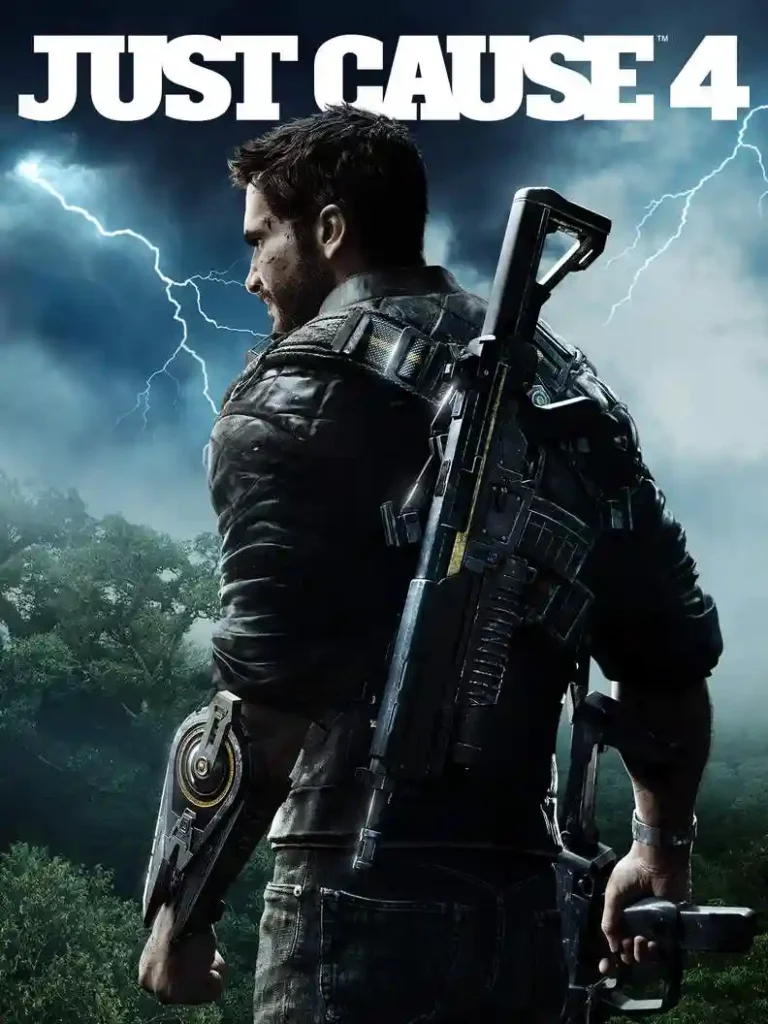
Just Cause 4 is a 2018 open-world action-adventure video game developed by Avalanche Studios and published by Square Enix. Released worldwide on December 4, 2018, for Microsoft Windows, PlayStation 4, and Xbox One, the title stands as the fourth installment in the Just Cause series and the mechanical successor to 2015’s highly celebrated Just Cause 3.
Just Cause 4 targeted unprecedented architectural limits by deploying Avalanche’s brand-new, proprietary Apex Engine. While its predecessors focused purely on weaponized gravity and structural explosions, this entry turned the environment itself into an aggressive combat element.
By integrating physics-simulated extreme weather events—ranging from massive, object-consuming tornadoes to high-velocity sandstorms—the game attempted to redefine the baseline boundaries of sandbox emergence. However, its ambitious technical departures sparked a highly divided reception at launch, polarizing the community over structural menu-driven progression overhauls and visible visual regressions compared to Just Cause 3.
Technical Specifications
| Attribute | Details |
| Developer | Avalanche Studios |
| Publisher | Square Enix |
| Engine | APEX Engine (Pioneering real-time physics-based rendering & weather mapping) |
| Platform(s) | Microsoft Windows, PlayStation 4, Xbox One |
| Release Date | December 4, 2018 |
| Genre | Action-adventure, Third-person shooter, Sandbox |
| Mode(s) | Single-player |
Storming Solís: Narrative and Setting
The single-player campaign journeys to Solís, a massive, fictional South American nation boasting 500 years of dense history and structural lore. Series protagonist Rico Rodriguez arrives on the island after being contacted by Mira Morales, a local dissident. Rico’s deployment is driven by deeply personal vengeance: he has uncovered evidence suggesting his late father, Miguel Rodriguez, clandestinely worked alongside the island’s rulers to engineer advanced weather-manipulation technology.
Solís is completely locked down by the Black Hand, the world’s most elite, technologically advanced private military company, which has served as a recurring antagonistic foil across the entire history of the franchise. Led by the cold, tactical commander Gabriela Morales, the Black Hand utilizes a network of weather-weapon superweapons known collectively as Project Illapa to maintain absolute population compliance.
To break their stranglehold, Rico goes entirely rogue from the Agency, spearheading a massive populist rebellion named the Army of Chaos to liberate the country zone by zone.
The Four Biomes of Solís: Spanning a massive 1,024 square kilometers, the map represents the largest and most ecologically diverse world map Avalanche had ever engineered. The terrain is split into four highly distinct environmental zones: lush tropical rainforests, sprawling alpine mountain ranges, stark arid deserts, and wide grasslands, all seamlessly stitched together around a central urban capital.
Extreme Weather Physics
The defining engineering feat of Just Cause 4 is the execution of real-time, fully simulated Extreme Weather Anomalies, driven entirely by the computational pipelines of the Apex Engine. Rather than acting as basic visual filters, weather events function as massive kinetic sandbox entities that completely rewrite map physics and player traversal paths:
- The Tornado (Grasslands): A colossal, fully dynamic wind funnel that wanders across the environment, physically pulling up civilian vehicles, tearing down structural masonry, and sucking up infantry combatants. High-skill players can deliberately fly their wingsuits into the peripheral jetstreams to launch themselves across massive spatial distances.
- The Tropical Thunderstorm (Rainforest): An aggressive tropical monsoon front defined by severe structural visibility hazards and active, homing cloud-to-ground lightning strikes that instantly blast metal structures, vehicles, and Rico himself if he stays airborne too long.
- The Sandstorm (Desert): A massive, blinding wall of dust that completely strips away player visibility and map HUD tracking while generating high-velocity wind shears that violently throw land vehicles and planes off course.
- The Blizzard (Alpine): A freezing mountain front packed with near-zero visibility, frozen sheet ice tracking that severely penalizes vehicle handling, and hazardous wind drafts that can violently stall aircraft thrusters.
Grapple Customization
To combat both the Black Hand and Mother Nature, Rico’s signature Grappling Hook was heavily upgraded into a deeply customizable mechanical computer framework. Discarding basic attachment logic, players can store, toggle, and trigger three independent loadout profiles, fine-tuning more than 4 million possible script and modifier combinations across three primary utility components:
1. Air Lifters
Deploys specialized, high-density helium balloons onto targeted objects. Players can modify the balloons to float indefinitely, travel directly toward designated follow-points, or violently explode upon reaching maximum altitude. This enables players to float heavy military tanks into the air, transforming them into improvised aerial gunships.
2. Boosters
Attaches rocket-propelled thruster nozzles onto target geometry. Boosters can be customized to burn out after a brief countdown, fire indefinitely, or trigger an intentional kinetic detonation. This allows players to turn standard cargo containers, explosive barrels, or unsuspecting enemy patrol boats into high-velocity, spinning unguided missiles.
3. Retractors
The classic high-tension retraction cable, upgraded with advanced mod parameters. Players can adjust the kinetic pull velocity, configure the cables to pulse automatically, or set them to release a powerful kinetic shockwave upon closure, violently smashing objects together.
Army of Chaos Logistics
Just Cause 4 completely altered how territory is conquered, replacing the traditional “destroy all military property to liberate a base” structure of prior games with the Frontline System.
As Rico completes objectives and generates structural chaos across Solís, he fills an overarching global meter to recruit squads of Squad Reserves. Using the tactical world map lens, players manually command these rebel forces to press forward, physically pushing a literal, visible battle line across the map to secure regional strikes.
This system introduced heavy, localized battlefield atmospheres; moving along an active frontline drops the player into constant, unscripted ambient skirmishes where the Army of Chaos and the Black Hand are actively waging open war with infantry armor, rocket barrages, and gunship support vectors.
Contemporary Stance
Sitting in mid-2026, nearly eight years after its late-2018 rollout, Just Cause 4 occupies a fascinating, highly vindicated position within retrospective gaming circles. At launch, the game was heavily review-bombed and critically slammed due to severe optimization bugs, aggressive texture pop-in, an agonizing motion-blur filter, and a perceived downgrade to water and explosion graphics compared to its 2015 predecessor.
However, looking back from modern computational sandboxes, the game has undergone a major critical re-evaluation. While Just Cause 3 is still widely championed for its visual beauty and pure baseline demolition loops, Just Cause 4 is increasingly revered as the absolute peak of emerent laboratory physics. The unprecedented freedom granted by the booster and balloon customization matrix has turned the title into a highly active cult-classic destination for sandbox purists who utilize the game engine as a digital engineering playground.
The software remains actively functional, highly stable, and beautifully preserved today:
The title enjoys exceptional technical health on modern platforms. While eighth-generation consoles famously choked under the heavy physics processing demands of the Apex Engine, running via native backward compatibility on PlayStation 5 and Xbox Series X/S hardware completely transforms the experience. Modern architectures effortlessly brute-force the old performance bottlenecks, running the game at a flawlessly smooth, locked 60 frames per second with vastly sharpened image clarity and near-instant modern SSD load times.
On PC via Steam, the game is exceptionally stable under modern 64-bit Windows 11 desktop environments, easily supporting native 4K resolutions and extreme framerates, preserving Solís as a premium destination for sandbox chaos.