Just Cause
 73
★ /10
73
★ /10
 PC
PC PS 2
PS 2 Xbox
Xbox Xbox 360
 ND Games
 Square Enix

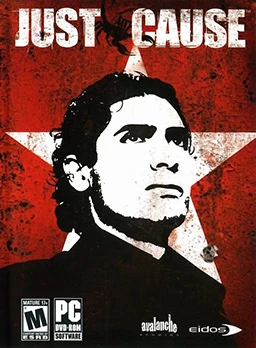
Just Cause is a 2006 open-world action-adventure video game developed by Swedish developer Avalanche Studios and published by Eidos Interactive. Released in September 2006 for Microsoft Windows, PlayStation 2, Xbox, and Xbox 360, the title stands as the foundational debut installment of the Just Cause franchise and the official birth of Rico Rodriguez’s explosive career.
At its launch, Just Cause was an incredibly ambitious, structurally massive experiment that arrived right at the dawn of the seventh generation of console hardware. While early open-world titles of the 2000s were strictly bound by urban landscapes and terrestrial driving systems, Avalanche Studios engineered a custom game engine that prioritized massive physical scale, high-altitude physics, and over-the-top Hollywood stunt logic—forever altering the scope of sandbox exploration.
Technical Specifications
| Attribute | Details |
| Developer | Avalanche Studios |
| Publisher | Eidos Interactive |
| Director | Christofer Sundberg |
| Designer | Magnus Nedfors |
| Engine | Avalanche Engine 1.0 (Pioneering 250,000-acre map streaming) |
| Platform(s) | Microsoft Windows, PlayStation 2, Xbox, Xbox 360 |
| Release Date | September 22, 2006 (Europe) / September 27, 2006 (North America) |
| Genre | Action-adventure, Third-person shooter, Sandbox |
| Mode(s) | Single-player |
Regime Change in the Caribbean: Narrative and Setting
The single-player campaign introduces series protagonist Rico Rodriguez, a highly capable, slick operative working for a top-secret United States government branch known simply as The Agency. Alongside his tactical handler Maria Kane and his eccentric, cowboy-boot-wearing mentor Tom Sheldon, Rico is dropped into San Esperito, a fictional Caribbean tropical paradise collapsing under political corruption.
Rico’s primary objective is to systematically overthrow the island’s brutal military dictator, President Salvador Mendoza, whom the Agency suspects is actively stockpiling weapons of mass destruction (WMDs).
To fracture Mendoza’s iron grip on the region, Rico must wage an asymmetric guerrilla war by playing the island’s local underground factions against one another:
- The Guerrillas: Led by the charismatic rebel José Caramicas, this populist militia fights directly to liberate local villages and restore democratic sovereignty.
- The Rioja Cartel: A prominent local drug trafficking syndicate locked in a brutal turf war against the Montano Cartel, Mendoza’s hidden financial backers.
The 2006 Scale Benchmark: Spanning over 250,000 acres (roughly 1,012 square kilometers), San Esperito was a mind-boggling technological statement in 2006. Long before modern procedural map generation became standard practice, the original Avalanche Engine successfully managed to render a continuous tropical landscape packing sandy beaches, dense deep-jungle canopies, localized native villages, and hidden cartel plantations with zero physical loading screens during active exploration.
The Birth of the Stunt Loop: Early Traversal
While subsequent sequels refined the mechanics into fluid, physics-defying superhero playgrounds, the 2003–2006 prototype established the core stunts that became the absolute signature of the franchise:
1. The Prototype Grapple and Parasail
In this original 2006 blueprint, the Grappling Hook was vastly different from the hyper-versatile, building-scaling traversal tool seen in Just Cause 2. Here, it functioned primarily as an alternative targeting vector for Parasailing. Rico could lock his grappling hook onto a moving civilian vehicle or patrol boat, instantly deploying his parachute to skyrocket high into the air, utilizing the vehicle’s forward momentum to glide endlessly across coastal waterways.
2. High-Altitude Base Jumping
The game placed a massive mechanical emphasis on vertical entry. Rico could freely pilot civilian planes and military attack helicopters straight up into the stratosphere, leap out of the cockpit, and engage in high-velocity Skydiving and Base Jumping. This freedom to freely drop onto any physical coordinate on a massive world map was a radical, thrilling departure from contemporary 2000s sandbox shooters.
3. Action-Movie Stunt Jumping
While driving any land vehicle at maximum speed, players could trigger Stunt Position with a single button press. Rico would instantly climb out of the cabin to balance precariously on the roof of the moving vehicle. From this position, high-skill players could cleanly leap across space to hijack adjacent enemy cars mid-chase, deploy their parachute to escape highway pileups, or jump clear before a vehicle careened off a sheer mountain cliffside.
The Liberation Structure: Factions and Side Missions
The baseline progression of Just Cause relied heavily on the Liberation Mechanic, a structure that became a mandatory pillar for future sequels and dozens of adjacent open-world titles across the industry:
- Stronghold Takeovers: To destabilize Mendoza’s government, Rico accepts localized military operations from the Guerrillas or the Rioja Cartel. These missions involve leading full-scale, chaotic infantry charges to breach physical military blockades, destroy communications towers, and execute local corrupt commanders.
- Side-Mission Diversity: Beyond the 21 primary narrative story missions, the world was populated with over 300 optional side assignments. Completing these tasks earned Rico valuable favor points with active allied factions, unlocking safehouses across San Esperito and granting immediate delivery access to advanced Agency weapons drops and sports car imports.
Retrospective Perspective (2026 Standing)
Sitting in mid-2026, exactly twenty years after Rico Rodriguez first checked into San Esperito, the original Just Cause is viewed by retrospective gaming communities as a fascinating, rough-around-the-edges historical time capsule. Let’s be entirely candid: from a modern mechanical standpoint, the 2006 client feels highly dated. Its loose shooting accuracy, repetitive side-mission structure, and lack of the fluid “slingshot” grappling loops popularized by Just Cause 2 make it a clunky play for modern audiences.
However, open-world preservation circles increasingly champion the game as a vital, landmark achievement that boldly proved that massive, uncompromised map scale and absolute aerial freedom were fully viable on home consoles.
The legacy software remains fully preserved and accessible today:
The title enjoys surprisingly robust technical health on current setups. On Xbox Series X and Xbox Series S hardware via native backward compatibility, the game runs flawlessly. System-level optimizations leverage automated Auto HDR tone mapping to make the bright Caribbean waters and lush jungle canopies of San Esperito look incredibly clean and vibrant on modern displays.
On PC via Steam, the title remains fully operational and highly stable under modern 64-bit Windows 11 frameworks. While it requires community configuration tweaks or custom gamepad mapping profiles to comfortably navigate modern controllers, the original storming of Salvador Mendoza’s private island remains a premium, highly recommended retro destination for sandbox historians looking to look back at the exact spark that ignited a legacy of absolute chaos.