Just Cause 3
 74
★ /10
74
★ /10
 PC
PC PS4
PS4 Xbox One
 ND Games
 Square Enix

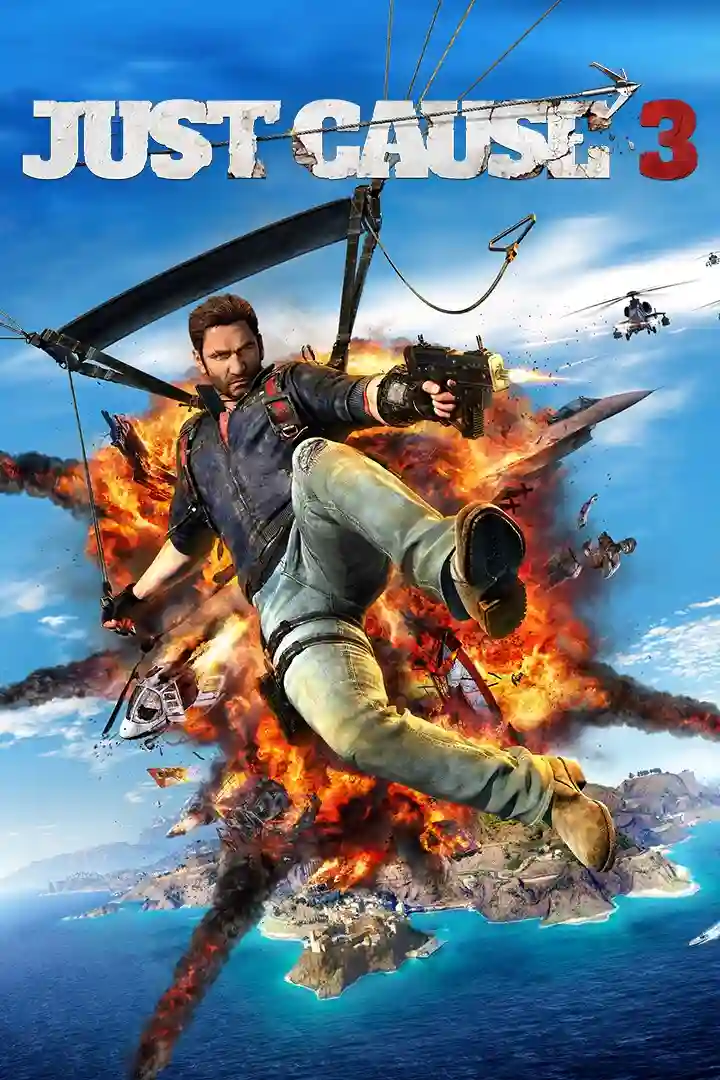
Just Cause 3 is a 2015 open-world action-adventure video game developed by Avalanche Studios and published by Square Enix. Released worldwide on December 1, 2015, for Microsoft Windows, PlayStation 4, and Xbox One, the title stands as the third installment in the Just Cause series and the direct sequel to 2010’s Just Cause 2.
Just Cause 3 represents the absolute zenith of the franchise’s physics-based destruction engine. Shifting the development focus to Avalanche’s New York studio, the team took the foundational tether mechanics of its predecessor and turned them up to a cartoonish extreme.
By introducing a high-velocity wingsuit into Rico’s traversal toolkit and giving players the power to actively retract multiple high-tension cables simultaneously, the game successfully evolved Rico Rodriguez from a mere action-movie stuntman into a literal, explosion-conjuring superhero.
Technical Specifications
| Attribute | Details |
| Developer | Avalanche Studios |
| Publisher | Square Enix |
| Director | Roland Lesterlin |
| Designer | Francesco Antolini |
| Engine | Avalanche Engine 3.0 (Upgraded physics processing and destruction pipelines) |
| Platform(s) | Microsoft Windows, PlayStation 4, Xbox One |
| Release Date | December 1, 2015 |
| Genre | Action-adventure, Third-person shooter, Sandbox |
| Mode(s) | Single-player |
Return to Medici: Narrative and Setting
The single-player campaign takes a deeply personal turn, tracking veteran Agency operative Rico Rodriguez as he returns to his fictional homeland of Medici, a beautiful, sun-drenched Mediterranean island republic.
Since Rico’s childhood exile following a brutal military coup, the beautiful archipelago has fallen under the iron fist of General Sebastiano Di Ravello, a ruthless, power-hungry military dictator.
Di Ravello’s tyrannical ambitions are fueled by the discovery of Bavarium, a fictional, highly volatile blue mineral found exclusively within Medici’s mineral deposits. Bavarium possesses infinite energy properties, functioning as both an explosive propellant capable of manufacturing weapons of mass destruction and a high-tier magnetic shielding vector.
To save his homeland, Rico goes off-the-clock from the Agency, partnering with his childhood best friend Mario Frigo, the brilliant scientist Dimah Al-Masadi, and a ragtag local rebellion to systematically dismantle Di Ravello’s regime block by block.
A Mediterranean Playground: Spanning roughly 400 square miles (1,000 square kilometers), Medici is divided into three distinct insular regions. The map trades the harsh deserts and dense rainforest biomes of Panau (Just Cause 2) for a beautifully unified, vibrant European aesthetic defined by fields of sunflowers, pastel-colored coastal fishing villages, ancient Roman ruins, massive offshore oil fields, and a towering, central volcanic mountain peak heavily fortified by military bases.
Traversal Evolution
The core mechanical breakthrough of Just Cause 3 is the integration of the Wingsuit, which fundamentally perfected the franchise’s signature physics-defying mobility loop:
The Traversal Trinity
Instead of just slingshotting himself across the sky with his parachute, Rico can instantly toggle into a high-speed aerodynamic glide using his wingsuit. Players can grapple onto ground geometry or distant structures while airborne to generate massive forward velocity, dive-bombing down mountain canyons before deploying the parachute at the absolute last second to land cleanly or float over enemy compounds. This smooth interaction allowed high-skill players to traverse the entire 400-square-mile map indefinitely without ever touching the floor or using a vehicle.
Retraction and Total Destruction
Avalanche Studios upgraded their proprietary physics engine to transform the environment into an interactive, fully destructible playground:
1. Multi-Tether Retraction
Rico’s grappling hook was upgraded to deploy up to six simultaneous cables. Crucially, the game introduced the ability to forcefully retract those tethers at the press of a button. This opened up an endless array of emergent, physics-based combat options:
- Slingshotting an enemy soldier straight into the ceiling of a concrete guard tower.
- Binding a military fuel tank to a patrolling armored vehicle, pulling them together for an instant explosion.
- Tying the rotors of an attack helicopter to adjacent stone walls, forcing it to tearing itself apart upon takeoff.
2. Systematic Infrastructure Liquidation
Unlike modern sandboxes that rely on pre-baked destruction animations, Just Cause 3 processed structural physics in real-time. Towering concrete bridges can be systematically fractured and dropped into canyons under heavy artillery fire.
The game’s progression logic tied territorial liberation straight to the total demolition of military property: vaporizing massive spherical radar arrays, pulling down propaganda statues with tethers, and detonating massive Bavarium refineries to turn entire bases into blinding firestorms.
The Air, Land, and Sea Expansion (The DLC Transformation)
The post-launch lifecycle of Just Cause 3 is highly regarded for introducing the Air, Land, and Sea Expansion Pass, which pushed Rico’s combat capabilities straight into the realm of sci-fi comic blockbusters:
- Sky Fortress (Air): Equipped Rico with a weaponized, rocket-propelled Bavarium Wingsuit. This engine upgrade turned Rico into a literal human fighter jet, enabling him to hover mid-air, execute infinite rocket boosts, and fire an integrated shoulder-mounted minigun and homing missile payload.
- Mech Land Assault (Land): Introduced a highly agile, armored combat mech outfitted with a “Gravitational Core” weapon, allowing players to telekinetically lift compliance cars, tanks, and infantrymen before violently hurling them across maps.
- Bavarium Sea Heist (Sea): Granted access to the “Loochador,” a high-speed missile boat equipped with homing rocket batteries and the “Eden Spark”—a devastating lightning-gun targeting laser that calls down targeted orbital electrical strikes.
Contemporary Stance & 2026 Perspective
Sitting in mid-2026, more than ten years after its initial rollout, Just Cause 3 is widely recognized as the definitive fan-favorite entry of the entire series. While its 2018 sequel (Just Cause 4) introduced complex weather mechanics and frontline battle simulations, community circles heavily criticized it for visual downgrades and a convoluted progression loop, cementing the 2015 Mediterranean sandbox as the true high-water mark for pure, unadulterated explosive freedom.
The software’s long-term legacy has been thoroughly saved and elevated by contemporary computing architectures:
The Console Liberation
At its initial 2015 launch, the console versions of Just Cause 3 were notoriously broken. On the original PlayStation 4 and Xbox One hardware, the game suffered from atrocious memory leaks, severe loading gates that could last up to two minutes, and catastrophic framerate dips that routinely tanked performance down to a sluggish 15 FPS during massive explosion chains.
In 2026, running via native backward compatibility on PlayStation 5 and Xbox Series X/S hardware, the game is completely transformed. Modern systems effortlessly brute-force the old optimization bottlenecks, locking the game’s performance to a flawlessly smooth 60 frames per second while modern NVMe SSDs completely eliminate the agonizing loading screens. Coupled with system-level Auto HDR, the azure waves of the Mediterranean and the bright blue glow of detonating Bavarium look pristine on modern displays.
The PC Sandbox Legacy
On PC via Steam, the title remains a thoroughly stable, visually stunning masterpiece running flawlessly under modern 64-bit Windows 11 desktop environments at native 4K resolutions and extreme framerates. Backed by an active community that still hosts specialized multiplayer servers and custom modification clients, Medici stands preserved as a premier destination for sandbox purists looking to experience the absolute peak of gravity-defying playground chaos.