Herzog Zwei
 Nintendo Switch,
  Sega Genesis
 SEGA Corporation
Where to buy
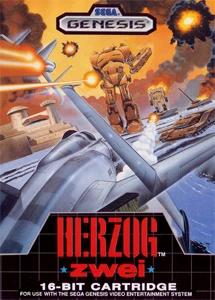
Herzog Zwei (1989) stands as one of the most critical turning points in the history of the legendary real-time strategy franchise. Following the experimental, highly obscure 1988 release of the original Herzog on the MSX home computer and the subsequent hardware evolution to the 16-bit era, the future of the strategy genre was highly uncertain.
Japanese developer Technosoft stepped in, refined the formula, and handed Sega Genesis/Mega Drive players an unprecedented masterpiece. Faced with the intense task of creating a completely new mechanical language years before industry-defining words like “RTS” or “MOBA” even existed, Technosoft delivered a stellar, redemptive chapter that bridged fast arcade shoot-’em-up action with deep, complex tactical logistics.
The Grand Genesis: A Brand New Blueprint
Herzog Zwei completely severed ties with the slow, turn-based tabletop roots of traditional strategy games. Instead, it established a completely fresh, tightly constructed real-time battlefield framework: The 16-Bit War of the Mechs.
The game’s geopolitical landscapes, industrial manufacturing, and squad deployments are strictly governed by an ongoing, symmetrical proxy war between two rival military commanders. The massive multi-map campaign plays out like a high-octane cybernetic political thriller, tracking a blue and red faction locked in a bitter struggle across alien worlds, volcanic wastes, and frozen islands to systematically destroy the opponent’s heavily fortified main headquarters.
The Core Evolution: Transformable Command & Real-Time Roots
Technosoft deliberately looked back at their arcade shooters like Thunder Force II as a mechanical anchor, discarding the static, god-view cursors of early computer simulations. However, they heavily evolved the engine:
- The Leap to the Mech Commander: Running on a highly optimized sprite engine, Herzog Zwei was the first entry to put the player physically on the map as an avatar. Players command a massive, transformable jet that can dynamically snap into a ground-pounding bipedal robot to engage foes directly, providing a fully interactive rotatable camera centered on the action.
- The Dynamic Fuel and Ammunition Timeline: The combat loop completely abandoned unpunished, limitless unit maneuvering. Technosoft implemented a strict energy and ammunition gauge directly on the player’s mech. Flying or shooting deep into enemy territory naturally drains your resource reserves; running out of energy triggers an immediate explosion and respawn penalty, forcing a massive layer of logistical speed management as players rush back to bases to refuel.
- The Ferry Logistics: Units cannot walk across the map freely upon production. The Commander’s jet mode functions as a literal transport crane. On their turn, a player must physically pick up a manufactured tank, anti-air missile battery, or infantry squad from a base pad and ferry them across map coordinates, executing precision drops directly into the frontline heat without exposing their vulnerable cargo to enemy fire.
The Deep Meta: Command Protocols & The Outpost Matrix
To maximize tactical asymmetry, Herzog Zwei threw out generic unit queueing. Every single manufactured asset must be pre-programmed with a mandatory, entirely exclusive Command Protocol that dictates its macro-strategy on the battlefield:
- B-1 (Stationary Guard): Commands the selected unit to lock its position, acting as a baseline defense turret to shred anything entering its line of sight.
- A-1 (Headquarters Assault): Forces the unit to march mindlessly and relentlessly toward the enemy’s main home base, prioritizing structural destruction above personal survival.
- B-2 (Outpost Occupation): Essential for territorial expansion. This protocol programs infantry to seek out, enter, and forcefully claim neutral sub-bases scattered across the map.
- A-2 (Search and Destroy): Sets the unit’s AI to an aggressive, free-roaming hunting mode, automatically tracking and engaging the nearest enemy asset within a wide radius.
- Supply (Rearmament): Specialized vehicles channel their inner cargo reserves to automatically locate, link up with, and replenish the ammunition and health of depleted frontline combat squads.
The Hidden Economy Matrix
Progression was governed by a massive, intricately complex web of economic balancing. Every captured outpost on the grid acts as an automated refinery, multiplying your production currency generation. To unlock game-breaking endgame death-balls, players must follow highly specific resource management paths—carefully balancing the cost of programming units with the passive resource upkeep drain of their current active army, turning console unit cultivation into a precise science.
The Battlefield Variances and Unit Deployments
While the game features identical unit capabilities for both the blue and red commanders, tactical diversity shifts completely based on the environmental layouts of the battlefields. More importantly, players must choose the perfect alternate command upgrades for every unit type based on the terrain. For example:
| Base Unit (Tier / Type) | Standard Command Protocol | Alternate Tactical Deployment |
| AMW-56 Infantry | Occupy Base (B-2: Secures neutral outposts to boost resource income) | Diversionary Patrol (B-3: Despatched to draw automated enemy turret fire) |
| Granat Tank | Search & Destroy (A-2: Roams field to clear enemy infantry lines) | Main Assault (A-1: Packed into transport lanes for a direct strike on the enemy HQ) |
| Striker Anti-Air | Stationary Guard (B-1: Deployed near bases to swat down the enemy Mech) | Perimeter Patrol (B-3: Moves along supply paths to intercept incoming transport jets) |
The Modern Standard: The Netplay and Sega Ages Legacy
While the official development lifecycle concluded in the 16-bit era, Herzog Zwei experiences an incredible competitive and casual renaissance today. It is widely revered as the spiritual godfather of the entire MOBA and RTS sub-genres, heavily inspiring modern hits like AirMech.
The definitive way the community interacts with the game is through modern retro emulation networks and the highly polished Sega Ages port. This definitive release completely reconstructed the classic client, integrating an optimized widescreen presentation, adding an incredibly valuable, fully visible active economy overlay right into the user interface, introducing an interactive tutorial system to teach modern players classic programming logistics, and enabling seamless digital matchmaking to keep head-to-head competitive split-screen tournaments thriving.
Release History
- Herzog Zwei (Japan Launch): December 15, 1989
- Herzog Zwei (North America Launch): April 19, 1990
- Sega Ages Herzog Zwei (Nintendo Switch): August 27, 2020
- Modern Packaging: Natively preserved and available across legacy digital retro collections and the standalone Nintendo eShop Sega Ages release, serving as a pristine historical monument to the birth of real-time strategy gaming.