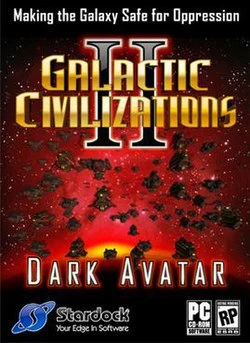
Galactic Civilizations II: Dark Avatar
Expansion of Galactic Civilizations II: Dread Lords 91
★ /10
91
★ /10
 PC
PC

Galactic Civilizations II: Dark Avatar is a critically acclaimed turn-based space grand strategy 4X video game expansion pack developed and published by Stardock. Released on February 14, 2007, exclusively for Microsoft Windows, it functions as the first major expansion to 2006’s masterpiece Galactic Civilizations II: Dread Lords.
Dark Avatar is widely recognized by strategy critics as an exemplary model for expansion design. Rather than merely adding cosmetic skins or minor balance patches, it radically re-engineered the foundational mechanics of the base game.
By introducing harsh environmental colonization restrictions, a dedicated planetary espionage grid, asteroid mining operations, and early distinct structural asymmetry among the alien factions, the expansion substantially deepened the strategic friction of the universe. It earned widespread critical praise, including a “Best Expansion Pack” nomination from GameSpot in 2007.
Technical Specifications
| Attribute | Details |
| Developer | Stardock |
| Publisher | Stardock |
| Lead Designer | Brad Wardell |
| Engine | Upgraded 3D Object-Oriented Engine |
| Platform | Microsoft Windows (XP / Vista / 7 / 10 / 11) |
| Release Date | February 8, 2007 |
| Genre(s) | Turn-based strategy, Space Grand Strategy, 4X |
| Mode | Single-player |
The Campaign Narrative: A Fractured Empire
The story of Dark Avatar picks up directly after the apocalyptic events of the Dread Lords campaign. The ancient, malicious Dread Lords have been successfully defeated and sealed away, but the power vacuum they left behind completely shatters galactic stability.
The merciless, insectoid Drengin Empire emerges as the undisputed superpower, successfully conquering or enslaving almost every major civilization in the galaxy, including the Terran Alliance.
However, the expansion shifts the narrative focus to a brutal internal civil war within the Drengin Empire itself. The empire splits into two fiercely opposed ideological sub-factions:
- The Regular Drengin: Seek to rule the galaxy through absolute, systemic enslavement, keeping the conquered races alive as labor forces to fuel the imperial economy.
- The Korath Clan: A fanatical, genocidal elite faction. Believing that keeping slaves leaves the empire vulnerable to future revolutions, the Korath vow to completely exterminate every single non-Drengin living organism in the universe.
Players navigate this grim cosmic conflict while two entirely new playable civilizations emerge from the shadows: The Krynn Consortium (a powerful underground corporate crime syndicate wrapped in religious fundamentalism) and The Iconian Refuge (an ancient, highly advanced mechanical civilization seeking to reclaim their historic homeworld from the Drengin).
Core Expansion Features: Strategic Overhauls
Dark Avatar revolutionized the mechanical pacing of a standard 4X match through several major systemic upgrades:
1. Planetary Environments & Tech Barriers
In the original Dread Lords, players could immediately land colony ships on any green garden world or habitable rock they stumbled across in deep space. Dark Avatar fundamentally ended this unrestricted manifest destiny by introducing Planetary Environments.
Worlds can spawn with hostile planetary traits, being classified as Toxic, Radioactive, Heavy Gravity, Extreme Temperature, or Barren. Factions are hardcoded to be completely incapable of colonizing these high-value worlds out-of-the-box.
To claim them, players must divert substantial portions of their economic budget into specialized, expensive technology tracks (e.g., Radioactive Colonization). This turned early-game exploration into a highly competitive land-grab, as factions fought bitterly over basic, habitable worlds while plotting long-term scientific strategies to unlock the hostile nodes.
2. The Agent Espionage System
The expansion completely replaced abstract, slider-based intelligence spending with a physical, character-driven Agent Matrix. Empires accumulate espionage funding over time to hire unique Spies (Agents).
Instead of operating globally, agents must be physically deployed onto a specific tile of an opponent’s colonized planet. Once positioned, the agent can execute targeted destabilization missions.
3. Asteroid Mining Operations
To bridge the gap between map exploration and factory logistics, the expansion seeded procedural Asteroid Fields across space coordinates. Starports can manufacture specialized, unarmed Asteroid Mining Ships to travel to these space rocks and establish a permanent mining outpost.
Once active, the mining base funnels a continuous stream of raw production points directly to a designated, linked friendly planet within its shipping grid.
However, these outposts operate without protective shields or hull armor. Hostile empires or roaming space pirates can easily swoop into the sector and blow up your asteroid mines to instantly cripple your primary shipbuilding capitals, requiring players to position defensive corvettes or orbital starbases to safeguard their deep-space supply chains.
The Path to Asymmetry
Prior to Dark Avatar, every civilization in Galactic Civilizations II shared a functionally identical technology tree, varying only by minor racial passive traits or unique ship hull geometries.
The expansion initiated the franchise’s shift toward True Faction Asymmetry. It introduced unique planetary facilities unique to specific species—such as the genocidal Korath Clan gaining exclusive access to Spore Modules capable of instantly wiping out a planet’s entire population from orbit.
This design philosophy laid the direct groundwork for the final expansion, Twilight of the Arnor, which would famously give every single race in the game a 100% unique, custom technology tree.
Modern Digital Preservation Status (2026 Perspective)
As of May 2026, Galactic Civilizations II: Dark Avatar stands perfectly preserved and readily accessible as an essential chapter in the evolution of turn-based space strategy. Stardock has fully consolidated the game’s historic footprint; the standalone Dark Avatar retail installer has been retired from individual distribution, and the complete expansion is natively pre-bundled inside Galactic Civilizations II: Ultimate Edition.
Distributed globally on digital platforms including Steam and GOG.com for a standard retail price of $19.99, the Ultimate Edition incorporates all the balance updates, visual layers, and scenario expansions directly into a unified client.
Because the game engine was architected from day one around clean, object-oriented Windows API parameters rather than legacy 16-bit frameworks, the software installs and executes flawlessly out-of-the-box under modern 64-bit Windows 11 architectures.
The storefront packages feature modern preservation updates ensuring full native support for modern widescreen resolutions, scaled user interface fonts, and multi-core processor stability—allowing contemporary strategy purists to experience the intense Drengin civil war, hostile world colonization barriers, and cutthroat asteroid mining mechanics with absolute, rock-solid technical fidelity.