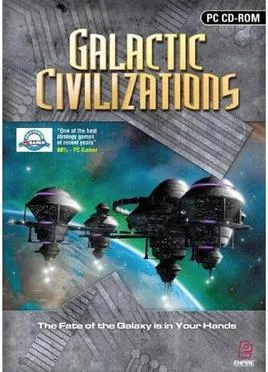
Galactic Civilizations
 83
★ /10
83
★ /10
 PC
PC
 1C Company, Empire Interactive, Strategy First


Galactic Civilizations (commonly abbreviated as GalCiv) is a critically acclaimed turn-based space grand strategy 4X video game developed by Stardock and published by Strategy First. While the game achieved its massive commercial and critical breakthrough with its Windows PC release in March 2003, the title holds a unique, highly revered status in software history, having originally debuted in 1994 as a premier, original release for IBM’s OS/2 operating system.
Designed by Stardock founder Brad Wardell, Galactic Civilizations carved out a definitive identity within the 4X genre (eXplore, eXpand, eXploit, and eXterminate).
By steering away from purely militaristic space wargames, the title introduced the strategy ecosystem to asymmetric political influence, interactive moral alignment scales, a dynamic galactic security council, and a highly sophisticated artificial intelligence engine that famously rejected traditional cheating scripts in favor of authentic strategic decision-making.
Technical Specifications
| Attribute | Details |
| Developer | Stardock |
| Publisher | Strategy First |
| Designer / Writer | Brad Wardell |
| Composers | Eric Heberling, Eric Johnson |
| Engine | Proprietary 32-bit Multithreaded Engine |
| Platform(s) | OS/2 (1994 Original), Microsoft Windows (2003 Remake) |
| Release Date | • OS/2: November 1994 • Windows: March 25, 2003 |
| Genre(s) | Turn-based strategy, Space Grand Strategy, 4X |
| Mode | Single-player |
The OS/2 Heritage: A 32-Bit Technical Vanguard
Before establishing itself as a Windows PC staple, the original 1994 incarnation of Galactic Civilizations was hand-coded by Brad Wardell during his time as a 20-year-old electrical engineering student to fund his college tuition. Operating on IBM’s OS/2 Warp platform, the title achieved massive structural milestones: it was the first commercial 32-bit personal computer game, the first to break past 256 colors to utilize 24-bit color depth, and the first to implement full native multithreading.
Because the architecture was multithreaded, the background engine could crunch complex economic loops and AI pathfinding calculations across multiple CPU threads simultaneously, a technical feat that DOS and early Windows 95 games could not replicate at the time. Stardock transitioned its core software suite to Windows around the year 2000, choosing to celebrate the game’s 10-year anniversary by completely rebuilding the classic 32-bit codebase from scratch to launch the modern Windows franchise in 2003.
The Narrative Premise: The Hyperdrive Race
The core campaign is set at the dawn of the 23rd century, initializing in the year 2178. Up until this milestone, interstellar travel across the stars was a dangerous, astronomically expensive venture. Civilizations were entirely dependent on massive, static space jump gates that only permitted transit between two specific coordinates. Because of these extreme physical bottlenecks, the vast majority of the galaxy remained a pitch-black, un-colonized frontier.
This status quo is shattered when humanity, operating under the centralized banner of the Terran Alliance, successfully invents a revolutionary propulsion breakthrough: Hyperdrive. Hyperdrive allows individual starships to freely navigate space lanes completely independent of fixed jump gates.
However, the technology is immediately leaked to five rival alien superpowers, including the merciless Drengin Empire, the highly spiritual Altarian Republic, and the mechanical Yor Collective. With the entire galaxy suddenly unlocked, a frantic, zero-sum manifest destiny begins to explore, colonize, and dominate the outer worlds.
Architectural Innovations: The Core Pillars
Galactic Civilizations subverted traditional space grand strategy by organizing its gameplay loops around four heavily integrated, non-linear design pillars:
1. Award-Winning, Non-Cheating AI
The defining achievement of the 2003 release earning it the prestigious “Best AI” award from Computer Games Magazine (tying with Halo: Combat Evolved) was its unyielding approach to computer opponents. On standard difficulty settings, the game’s artificial intelligence is completely barred from receiving hidden economic resource injections, map-revealing cheats, or production speed shortcuts.
Instead, the AI operates under the exact same data constraints as the human player. It utilizes predictive tracking matrices to actively analyze your empire’s diplomatic vulnerabilities, exploit un-defended holes in your border sensor grids, and adapt its weapon choices dynamically to counter your starfleet compositions.
2. The Ideological Ethics System
Long before morality choices became a normalized gameplay mechanic, GalCiv introduced a structural Ethics Alignment Matrix. As players colonize newly discovered worlds, they are routinely faced with interactive text events detailing planetary dilemmas. For example, upon locating a primitive, pre-industrial alien society on a choice garden world, players must choose one of three paths:
- Evil: Enslave the native population, instantly netting a permanent 10% industrial productivity bonus to the planet, but completely destroying your system-wide diplomatic reputation.
- Neutral: Confine the alien cultures to isolated reservations, losing minor potential resource grids but keeping an ethical middle-ground.
- Good: Vow to only colonize sections of the planet completely uninhabited by the natives, losing 30% of the world’s potential industrial capacity to protect their way of life.
Your ongoing decisions permanently cement your civilization into an overall alignment (Good, Neutral, or Evil). This ethics rating alters the aesthetic background of your empire, dictates how hostile alien races negotiate with you, and locks or unlocks specialized high-tier technologies, weapon modules, and planetary facilities.
3. The United Planets Security Council
Political power is channelled directly through the United Planets Security Council. Periodically throughout a match, all major galactic superpowers meet to propose and vote on sweeping, universe-wide constitutional amendments, such as capping maximum galactic taxation scales, outlawing specific ballistic weapons, or forcing global economic aid toward poverty-stricken systems.
An empire’s voting power is derived entirely from their global Cultural Influence and total population density. A culturally dominant player can effectively rewrite the rules of the game to economically cripple a warmongering neighbor without ever launching a single warship.
While empires can choose to illegally withdraw from the United Planets at any moment, doing so instantly triggers a universal trading embargo that completely cuts off your cross-border commercial income lanes.
4. Macroeconomic Slider Management
Planetary micromanagement is streamlined into a centralized, elegant Global Budget Interface. Players tweak a universal tax slider to collect liquid cash from their citizens.
The state’s entire economic throughput is then systematically distributed across three interconnected, macro-level bar sliders: Manufacturing, Scientific Research, and Social Entertainment.
Tuning these balances requires continuous caution. Setting taxes too high causes planetary approval ratings to drop. Once approval falls below a critical threshold, population growth completely freezes, and your manufacturing facilities experience grinding labor strikes-forcing you to siphon massive portions of your treasury straight into social entertainment to keep the wheels of your empire turning.
Modern Preservation Status
As of May 2026, Galactic Civilizations stands beautifully preserved and fully accessible as the proud, foundational bedrock of a massive, ongoing 4X franchise that spans up through Galactic Civilizations IV: Supernova. The definitive 2003 original release—alongside its highly praised Altarian Prophecy expansion pack—is actively distributed on mainstream digital platforms, including Steam and GOG.com, frequently packaged under the title Galactic Civilizations I: Ultimate Edition for a baseline retail price of $9.99.
Because Stardock natively architected the 2003 remake around standard 32-bit Windows API layers rather than legacy DOS or command-line wrappers, the digital client boots and runs flawlessly out-of-the-box on contemporary 64-bit Windows 11 architectures without requiring external emulators or complex configuration tweaks.
Modern digital preservation updates bundled into the storefront files ensure complete native compatibility for arbitrary widescreen monitor resolutions, optimized UI text scaling, and zero-latency performance stability, allowing contemporary strategy purists to experience the precise, award-winning non-cheating AI and deep ethical sandbox design that originally launched Stardock’s strategy legacy.