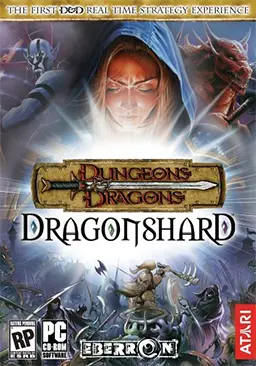
Dungeons & Dragons: Dragonshard
 80
★ /10
80
★ /10
 PC
PC Atari
Atari SNEG
SNEG

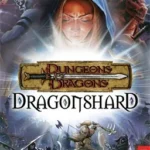
Dungeons & Dragons: Dragonshard (September 27, 2005) stands as one of the most mechanically daring, genre-blurring experiments in the history of tactical real-time strategy. Developed by Liquid Entertainment—the brilliant design minds behind Battle Realms—and published by Atari, the title holds a landmark distinction: it was the first-ever video game set in Keith Baker’s freshly minted, magitech-infused dark fantasy universe of Eberron.
While traditional D&D adaptations of the era clung rigidly to turn-based rules or isometric party RPG frameworks, Dragonshard threw out the rulebook to fuse high-macro base building with microscopic, grid-by-grid dungeon crawling.
The Narrative Core: The Race for the Heart
Instead of tracking the typical continental conflicts of Khorvaire, the game takes place on the isolated, volatile subcontinent known as the Ring of Storms. Centuries ago, a monolithic cosmic artifact known as the Heart of Siberys slammed into the earth.
The setting’s cosmological creation myth dictates that the world is built from the bodies of three primordial dragons: Siberys (the sky ring), Eberron (the surface), and Khyber (the underworld). The campaign follows three aggressively opposed factions locked in a brutal three-way war to claim the Heart’s limitless magical power, either to achieve divine salvation, protect ancestral lands, or unlock ancient, dark secrets.
The Core Evolution: The Dual-Layer Realm
Liquid Entertainment’s greatest masterstroke was splitting every map canvas into a Dual-Layer Real-Time Ecosystem. The game requires players to manage two entirely different genres running simultaneously directly on top of each other:
- The Surface Layer (Macro RTS): Governed by traditional real-time strategy loops. Players clear square building grids, erect localized recruitment hubs, deploy automated defense towers, and command massive military movements across open battlefields.
- The Underworld / Dungeons (Micro RPG): Marching a squad down a staircase shifts the gameplay entirely into a classic D&D dungeon crawler. The Underworld features narrow, fog-of-war corridors, trap-primed vaults, locked puzzle chests, and lethal neutral monsters like Illithids (Mind Flayers) and ancient Golems.
The two layers share a deep, symbiotic relationship. Armies cannot expand on the surface without Gold, but Gold cannot be passively mined; it must be actively earned by sending your heroes underground to pillage hidden treasure troves, rescue captives, and disarm trap grids.
The Army Hierarchy Matrix
To eliminate the chaotic clicking and tedious unit-babysitting of traditional RTS blobs, Dragonshard completely restructured combat around a tight, three-tier command chain:
| Unit Tier Class | Operational Unit Types | Core Combat Mechanics & Strategic Impact |
| Champions | Main Hero Units (Fighter, Cleric, Wizard, Rogue) | Chosen at the start of a match. They wield game-changing active spells, handle underworld trap-disarming, and act as the absolute vanguard of your army. |
| Captains | Trainable Command Units | Purchased from base infrastructure. Captains can be upgraded up to Level 5 using Experience Points, gaining access to higher combat stats and advanced tactical skill-trees. |
| Soldiers | Automated Escort Squads | As a Captain levels up, they automatically spawn up to four subordinate support soldiers. They automatically follow their Captain, absorbing incoming damage first to multiply the Captain’s effective health pool. |
The Three Factions
The game’s asymmetrical design shines through its three playable faction alignments, each possessing custom architecture, exclusive unit traits, and completely unique Juggernaut end-game titans.
| Faction Name | Sociological Core & Architecture | Signature Elite Forces & Juggernaut |
| Order of the Flame | An alliance of Humans, Dwarves, and Halflings tied to the Church of the Silver Flame, dedicated to banishing evil. | Recruits celestial Archons, fierce Sorcerers, and commands the massive, mechanical Warforged Titan as their ultimate ground-pounding Juggernaut. |
| The Lizardfolk | The native, sentient protectors of the Ring of Storms, evolved by the magical radiation of the Heart of Siberys. | Deploys toxic Drakelords, Yuan-Ti Purebloods, and marshals giant prehistoric War Feldrakes to focus on raw, brute physical power. |
| The Umbragen | Remnants of ancient elves who fled into Khyber to survive a cosmic cataclysm, altering themselves by absorbing volatile dark energies. | Commands sinister shadow stalkers, soul-draining knights of darkness, and summons nightmarish flying demons to terrorize enemies from above. |
The Modern 2026 Status: The Digital Revitalization
For nearly two decades, Dragonshard sat trapped in retail disc limbo, frequently suffering from severe memory leaks, fixed 4:3 display stretching, and game-breaking networking bugs on contemporary operating systems. However, the title has undergone an extraordinary digital preservation renaissance.
Publisher SNEG officially re-released Dungeons & Dragons: Dragonshard on Steam. This modern digital client is fully optimized out-of-the-box for Windows 10 and Windows 11 frameworks.
The digital version natively integrates high-definition widescreen resolution parameters, patches legacy frame rate and physics scaling bugs, updates profile save logic, and ensures full ASLR (Address Space Layout Randomization) compatibility for modern multi-core processors. Parallel to this, GOG updated its digital repository to mirror these foundational stability patches. Whether you grab the game on Steam or GOG today, you can command your Warforged Titans and delve into the traps of Khyber in flawless high-definition without requiring any manual community modding.