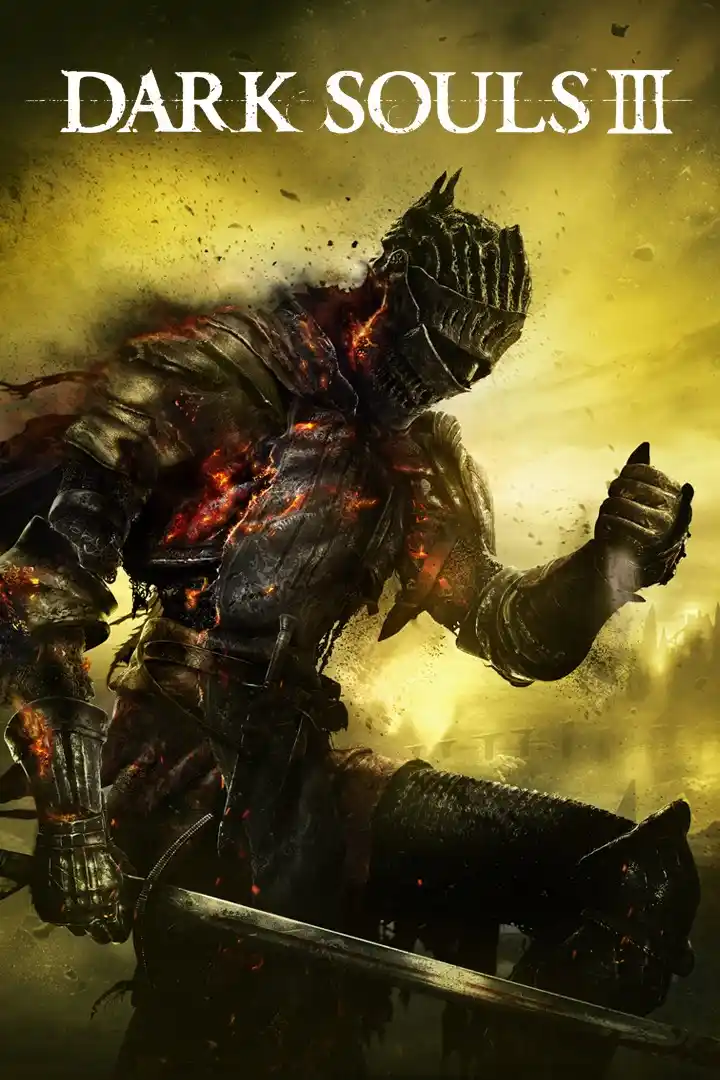
Dark Souls III
 89
★ /10
89
★ /10
 PC
PC PS4
PS4 Xbox One
 FromSoftware, Inc.
 Bandai Namco Entertainment

Dark Souls III is a 2016 action role-playing game developed by FromSoftware and published by Bandai Namco Entertainment. Released in Japan on March 24, 2016, and worldwide on April 12, 2016, for PS4, Xbox One, and PC, it is the third and final mainline entry in the Dark Souls series, directed by Hidetaka Miyazaki following his absence from Dark Souls II.
It holds a Metacritic score of 89 on PS4 and PC. The r/patientgamers thread “Dark Souls 3 is a 2016 game that looks and plays like a 2026 game” currently appears in the Knowledge Panel for this query — the most positive possible framing from the “patient gamer” community. The Fextralife wiki for the game draws more than 12,000 monthly organic visitors from a single Google search, a figure exceeding both Dark Souls and Dark Souls II‘s equivalent numbers and reflecting a playerbase that has remained active through a decade of subsequent FromSoftware releases.
Technical Specifications
| Attribute | Details |
|---|---|
| Developer | FromSoftware |
| Publisher | Bandai Namco Entertainment |
| Director | Hidetaka Miyazaki |
| Lead Composer | Yuka Kitamura |
| Platform(s) | PlayStation 4 · Xbox One · PC |
| Release Date | Japan: Mar 24, 2016 · NA/EU: Apr 12, 2016 |
| Genre | Action RPG |
| Mode(s) | Single-player · Online (co-op, PvP, arena) |
The Undying Kingdom of Lothric
Dark Souls III takes place in Lothric, a kingdom in the final stages of the first flame’s decay — a kingdom whose history is saturated with the cycles of fire-linking and hollowing that the previous games established. The player character is an Unkindled, a failed undead who attempted to link the First Flame and was reduced to ash, now raised at the end of an era when the Lords of Cinder who linked the flame before have abandoned their thrones and must be brought back by force.
The world is the most explicitly nostalgic in the series. Irithyll of the Boreal Valley is architecturally a descendent of Anor Londo; the game visits Anor Londo itself in a sequence that revisits both its layout and its emotional register from the first game in a different key. The lore connects specific characters to figures from the first Dark Souls — Yhorm the Giant and his connection to Siegmeyer’s bloodline, Aldrich who consumed the gods — in ways that reward players who know the first game while functioning independently for those who do not.
The game’s final boss, the Soul of Cinder, is a composite entity — every soul that has ever linked the First Flame accumulated into a single form — who fights using the movesets of the series’ major classes before shifting in its final phase to what reads unmistakably as a remembrance of Lord Gwyn. It is Miyazaki’s conclusion to a story he began in 2011.
Combat: The Fastest Dark Souls
Dark Souls III is substantially faster than its two predecessors — a deliberate shift toward the speed and aggression of Bloodborne (2015) that Miyazaki was developing concurrently. Enemies hit more frequently and with more follow-up attacks; the player’s roll animation executes more quickly; the consequence of hesitating in a fight is more immediately punishing. Invincibility frames during a roll are fixed regardless of stats (correcting the Agility system from Dark Souls II), and the combat’s baseline competence ceiling is higher than either predecessor.
The practical effect is that Dark Souls III rewards attacking more than either previous entry. Stamina management remains essential, but the game’s enemy design punishes turtling — players who hide behind shields find significantly fewer opportunities than those who roll through attacks and respond. Most of the game’s most celebrated boss encounters are calibrated around this aggressive exchange rather than patient defensive play.
Weapon Arts
Dark Souls III introduced the Weapon Art system: each weapon in the game has a unique special attack activated by pressing the skill button (left trigger + attack). A straight sword’s weapon art might be a parry setup; an ultra greatsword’s might be a two-handed stance that staggers armoured enemies; a curved sword’s might be a rapid stepping slash. The system provides meaningful differentiation between weapons that might otherwise appear similar in the basic moveset.
Weapon Arts became the direct ancestor of Elden Ring‘s Ashes of War — the item-based ability system that allows arbitrary assignment of weapon skills to any weapon in that game. Players who come to Dark Souls III from Elden Ring will recognise the structural logic immediately, and players who play this game before Elden Ring will encounter the simpler, more constrained form of a system that the later game expands significantly.
Key Bosses
Dark Souls III produced several encounters that are now among the most discussed in the series:
Pontiff Sulyvahn is the mid-game difficulty wall for many players — a fast, aggressive dual-blade boss who spawns a phantom clone of himself partway through the fight and attacks in rapid overlapping patterns. He is where the game’s combat ethos becomes non-negotiable.
Dancer of the Boreal Valley guards the entrance to the late game but can be fought after the third Lord of Cinder via an NPC interaction, creating one of the game’s most famous challenge routes: defeating her early requires a level of combat mastery far beyond what the game otherwise demands at that point.
Nameless King is the hardest optional boss in the base game — a two-phase encounter involving a dragon and its rider in an arena above the clouds, with a camera that struggles with the aerial phase and attacks that punish any approach. He is disproportionately present in “best Souls bosses” lists.
Yhorm the Giant is structurally the most divisive boss in the game — a large gimmick fight resolved quickly once its mechanic is discovered — but his associated questline involving Siegward of Catarina is the game’s most emotionally effective optional storyline: the NPC’s dramatic arrival at exactly the right moment to fight alongside the player, honouring a promise he made to an old friend, is cited as one of the most memorable gameplay moments in the trilogy.
Ashes of Ariandel
The first DLC expansion, Ashes of Ariandel, released October 25, 2016. Set in a Painted World — an alternate dimension where unwanted things are contained — it adds approximately two to four hours of content centred on Sister Friede and her father Ariandel. Friede is one of the most acclaimed boss designs in the game’s history: a three-phase encounter (two with Friede, the third with Friede and Ariandel together) distinguished by AI that genuinely adapts to the player’s position and a difficulty that dramatically exceeds the base game’s final boss. The DLC also introduced The Undead Match, a dedicated arena for PvP duels and brawls that provided structured competitive play outside the invasion system.
The Ringed City
The second and final DLC, The Ringed City, released March 28, 2017, and is widely treated as the conclusion not just to Dark Souls III but to the entire Dark Souls series. Set at the literal end of the world — in the Dreg Heap where all things eventually accumulate as the fire dies — it follows the player’s pursuit of Slave Knight Gael across a collapsing landscape to a confrontation at the edge of everything.
Gael is the final boss of The Ringed City and, by most community consensus, the best boss in Dark Souls III and among the best in the series. The fight is kinetic, emotionally resonant, and mechanically fair in a way that several of the game’s more demanding bosses are not. His moveset is varied across three phases; the arena is vast; the score shifts from orchestral to vocal partway through. The lore of why Gael is there — what he has spent a lifetime collecting and why — is communicated through item descriptions and environmental storytelling rather than direct narrative, and it recontextualises his presence in a way that the fight earns rather than states.
The Ringed City also contains Midir, an enormous dragon whose optional boss encounter represents the highest-damage endurance fight in the series and is recommended only after considerable preparation.
Both DLCs are included in the The Fire Fades Edition (released May 2017), which is the recommended purchase.
Is DS3 Beginner Friendly?
“Is Dark Souls 3 beginner friendly?” is one of the game’s People Also Ask results, reflecting a genuine evaluative question. The answer the community gives most consistently: yes, with qualifications, and more beginner-friendly than either predecessor.
The combat’s responsiveness — faster rolls, cleaner i-frames, more immediate feedback on attack timing — means that the player’s skill development translates more directly to progress than in Dark Souls, where mechanical opacity can cause difficulty beyond intended design. The most actively populated online community in the trilogy (for summoning assistance with bosses) reduces the friction of specific hard encounters. The game is more linear in structure than Dark Souls, reducing the navigational difficulty of finding the next progression point.
The qualifications: the game expects combat engagement at a pace that DS1 does not, and its early areas are harder than DS1’s equivalent. The bosses after the midpoint (Pontiff onwards) require a level of mechanical comfort that some new players reach more easily having played the earlier entries.
The practical recommendation that has settled in the community: DS3 first if the goal is to test whether the genre is enjoyable before committing to the full trilogy. DS1 first if the goal is to understand the narrative foundation and experience the world design at its most deliberate. DS3 is the more immediately satisfying product; DS1 is the more formative experience.
The Dark Souls III of Dark Souls
A Eurogamer retrospective titled “Dark Souls 3: the Dark Souls 3 of Dark Souls” captures the critical consensus from a particular angle: Dark Souls III is the series at its most crystallised. It does everything Dark Souls did but faster, more polished, with more content, and with twelve additional years of FromSoftware’s combat iteration behind it. As a demonstration of what the Soulslike formula is capable of at the end of its first decade, it is the cleanest possible answer.
The implication is that it is also the least surprising. Dark Souls was unprecedented. Dark Souls II was experimental. Dark Souls III is expert. The lack of the first game’s world-design revelation or the second game’s structural risk-taking is the most accurate criticism of it, and it is not much of a criticism: making something this good by executing a known formula with extreme skill is its own achievement.
Reception
Dark Souls III holds a Metacritic score of 89 on PS4 and 89 on PC, consistent with the franchise’s previous entries. It was the fastest-selling FromSoftware game at launch — shipping three million copies in its first ten days — and has sustained a Steam concurrent player count in the thousands for a decade. The game’s active online population for invasions and co-op is higher than either predecessor by an order of magnitude, a consequence of the PC player base’s consistent reinvestment in the title.
The Fire Fades Edition, including both DLCs, is the recommended version. No native PS5 or Xbox Series port has been released, though the PS4 version benefits from backward compatibility enhancements on those platforms.