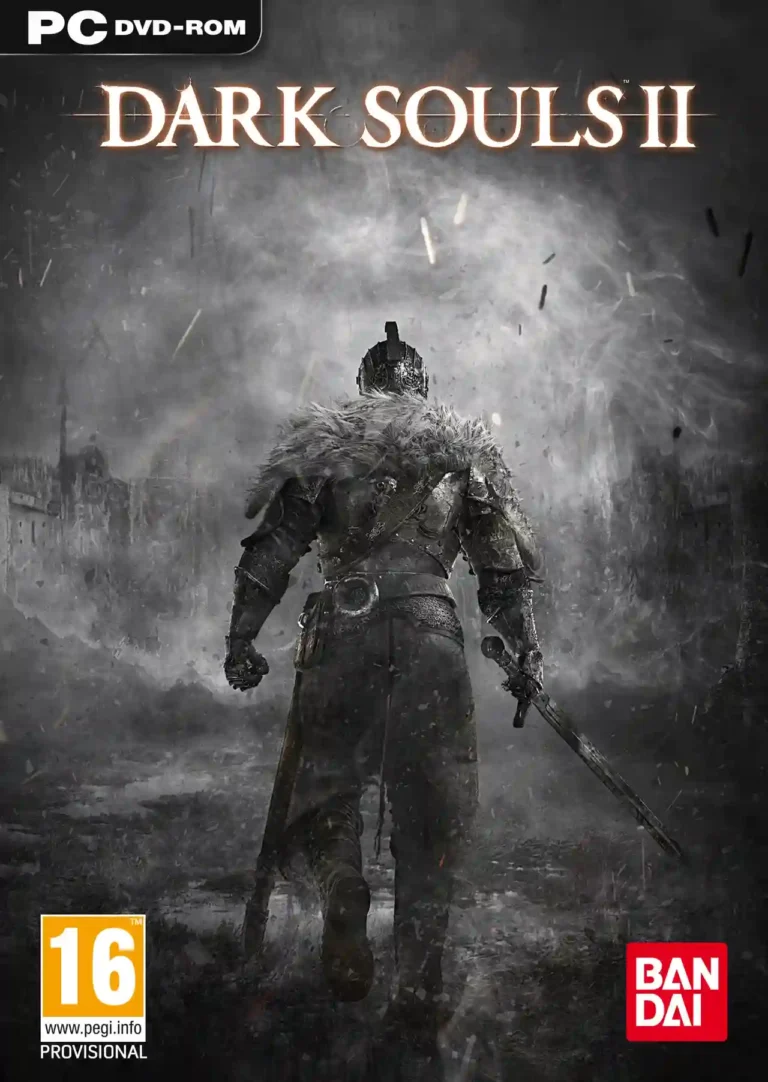
Dark Souls II
 91
★ /10
91
★ /10
 PC
PC PS 3
PS 3 PS4
PS4 Xbox 360
 Xbox One
 FromSoftware, Inc.
 Bandai Namco Entertainment

Dark Souls II is a 2014 action role-playing game developed by FromSoftware and published by Namco Bandai Games. Released for PlayStation 3 and Xbox 360 on March 11, 2014 (North America), with a PC version following in April, it is the second entry in the Dark Souls series and the only mainline Souls game not directed by Hidetaka Miyazaki. A revised and expanded version, Scholar of the First Sin, released in April 2015 for PS4, Xbox One, and PC and is the current standard edition on all storefronts.
It holds a Metacritic score of 91 on PS3 — tied with the first game on the same platform. The r/patientgamers thread “Dark Souls 2 is good actually” appears three times in the top twenty organic results for this game in Google search, across multiple posts from different years. No other game in this project has generated that specific phrase in that volume. This is the defining fact about Dark Souls II‘s reputation in 2026.
Technical Specifications
| Attribute | Details |
|---|---|
| Developer | FromSoftware |
| Publisher | Namco Bandai Games |
| Directors | Tomohiro Shibuya · Yui Tanimura |
| Composer | Motoi Sakuraba · Yuka Kitamura |
| Original Platforms | PS3 · Xbox 360 · PC |
| Current Platform | PC (Scholar of the First Sin, app 335300) · PS3/360 (original) |
| Original Release | PS3/Xbox 360: Mar 11, 2014 (NA) · PC: Apr 25, 2014 |
| Scholar of the First Sin | April 7, 2015 (PS4, Xbox One, PC 64-bit) |
| Genre | Action RPG |
| Mode(s) | Single-player · Online (co-op, PvP, arena) |
What Happened in Development
When Dark Souls shipped in 2011, Hidetaka Miyazaki was already committed to his next project: Bloodborne, the PS4-exclusive Gothic horror action RPG that would release in 2015. Dark Souls II was developed in parallel — by a separate team at FromSoftware under directors Tomohiro Shibuya and Yui Tanimura — while Miyazaki was unavailable. He returned to the Souls series as director for Dark Souls III (2016).
This fact is the most-cited contextual explanation for why DS2 feels different. The game is not a failure of the formula so much as a different team’s interpretation of it — one that expanded certain systems, contracted others, and made mechanical decisions that Miyazaki subsequently reversed. Some of those decisions are the source of the game’s reputation problem. Some of them are the source of its most passionate defenders.
Drangleic: Setting and Tone
Dark Souls II takes place in Drangleic, a kingdom of uncertain relationship to Lordran — some lore reading suggests it is the same geography in a later time cycle, others that it is adjacent territory. The player character is an undead who has travelled far in search of a cure for the hollowing curse, and arrives in Drangleic drawn by the promise of the kingdom’s king, Vendrick, who reportedly found a solution. He is long gone when the player arrives.
The tone is more melancholic and less mythological than the first game. Where Dark Souls built its world from the wreckage of a dying god’s sacrifice, DS2 is preoccupied with the idea of a curse that repeats across time — cycles of kingdoms that rise, hollow, and collapse, with the player arriving always at the end of one. The game explicitly engages with this theme in a way the first game left implicit. Scholar of the First Sin adds the character Aldia, Vendrick’s brother and a self-described seeker of truth, who appears throughout the game to offer commentary on the curse and the choices it produces, and whose questline yields an additional ending.
Majula, the hub area replacing Firelink Shrine, is frequently cited as the most atmospheric hub in the series: a clifftop coastal village that catches the setting sun over the sea, populated by NPCs who arrive one by one as the player progresses, whose soundtrack — a gentle, melancholy piano piece by Motoi Sakuraba — plays differently at different times of day. The community’s attachment to Majula is disproportionate to its size and functions as the single most cited positive element of the game.
What DS2 Changed
Dark Souls II made several mechanical decisions that diverged from the first game and that define how it is experienced differently:
Agility is a new stat governing the invincibility frames during a roll — the core defensive mechanic of the Souls formula. In Dark Souls, i-frames were fixed; in DS2, they begin low and increase as Agility is levelled. The practical effect is that a player who does not invest in Agility finds enemy attacks connecting through rolls that felt safe in the previous game. The Agility system is the source of the most consistent mechanical criticism and was removed from Dark Souls III.
Hollowing and HP work differently: dying gradually reduces maximum HP (down to 50% at maximum hollowing), which is restored by consuming Effigies (limited-supply items). This creates a persistent pressure that incentivises caution or item management in ways the original’s humanity system did not.
Build freedom is significantly expanded. DS2 has the most diverse weapon and armour roster in the trilogy, with a large number of viable build archetypes, a dual-wielding power stance system (pressing the attack button with both weapons simultaneously triggers a unique moveset), and an adaptability stat that consolidates ADP and AGL effects, allowing players to design characters more flexibly than either predecessor or successor allowed.
The Bonfire Ascetic is a consumable that resets a boss and respawns enemies at a specific bonfire while permanently increasing the area’s difficulty tier. It enables players to fight bosses multiple times, access NG+-level items early, and provides a form of optional endgame challenge. It has no equivalent in any other Souls game.
The Case for DS2: Content, DLC, and the Arena
The argument made by the “is good actually” threads is not that DS2 has no problems — the agility system, the hitboxes, the variable lighting downgrade from the “Project Dark” trailers — but that its positives are undersold relative to those problems.
Volume: Dark Souls II is the largest Souls game by content, with more areas, more bosses, and more hours of exploration than either the first game or Dark Souls III.
The DLC trilogy is widely considered the strongest DLC package in the Souls series, and possibly in FromSoftware’s catalogue. Three expansions — Crown of the Sunken King, Crown of the Old Iron King, and Crown of the Ivory King — each add a full zone with distinct visual identity, unique enemies, and bosses that the community frequently ranks among the best in the series:
Fume Knight (Crown of the Old Iron King) is the most discussed: an aggressive, unrelenting humanoid boss who has discarded his armour and fights in a style that anticipates the design philosophy of Bloodborne and later entries. He is one of the most mechanically demanding optional bosses in any FromSoftware game and one of the most consistently cited by experienced players as a favourite encounter.
Burnt Ivory King (Crown of the Ivory King) introduces a mechanic in which the player must locate and recruit specific NPC knights before the boss encounter, each of whom fights alongside the player in the resulting battle — a co-operative, context-dependent encounter whose setup the community has not found replicated elsewhere in the series.
The dedicated PvP arena — Undead Purgatory, later expanded through Covenant activities — provided structured player-versus-player competition with rankings and rewards, a feature not present in Dark Souls and only partially implemented in Dark Souls III.
Scholar of the First Sin
Scholar of the First Sin is the standard edition for new players. It includes all three DLCs, improved technical performance (64-bit engine, higher resolution, better framerate on PS4/Xbox One/PC), and two substantive content changes: revised enemy and item placement throughout the base game (intended to rebalance the experience and close farming exploits), and the addition of Aldia and his questline.
The community is divided on the revised enemy placement: some consider it more coherent than the original, others prefer the original’s configuration and note that several fan-favourite item locations were changed. For a first playthrough, Scholar of the First Sin is the practical recommendation. The original PC version (app 236430) remains available on Steam but is not maintained.
Is DS2 Worth Playing?
The repeated appearance of “Dark Souls 2 is good actually” in r/patientgamers — a subreddit specifically oriented toward patient, considered engagement with older games — reflects a specific player profile: people who came to DS2 after the consensus had formed, without the expectation of DS1‘s interconnected world or DS3‘s mechanical refinement, and found a large, distinctive, melancholic game with DLC as strong as anything in the series.
The community has not reached consensus. The agility controversy, the hitbox criticisms, and the directorial absence of Miyazaki are permanent features of how the game is discussed. So is Majula, the Fume Knight, and the sense that DS2 attempted something different enough from its predecessor to be evaluated on its own terms rather than as a failed sequel.
Reception
Dark Souls II received a Metacritic score of 91 on PS3 (86 on PC), broadly positive reviews citing the expanded content and faithful extension of the formula, with criticism centred on pacing, enemy placement, and the agility system. The original release’s performance on PC was notably poor, largely resolved in Scholar of the First Sin. GameSpot’s review, titled “A Newcomer in Drangleic,” placed it as one of the strongest entries in an emerging franchise; subsequent critical reception has remained stable while community opinion has remained genuinely divided.
The game has no native PS5 or Xbox Series port, and no remastered edition has been announced. It is the only Souls game without a native current-generation release, and its PC version (Scholar of the First Sin, 64-bit) is the most actively maintained platform for new players.