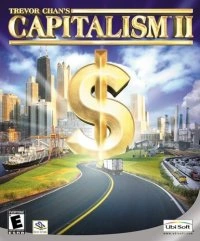
Capitalism II
 82
★ /10
82
★ /10
 PC
PC
 Ubisoft


Capitalism II (simplified Chinese: 金融帝国II) is an in-depth business simulation and economic strategy video game developed by Enlight Software and originally published by Ubisoft. Released in December 2001 for Microsoft Windows, with a Mac OS X port following via Virtual Programming, the title is the direct sequel to the 1995 masterpiece Capitalism.
Designed by legendary industry figure Trevor Chan, Capitalism II overhauls its predecessor’s layout, migrating from a raw data-entry spreadsheet framework to a vibrant, pseudo-isometric city engine. The game is widely praised as one of the most mechanically accurate, complex corporate simulation games ever engineered, modeling vertical production pipelines, corporate branding, real estate development, and cutthroat stock market actions with rigorous fidelity.
Technical Specifications
| Attribute | Details |
| Developer | Enlight Software |
| Publisher(s) | • Ubisoft (Original retail) • Retroism / Enlight Software (Digital distribution) |
| Lead Designer | Trevor Chan |
| Engine | Upgraded 2D Pseudo-Isometric Engine |
| Platform(s) | Microsoft Windows, Mac OS X |
| Release Date | December 17, 2001 |
| Genre(s) | Business simulation, Economic strategy |
| Modes | Single-player, Multiplayer |
Core Gameplay Architecture
The central gameplay mechanics of Capitalism II place the player in the role of a corporate Chief Executive Officer (CEO) tasked with growing a small localized business into a multi-national conglomerate while surviving aggressive free-market competition.
The Pseudo-Isometric City Blueprint
Departing from the flat tile matrices of the 1995 original, Capitalism II introduces a living, dynamic 2D visual style reminiscent of SimCity 3000. Players interact with an active simulation of major municipal environments, complete with tracking traffic metrics, fluctuating land costs, and visible customer crowds moving into individual retail department store blocks. The macroeconomy requires players to navigate over 60 distinct product classifications—spanning from consumer electronics and heavy automobiles to refined apparel and soft beverages.
The Vertical Supply Chain & Internal Grid
Production models remain tethered to an internal 3×3 Functional Module Grid. When constructing a Factory, R&D Center, or Retail outlet, the building does not function as a generic automated queue. Instead, the player must manually link operational blocks internally:
- Purchasing Units: Establish shipping channels to source physical raw materials or wholesale commodities from farms, mines, or international ports.
- Manufacturing Units: Refine imported supplies into complex consumer goods. The speed of production is determined by the experience level of the module workforce.
- Sales Units: Handle output distribution, routing completed items directly to market shelves or secondary industrial factories.
- Advertising Units: Link directly to local media entities (Newspaper, Television, Radio networks) to pump cash into localized brand awareness campaigns.
Key Feature Expansions
Capitalism II expanded its mechanical complexity significantly beyond its predecessor by introducing new macro-systems and structural variants:
Real Estate Development
The most drastic mechanical upgrade to the simulation is the integration of a full-scale Commercial and Residential Real Estate market. Players are no longer forced to strictly stick to manufacturing pipelines; they can spend capital to purchase land in highly populated city centers to construct towering corporate skyscrapers, commercial office towers, and luxury high-rise apartment complexes. Property values fluctuate based on adjacent economic development, and players can tweak rental price percentages to generate a highly stable, recurring passive cash loop completely independent of store sales.
The Executive C-Suite Roster
To alleviate late-game micromanagement as a corporate empire grows across multiple cities, players can construct a Headquarter corporate base to recruit highly specialized upper-management executives:
- Chief Operating Officer (COO): Can be handed full authority over the day-to-day operations of retail storefronts and factories, automatically swapping out supplier routes if old resource nodes dry up.
- Chief Marketing Officer (CMO): Handles the automated balancing of media marketing budgets, shifting advertising investments across local channels based on optimal demographics.
- Chief Technical Officer (CTO): Directs tech progression across specialized Research & Development laboratories to preserve a persistent quality advantage over competitor lines.
Dual Strategic Campaigns
The single-player landscape guides players across two independent campaign trajectories designed for differing expertise thresholds:
- The Entrepreneur Campaign: An in-depth, scenario-driven operational framework that acts as an advanced tutorial. Scenarios ease players into complex systems, tasking them with completing small, localized goals such as rescuing a failing agricultural firm or balancing a single retail chain under a strict time limit.
- The Capitalist Campaign: An unguided, high-stakes operational gauntlet where players are dropped into global maps against ultra-aggressive AI syndicates. Winning requires absolute dominance across global market shares, forcing players to orchestrate hostile stock takeovers and industrial monopolies.
The Stock Market Engine
The game features an intensely realistic financial trading simulator. Unless restricted by scenario parameters, players can manage corporate capital and personal wealth directly on the public stock exchange.
“In Capitalism II, the stock market behaves less like a generic high-score screen and more like an aggressive weapon. Miscalculating your corporate equity ratios leaves your board of directors wide open to systematic hostile infiltration by the AI.” — Computer Gaming World Review Archive
Public entities issue equity stock that fluctuates based on quarterly profit margins, cash reserves, and global economic health index variables. Executives can order corporate Stock Buybacks to lock up controlling majorities, split shares to lower trading barriers, short sell overvalued competitor assets to capitalize on industrial recessions, or issue high-yield cash dividends to keep major public shareholders from liquidating their stock blocks during a downturn.
History, Reception, and Modern Status (2026)
Critical Impact
Upon its winter 2001 launch, Capitalism II received highly favorable reviews from mainstream strategy and computing publications. It holds a composite score of 82/100 on review aggregator Metacritic. Outlets like IGN presented a 9/10 score, while GameSpot awarded it an 8.5/10, crowning it the undisputed standard of serious financial simulation gaming. Critics heavily lauded the incredible educational depth of the supply chains and the thrilling nature of the stock market. Minor criticisms targeted confusing nested menus and generic, uninspired musical choices.
The Evolution into Capitalism Lab
On December 14, 2012, Enlight Software shifted its long-term focus by deploying Capitalism Lab—a specialized, continually upgraded standalone expansion designed specifically for hardcore simulation purists.
As of 2026, Capitalism Lab serves as the modern standard evolution of the franchise. While Capitalism II represents the classic layout, Capitalism Lab adds full modern widescreen optimization, multi-core architecture support, and highly advanced specialized expansion packs including the Banking and Finance DLC (enabling the running of commercial banks and insurance firms) and the Digital Age DLC (simulating e-commerce and high-tech internet startup disruptions).
Digital Preservation
As of May 2026, Capitalism II remains fully preserved, active, and commercially available via digital distribution storefronts such as Steam and GOG.com under the cooperative publisher management of Retroism.
The client functions cleanly on modern multi-core Windows 10 and Windows 11 hardware configurations out-of-the-box, with no severe emulation layers required. The codebase maintains native resolution adjustments up to 1080p, while the classic, crisp 2D isometric shoppers and trading floors perform at steady frame rates, remaining highly accessible for strategy historians and corporate simulation purists.