Capitalism
 PC
PC
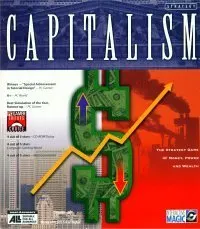
Capitalism is a complex business simulation and economic strategy video game developed by Enlight Software and published by Interactive Magic. Released in October 1995 for MS-DOS and Mac OS, the game was designed by legendary strategy designer Trevor Chan and serves as the foundational debut entry of the celebrated Capitalism franchise.
Widely considered by critics and economists to be one of the most mechanically rigorous, comprehensive, and accurate business simulation games ever programmed, Capitalism completely discards superficial structural decoration mechanics common to casual tycoon games. Instead, it tasks the player with acting as the Chief Executive Officer (CEO) of a multi-national conglomerate, requiring deep spatial and numerical micro-management over vertical supply chain pipelines, corporate marketing campaigns, research and development paradigms, and highly volatile stock market trading loops.
Technical Specifications
| Attribute | Details |
|---|---|
| Developer | Enlight Software |
| Publisher | Interactive Magic |
| Designer / Programmer | Trevor Chan |
| Engine | Custom 2D Numerical Simulation Matrix |
| Platform(s) | MS-DOS, Mac OS |
| Release Date | October 31, 1995 |
| Genre | Business simulation, Economic strategy |
| Mode | Single-player |
Gameplay Architecture & The Vertical Supply Chain
In a standard free-form match, the player initializes their tenure with a maximum of $200,000,000 in liquid seed capital. To build a dominant corporate empire while competing against aggressive, highly adaptive AI corporations, the player must establish and optimize a multi-tiered supply chain pipeline spanning over 50 unique consumer commodities—ranging from apparel and processed foodstuffs to complex electronics and automobiles.
The Three Operational Strata
The macroeconomic engine operates across three distinct corporate layers, requiring players to balance the unique logistical realities of each tier:
- Raw Material Extraction & Farming: The foundational layer of production. Players can construct oil wells, logging camps, and chemical mines to extract planetary resources. Concurrently, players can operate massive Farms to grow crops (e.g., wheat, cotton) or raise livestock for milk, meat, and leather. These enterprises are heavily tied to local weather cycles and soil fertility metrics.
- Manufacturing and Factory Layouts: The industrial refinery node. Players build factories to combine multiple raw components into finished consumer goods. The internal operation of a factory is handled via a specialized 3×3 Functional Grid Matrix. Players must manually wire up internal functional blocks—including Purchasing Units (sourcing materials from internal mines or foreign suppliers), Processing/Manufacturing Units (refining the items), Sales Units (routing items to storehouses), and Advertising Blocks. Bottlenecking an internal block halts production across the entire facility.
- Retailing & Department Stores: The final pipeline phase that interfaces directly with the simulated consumer public. Players operate a network of Department Stores to sell products. Each storefront can hold up to four distinct items simultaneously. Retailing success requires careful optimization of localized land costs, consumer population density, and direct competitor pricing arrays.
The Core Product Index
Consumer demand and retail velocity for any given commodity are dynamically calculated based on three core parameters managed by the player:
Overall Competitiveness = f(Price,Product Quality,Brand Awareness)
Product Quality is heavily dictated by the technological sophistication of the factory machinery and the raw materials used. To systematically elevate this metric, players must fund Research and Development (R&D) Centers. Allocating R&D budgets to long-term tech cycles (ranging from 6 months to 10 years) unlocks exponential technology gains, granting massive quality modifiers that allow a player to establish an unassailable monopoly over market segments. Brand Awareness is amplified by funneling millions of dollars into localized newspaper, radio, and television advertising channels.
Corporate Finance & The Stock Market
Beyond managing storefront inventories and factory logistics, Capitalism features an intensely deep corporate finance simulation driven by an active Stock Market Engine. Unless restricted by custom scenario scripts, players can actively trade public shares mid-match:
“The stock market in Capitalism transforms the game from a standard logistics manager into a cutthroat corporate thriller. A player can have flawless department store margins, only to be completely dismantled by a competitor executing a hostile takeover of their corporate board.” — Editorial Strategy Retro Review
- Equity Accumulation: Players can use their personal wealth or corporate capital to buy up shares of their own company or competitor corporations. Holding a dominant majority stake grants direct operational control over rival facilities.
- Hostile Takeovers: If a player allows their stock price to crater due to mismanagement or excessive debt, aggressive AI executives will systematically launch coordinated stock buy-ups, forcefully seizing control of the player’s board and triggering an instant bankruptcy game-over.
- Capital Manipulations: To defend their company or generate shareholder value, CEOs can order corporate Stock Buybacks to consolidate equity, issue cash dividends to keep investors content, short sell overvalued rival stocks, or issue fresh shares to immediately generate liquid operational capital during recessions.
Real-World Academic Application
Because Capitalism features an incredibly accurate simulation of macroeconomic forces—including consumer demand elasticities, inflation loops, corporate tax structures, and economic recessions—it transcended the boundaries of traditional interactive entertainment to become a recognized serious game tool for real-world business pedagogy.
During the late 1990s and early 2000s, elite academic institutions—including Harvard University, Stanford University, and the Wharton School of the University of Pennsylvania—officially integrated Capitalism (and its subsequent expansion Capitalism Plus) into their MBA and undergraduate economics curricula. Professors utilized the simulation as a dynamic laboratory, forcing students to apply theoretical corporate strategies, manage complex balance sheets, and test pricing theories within a risk-free, highly complex digital marketplace.
History and Franchise Evolution (2026)
Capitalism Plus (1996)
Following the critical milestone success of the 1995 original, Enlight and Interactive Magic deployed Capitalism Plus in 1996 for Windows 95. This expanded edition introduced high-resolution SVGA graphics, mapped out real-world global maps, integrated complex custom map editors, and injected several new industries including luxury jewelry lines and heavy electronics manufacturing.
Capitalism II (2001)
In 2001, Ubisoft and Enlight launched the official mainline sequel, Capitalism II. This version introduced a fully modernized 3D graphics shell, added highly detailed specialized retail outlets (such as dedicated grocery stores, apparel boutiques, and electronics shops), and implemented an expansive Real Estate Investment System allowing players to construct commercial skyscrapers and high-rise apartments to generate stable rental income.
Capitalism Lab (Modern Era)
On December 14, 2012, Enlight Software bypassed traditional sequel cycles by launching Capitalism Lab, a highly specialized, continuously updated standalone expansion of Capitalism II designed specifically for hardcore simulation purists.
As of 2026, Capitalism Lab remains actively supported, heavily modded, and stands as the definitive global benchmark for business strategy simulations. Supported by highly complex official downloadable content (DLC) packages—including the Subsidiary DLC, City Economic Simulation DLC, Digital Age DLC, and Banking and Finance DLC—the platform allows players to simulate high-tech internet startup disruptions, run full banking institutions, manage local city mayoral policies, and integrate custom player-made mods adding thousands of modern industries.
Meanwhile, the original 1995 Capitalism and 1996 Capitalism Plus gems remain fully preserved and available across modern digital distribution retro showcases like GOG.com and Retroism, allowing strategy historians to experience the exact foundation that birthed the genre.