Call of Juarez: Gunslinger
 76
★ /10
76
★ /10
 Nintendo Switch,
  PC,
PC,  PS 3,
PS 3,  Xbox 360
 1C-SoftClub, Techland,
  Ubisoft


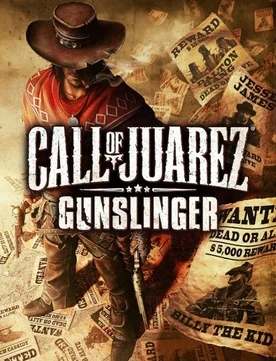
Call of Juarez: Gunslinger is a 2013 Western-themed arcade first-person shooter video game developed by Techland and published originally by Ubisoft. Released on May 22, 2013, for Microsoft Windows, PlayStation 3, and Xbox 360 (with a native Nintendo Switch port deployed later in December 2019), the title stands as the fourth installment in the Call of Juarez franchise and a standalone mechanical spin-off completely unrelated to the historical narrative arcs of the McCall bloodline.
Conceived as a direct creative course correction following the devastating critical and commercial failure of 2011’s Call of Juarez: The Cartel, Techland utilized Gunslinger to successfully redeem the reputation of the brand. Dropping the clunky modern-day drug grids and generic military templates, the developers returned the series to its 19th-century frontier roots. Stripping away open-world bloat to focus entirely on a highly stylized, fast-paced linear score-attack framework, the game achieved immense critical acclaim, heavily praised for its unique unreliable narrator mechanic, comic-book cel-shaded aesthetics, and incredibly punchy, addictive arcade gunplay loop.
Technical Specifications
| Attribute | Details |
| Developer | Techland |
| Publisher | Ubisoft (2013–2018) / Techland Publishing (2018–present) |
| Lead Designer | Wojtek Podgórski |
| Writer | Haris Orkin |
| Composer | Paweł Błaszczak |
| Engine | Chrome Engine 5 (Re-engineered for stylized vector shading and high-velocity physics) |
| Platform(s) | Microsoft Windows, PlayStation 3, Xbox 360, Nintendo Switch |
| Release Date | May 22, 2013 (Nintendo Switch Launch: December 9, 2019) |
| Genre | Arcade First-person shooter |
| Mode(s) | Single-player |
The Tall Tales of Abilene: The Unreliable Narrator Matrix
The single-player campaign takes place during a single rainy night in Abilene, Kansas, in the year 1910. The story begins as an aging, enigmatic legendary bounty hunter named Silas Greaves walks into a local saloon to rest his boots. Recognized by the locals, Silas agrees to regale those present—including the bartender Molly, an old-timer named Steve, a sarcastic skeptic named Jack, and a wide-eyed, captivated teenager named Dwight (who is subtly revealed to be a young, historical Dwight D. Eisenhower)—with the staggering exploits of his youth.
Silas claims that his entire life was a decades-long, blood-soaked quest for raw vengeance, hunting down the trio of outlaws who brutally murdered his brothers.
The game’s narrative structure functions as a phenomenal, highly inventive meta-commentary on historical frontier myths. Silas Greaves is an explicitly unreliable narrator, meaning the gameplay actively warps, rewrites, and retroactively shifts in real-time based on his spoken dialogue, his hazy memories, or the real-time interruptions of the saloon patrons:
- Dynamic World Shifting: If Silas states that an encounter was suddenly ambushed by Apache warriors, the canyon geometry will instantly shift, and Native American models will drop from the sky. If Jack interrupts to point out that Apache troops never operated in that specific territory, Silas will correct himself (“Right, right, it was actually cowboys…”), and the enemy models will dynamically morph into outlaws right in front of the player’s eyes.
- The Retcon Rewind: If Silas forgets how an escape sequence occurred, or if his character path leads directly into a dead end or a sudden death, he will casually declare, “Wait, that’s not how I died,” forcing the game engine to physically rewind the level’s progression timeline like a VHS tape to place the player at an alternative starting branch.
Living Among the Legends: Silas’s tall tales seamlessly place him at the absolute center of every iconic historical standoff of the Old West. Throughout the campaign, players actively team up with, escape from, or face down a massive pantheon of legendary historical outlaws and lawmen, including Billy the Kid, Pat Garrett, Jesse James, John Wesley Hardin, Johnny Ringo, Curly Bill Brocius, and the notorious Butch Cassidy and the Sundance Kid.
Arcade Velocity: Combat and the Skill Grid
Gunslinger completely discarded the slow-paced tactical realism and cover mechanics of the older entries to embrace a high-octane, arcade score-attack design language.
- The Combo Multiplier Pipeline: Every lethal action—such as executing headshots, blasting running targets, shooting sticks of dynamite out of mid-air, or perforating outlaws through thin wooden walls—rewards the player with raw experience points. Chaining kills together before a specialized on-screen meter decays builds up a massive Combo Multiplier, allowing high-skill players to rack up immense score multipliers.
- The Sense of Death: Acting as a high-stakes defensive safety shield, as the player takes continuous damage and their health dips into critical territory, a specialized meter fills completely. Upon receiving what would normally be a fatal ballistic impact, time completely freezes, and the camera switches to a slow-motion perspective tracking the trajectory of the bullet. The player must quickly tilt the analog stick or tap a key left or right to physically dodge the bullet, saving them from a game over screen and instantly refilling their concentration meter.
The game features an incredibly precise, standalone Duel Mode at the conclusion of major chapters. Emulating classic cinematic Mexican standoffs, players manage two conflicting metrics simultaneously: using the left stick or mouse to constantly center a focus reticle directly over the rival gunslinger to maximize hit accuracy, while simultaneously using the right stick or keys to keep their avatar’s hand hovering directly over their gun holster to maximize their raw speed percentage.
Upon hearing a sudden heartbeat audio cue, players can choose to pull their weapon honorably after the enemy draws, or pull early to execute a dishonorable, low-score pre-emptive shot.
Aesthetic Overhaul: The Cel-Shaded Frontier
To distance the title from the generic aesthetic of The Cartel, Techland utilized Chrome Engine 5 to deploy a gorgeous, comic-book-inspired cel-shaded visual design layout. Heavily defined by thick outlines, highly vibrant, painterly color palettes, and stylized ink-splatter post-processing filters, the visuals looked less like a dry military simulation and more like a graphic novel come to life.
The engine was praised for its spectacular particle systems; thick plumes of black gunpowder smoke realistically linger inside indoor saloons, and dynamic sunbeams split dramatically through the gaps of wooden barn structures, giving the arcade action a highly distinctive visual identity.
Contemporary Stance
Call of Juarez: Gunslinger is universally celebrated as the absolute uncompromised creative peak and crown jewel of the entire franchise. Thirteen years separated from its launch, it stands as a legendary text-book example of how a development studio can successfully rescue an intellectual property from the brink of total brand death by narrowing its scope to focus strictly on pure, mechanical fun.
The software enjoys immaculate long-term technical health and wide availability across contemporary computing ecosystems:
The Publishing Reclamation
In April 2018, as the intellectual property agreements with original publisher Ubisoft expired, the game was temporarily delisted from digital store networks alongside The Cartel. However, Techland successfully bought back the full, independent publishing rights to the Call of Juarez IP.
While they chose to leave the poorly received The Cartel in the digital vault, Techland officially brought Gunslinger back to Steam, GOG, and the Xbox/PlayStation storefronts under their own self-publishing banner, guaranteeing its permanent long-term commercial protection.
Digital Health and Cross-Platform Accessibility
On modern platforms, the game is in an exceptional state. The 2019 Nintendo Switch port remains a massive favorite among handheld collectors, praised for integrating excellent, highly precise motion-control gyro-aiming parameters alongside HD Rumble support. On PC via Steam and GOG, the software is fully optimized out-of-the-box for modern 64-bit Windows 11 desktop environments.
The code holds a highly coveted “Verified” status on the Steam Deck architecture, meaning it scales perfectly to native portable settings with full controller mapping configuration. On modern desktop setups, contemporary GPUs easily brute-force the cel-shaded lines of Chrome Engine 5 to native 4K resolutions at un-capped frame rates exceeding 144Hz, ensures that Silas Greaves’ grandiose, whiskey-fueled tall tales remain flawlessly playable for modern action purists.