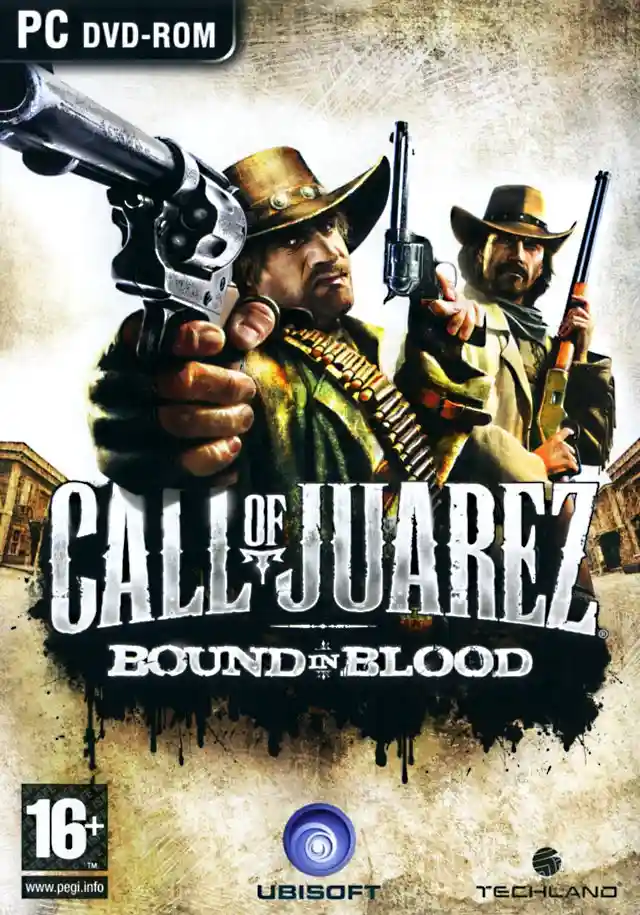
Call of Juarez: Bound in Blood
 77
★ /10
77
★ /10
 PC
PC PS 3
PS 3 Xbox 360
 1C-SoftClub
 Ubisoft

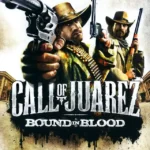
Call of Juarez: Bound in Blood is a 2009 Western-themed action-adventure first-person shooter video game developed by Polish studio Techland and published originally by Ubisoft. Released in June and July 2009 for Microsoft Windows, PlayStation 3, and Xbox 360, the title stands as the second entry in the Call of Juarez franchise and a direct narrative prequel to the 2006 original.
Following the critical validation of the first game’s dual-narrative framework, Techland leveraged Bound in Blood to iron out the mechanical pain points of its predecessor. Dropping the slow-paced stealth platforming entirely, the developers engineered a sleek, adrenaline-fueled action experience. Built on Chrome Engine 4, the prequel achieved widespread critical and commercial success, heavily praised for its spectacular cinematic staging, intense sibling dynamic, and highly refined gunslinging mechanics that deeply enriched the tragic lore of the McCall family bloodline.
Technical Specifications
| Attribute | Details |
| Developer | Techland |
| Publisher | Ubisoft (Publishing rights permanently transferred to Techland in 2018) |
| Lead Designer | Maciej Masiuk |
| Writer | Haris Orkin |
| Composer | Paweł Błaszczak |
| Engine | Chrome Engine 4 (Pioneering material shaders, structural post-processing, and expansive landscape streaming) |
| Platform(s) | Microsoft Windows, PlayStation 3, Xbox 360 |
| Release Date | June 30, 2009 |
| Genre | First-person shooter, Wild West Action |
| Mode(s) | Single-player, Online Multiplayer (Defunct) |
The McCall Brotherhood: Narrative and Prequel Architecture
The single-player campaign opens in the devastating final year of the American Civil War (1864). The plot follows the McCall Brothers—Ray and Thomas—hardened soldiers serving on the frontlines of the Confederate Army during the chaotic Atlanta Campaign. Upon realizing that General Sherman’s troops are advancing directly toward their family estate, the brothers discard their military obligations, deserting their post in a desperate attempt to rescue their mother and younger brother, William, an idealistic, pacifist seminary student.
They arrive too late, finding their mother dead and their ancestral home reduced to ash. Forced to flee from their vengeful commanding officer, the fanatic Colonel Barnsby, the trio heads west into the lawless territories of Arkansas, Texas, and Mexico, transitioning rapidly into notorious outlaws.
The narrative beautifully sets up the dark psychological origin story of Reverend Ray from the 2006 original. To secure the immense capital required to rebuild their family home, the brothers partner with a ruthless Mexican bandit chief, Juan “Juarez” Mendoza, to locate the legendary, cursed Gold of Juarez.
The structural tension shifts from a standard outlaw caper into a gripping psychological tragedy as both Ray and Thomas fall deeply in love with Juarez’s captive mistress, Marisa Reyes. Driven by toxic lust, greed, and paranoia, the brothers gradually turn their weapons on one another, while young William watches in horror, attempting to use his Bible to salvage his brothers’ damned souls before the cycle of violence destroys them all.
Sibling Dualism: Divided Gameplay Mechanics
While the 2006 original automatically forced players to swap characters between chapters, Bound in Blood revolutionized the design loop by letting players actively choose which brother to pilot at the inception of almost every major campaign mission. The unselected brother automatically switches over to a highly aggressive, supportive AI companion.
The two protagonists feature completely distinct mechanical frameworks that dictate tactical approaches to combat zones:
1. Ray McCall (The Heavy Enforcer)
Ray represents uncompromised, short-range ballistic devastation. Heavily built and utterly fearless, Ray can carry heavy structural iron plates to deflect incoming bullet fire. He is the only brother capable of dual-wielding pistols, commanding devastating close-quarters crossfires.
Furthermore, Ray can carry and throw dynamite sticks to flush enemies out of cover, wield heavy gatling guns, and physically kick down locked saloon and fort doors to breach hostile strongholds first.
2. Thomas McCall (The Agile Marksman)
Thomas represents high-speed mobility and surgical precision. Incapable of handling heavy armaments or dual-wielding, Thomas relies on long-range repeating rifles, throwing knives for silent stealth executions, and a traditional wooden hunting bow.
Thomas utilizes a Tactical Lasso to grapple onto high-altitude tree branches, mountain ledges, and structural rooftops, allowing him to easily scale the environment to secure high-ground sniper vantage points to cover Ray’s frontline assaults.
The Split Concentration Architecture
Both brothers accumulate energy to trigger their own distinct iterations of Concentration Mode (the series’ signature bullet-time mechanic). When Ray triggers the mode, the camera locks onto a slow-motion view where the player quickly sweeps the analog stick or mouse to paint targeting reticles across multiple hostiles, executing an instantaneous multi-target firing barrage upon release.
Thomas’s mode operates like a classic quick-draw simulation: the player must actively pull back on the analog stick or mouse to physically simulate pulling back the hammer of his single-action revolver, rapidly fanning the trigger to spray precision lead into a target line.
Open Frontiers: Bounties and Upgrades
Breaking away from strictly linear levels, Bound in Blood famously experimented with open-world design structures across Chapters 6 and 8. The brothers are dropped into massive, free-roaming hub maps representing the expansive wilderness grids of the Old West.
To fund higher-tier weapon upgrades, players can completely ignore the primary narrative markers to browse localized sheriff stations, accepting high-stakes Bounty Hunter Contracts. These side quests task the brothers with tracking down elusive outlaw gangs hiding in remote canyon networks, rescuing civilian hostages, or participating in intense, high-tension Quick-Draw Duels against legendary gunslingers.
The accumulated capital is spent directly at local gunsmith shops to replace rusty, low-tier sidearms with pristine, silver-plated Prime caliber weaponry boasting vastly superior reload metrics and damage stats.
Contemporary Stance & 2026 Perspective
Looking back from mid-2026, seventeen years removed from its global rollout, Call of Juarez: Bound in Blood is celebrated as a premier, masterfully executed historical shooter. While its 2011 sequel (Call of Juarez: The Cartel) temporarily derailed the franchise by shifting to a highly criticized modern-day drug war setting, Bound in Blood is held up alongside the 2013 arcade masterpiece Call of Juarez: Gunslinger as the absolute absolute artistic high-water mark of Techland’s Wild West universe.
The preservation of the title remains remarkably robust today, benefiting from a highly accessible digital and emulative network structure:
The Premium Xbox Series X/S Framework
Unlike the 2006 original, which remains tragically stranded on legacy hardware, the Xbox 360 version of Bound in Blood is fully backward compatible on Xbox One and Xbox Series X/S. Adding the game to the compatibility program back in late 2018 completely saved the game from obsolescence. On modern Xbox Series X/S hardware, system-level architecture effortlessly brute-forces the old 2009 performance caps, running the game at a locked, beautifully fluid 60 frames per second profile with sharpened resolution parameters and near-instant load times via the internal SSD pipeline.
The Standard PC Distribution
On PC via Steam and GOG, the software operates with flawless out-of-the-box stability under modern 64-bit Windows 11 desktop environments. Because Techland successfully reclaimed the full IP publishing rights from Ubisoft, the title remains permanently protected and readily available for purchase. Contemporary graphics cards easily upscale Chrome Engine 4’s expansive draw distances, detailed canyon lighting, and visceral dust particle layers to native 4K resolutions at ultra-high refresh rates exceeding 144Hz.
While the game is technically categorized as Unsupported on the Steam Deck architecture due to legacy driver validation checks and initial mouse-mapping launcher requirements, desktop PC configurations ensure that the tragic, blood-soaked genesis of the McCall brothers remains perfectly preserved for modern gaming purists.