World in Conflict
 89
★ /10
89
★ /10
 PC
PC
 1C-SoftClub,
  ak tronic Software & Services GmbH,
  Sierra,
  Ubisoft
Where to buy

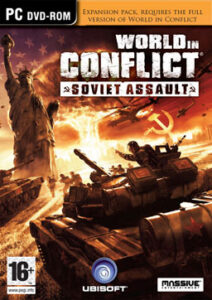
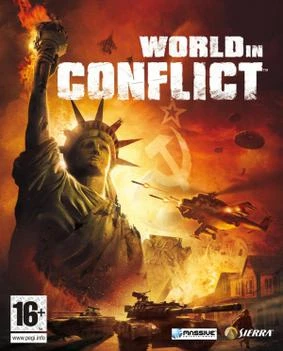
World in Conflict is a 2007 real-time tactics game developed by Massive Entertainment and published by Sierra Entertainment under Vivendi Games, released September 18, 2007 for PC. It holds a Metacritic score of 89, swept awards at E3 2007 before release, topped the sales charts in North America, Germany, and Australia at launch, and earned from GameSpot — in a 9.5/10 — the phrase that stuck: “the studio’s masterwork.” Nearly two decades on it still anchors “most enjoyable RTS I’ve ever played” threads, and the 2018 retrospective that ranks beside it argues it never got a true successor. Its premise is the alternate history every Cold War kid half-expected: it’s 1989, the Soviet Union is collapsing, and instead of falling it invades Seattle.
Two things about its design still startle newcomers. There is no base-building — you command a small force bought with reinforcement points that replenish as you lose it — and there are tactical nukes on the hotbar, in a fully destructible suburban America rendered, in 2007, more beautifully than most games render anything.
Technical Specifications
| Attribute | Details |
|---|---|
| Developer | Massive Entertainment (Malmö; makers of Ground Control) |
| Publisher | Sierra Entertainment / Vivendi Games (later Ubisoft) |
| Engine | MassTech |
| Narrator | Alec Baldwin |
| Release | September 18, 2007 (PC; Xbox 360 and PS3 versions cancelled) |
| Metacritic | 89 · GameSpot 9.5/10 |
| Expansion | Soviet Assault (March 2009) — bundled as the Complete Edition |
| Multiplayer | Massgate — official servers shut Dec 2015 · community revival 2016 · open-sourced by Ubisoft 2017 · massgate.org today |
| Factions | United States · Soviet Union · NATO (campaign: US/NATO only) |
| Genre | Real-time tactics, alternate-history Cold War |
| Mode(s) | Single-player campaign · 16-player multiplayer (Domination, Assault, Tug of War) |
1989: The Soviets Land in Seattle
Facing economic collapse, the USSR gambles on war: a feint in Europe, then cargo ships disgorging an army onto the Washington coast. You are Lieutenant Parker, a silent US Army officer under the hard-bitten Colonel Sawyer, alongside the flawed, unforgettable Captain Bannon and the by-the-book Webb — a cast whose arcs, culminating in one of strategy gaming’s most-remembered sacrifices, gave an RTS campaign the emotional weight of a war film. The missions sweep from Seattle’s suburbs to Europe and back, framed by Alec Baldwin’s narration and set pieces — the shopping-mall firefight, the fall of the Space Needle’s skyline, the final stand at Cascade Falls — that Massive’s own developers still cite as “the fantasy of war in Suburbia.” Soviet Assault later added the Red Army’s six-mission side of the same story.
No Bases, Four Roles, One Button for Armageddon
Massive carried the no-base design forward from its Ground Control series and perfected it: players pick a role — Air, Armor, Infantry, or Support — spend reinforcement points on a handful of units, and win by holding command points, with losses refunding into fresh drops so the fight never stalls. Tactical Aid points, earned in combat, buy artillery, airstrikes, carpet bombing, and the nuclear strike whose mushroom cloud became the game’s signature image. Terrain is fully destructible — forests burn, buildings collapse into rubble that infantry can hold — and the “time as a resource” design essays that still cite the game exist because every second of a round is a decision. Multiplayer, on Massive’s Massgate service, supported sixteen players in role-based teams and was, by broad consensus, the best team-tactics experience of its era.
Play or Pass? What the Community Says
The “play or pass” question gets a near-unanimous answer: play — with two caveats. The campaign (plus Soviet Assault) is roughly twenty hours of the best story an RTS has told, and it runs on modern Windows out of the GOG box. Multiplayer requires a step: the official servers closed in December 2015, the community rebuilt Massgate in 2016, Ubisoft open-sourced the server code in 2017, and massgate.org keeps lobbies alive today — small, but active and friendly to newcomers. The genre comparison threads have settled too: Eugen’s WARNO and Wargame are the modern games closest in spirit, with WARNO’s community openly wishing for “Total WARNO: World in Conflict” — the mod that would be unnecessary if Massive, now Ubisoft Massive and busy with The Division and Avatar, ever came home to it.
Reception and Legacy
The 89 placed it among 2007’s best-reviewed games in a year that included BioShock and Portal, with praise for the campaign, the graphics (a DirectX 10 showcase), and multiplayer design; the only recurring reservations were a steep learning curve for RTS-base veterans and a campaign some wished were longer. Commercially it topped charts, then faded under Vivendi’s merger turmoil — console versions were cancelled, Massive was sold to Ubisoft in 2008, and the series ended with the expansion. The legacy is a paradox the retrospectives keep returning to: a landmark that influenced the real-time-tactics subgenre and yet has no sequel, a game of its moment that still looks and plays like a late arrival rather than an early one.
Where to Play It Today
World in Conflict is sold as the Complete Edition — base game plus Soviet Assault — exclusively on GOG, DRM-free, at $9.99 and routinely $2.49, with a 4.3/5 rating from more than 600 reviews; the Steam store page is delisted, leaving only the community hub. GOG notes that online multiplayer is off out of the box (LAN only); installing the community Massgate client restores it. Ubisoft gave the Complete Edition away free in December 2017, so many veterans already own it on Ubisoft Connect. For anyone arriving via WARNO or a “best RTS campaigns” list: this is the one, and it costs less than a coffee.