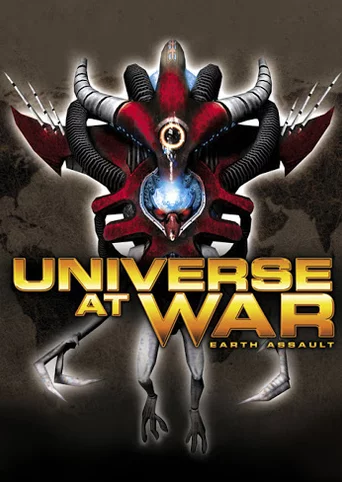
Universe at War: Earth Assault
 77
★ /10
77
★ /10
 PC
PC Xbox 360
 SEGA Corporation
Universe at War: Earth Assault (2007) stands as one of the most critical turning points in the history of the legendary real-time strategy franchise. Following the highly polarizing studio closure of Westwood Studios and the subsequent fracturing of the classic Command & Conquer lineage under Electronic Arts, the future of sci-fi strategy was highly uncertain.
Japanese publisher Sega stepped in, secured the global publishing rights, and handed development duties to the American studio Petroglyph Games—composed entirely of legendary, veteran Westwood developers. Faced with the intense task of salvaging a deeply fractured RTS community after the polarizing experiments of contemporary micro-intensive clones, Petroglyph delivered a stellar, redemptive chapter that bridged classic nostalgic mechanics with modern technological leaps.
The Grand Reset: A Brand New Universe
Universe at War completely severed ties with the classic Tiberium and military tropes of traditional real-time strategy. Instead, it established a completely fresh, tightly constructed dark-fantasy and high-concept sci-fi lore continuity: The Apocalypse of Earth.
The game’s geopolitical landscapes, environmental destruction, and faction alignments are strictly governed by a cosmic war between three vastly different alien civilizations. The massive multi-faction campaign plays out like an interconnected political thriller, tracking the near-extinction of humanity as a ruthless alien strip-mining empire disrupts the planet, sparking a global war that drags sentient machine avengers, ancient sleeping gods, and human military remnants into a grand struggle to prevent a world-shattering planetary consumption.
The Core Evolution: Modular Monoliths & Polished Roots
Petroglyph deliberately looked back at their Command & Conquer: Tiberian Sun roots as a mechanical anchor, discarding generic, identical faction base building and uniform unit blobs. However, they heavily evolved the engine:
- The Leap to Monolithic Walkers: Running on a beautifully optimized 3D graphics engine, Universe at War was the first entry to ditch traditional static base lines for the Hierarchy’s massive, moving Walker bases. Players were handed a fully rotatable camera to track these towering titans as they physically crushed terrain, while production and tech trees were transformed into literal, moving fortresses on the battlefield.
- The Dynamic Tactical Dynamics Suite: The tech tree completely abandoned rigid, unchangeable build orders. Petroglyph implemented a real-time “Tactical Dynamics” customization tree directly in the user interface. Players could swap their global research suites on the fly mid-combat—shifting their civilization’s focus from high-speed movement to heavy armor or stealth parameters in seconds, adding a massive layer of tactical speed management to matches.
- The Hardpoint Destruction Engine: The combat grid completely abandoned generic unit health bars for its massive tier-units. Petroglyph implemented a localized hardpoint destruction matrix. When engaging an enemy Walker base, units weren’t restricted to just attacking the core hull. Instead, they could target specific components—physically blowing off individual plasma turrets, shield generators, or unit-recruitment bays to cripple the enemy’s production without ever opening themselves up to a full counter-attack.
The Deep Meta: Faction Unique Skills & The Flow Network
To maximize faction asymmetry, Universe at War completely threw out generic resource management. Every alignment was granted a mandatory, entirely exclusive Macro Mechanic that dictated their macro-strategy:
- The Hierarchy (Walker Hardpoint Customization): Allows heavy alien heroes to pay resources directly onto their active Walkers to physically attach plasma cannons, anti-aircraft lasers, or radiation shields, modifying their mobile base into an ultimate frontline assault weapon.
- Novus (The Flow Network): Sentient machine squads can channel their inner data forms to slip into the “Flow Network.” Building light-pylons across the map creates invisible energy lines, allowing entire Novus armies to travel instantly across the grid as digital light beams, bypassing traditional terrain movement constraints.
- Masari (Light/Dark Matter Shift): Ancient sleeping gods specialize in cosmic elemental adaptation. Their unique trait allows their entire faction to toggle between Light Mode (granting flying capabilities, long-range fire damage, and sight buffs) and Dark Mode (sacrificing mobility to gain heavy armor, ground-pound shockwaves, and passive defensive energy shields).
The Hidden Hierarchy Customization Matrix
Progression was governed by a massive, intricately complex web of technological balancing. Customizing your macro-strategy required a precise science of military financing—carefully adjusting your hardpoint loadouts on your massive tier assets based on the enemy’s composition. For example:
| Base Unit (Monolithic Asset) | Upgrade Path A | Upgrade Path B (Alternate) |
| Assembly Walker (Hierarchy) | Plasma Siege Monolith (Gains heavy plasma artillery and localized base-crushing footprints) | Reaping Habitat (Sacrifices offensive guns to mass-produce raw resources from organic matter) |
| Mirabel & Vector (Novus Hero) | Sniper Configuration (Gains extreme long-range piercing lasers to pick off enemy hardpoints) | Missile Barrage (Gains high-speed, area-of-effect anti-swarm missile capabilities) |
| Peacekeeper (Masari) | Light Inquisitor (Gains searing laser beams that melt enemy heavy armor over time) | Dark Vanguard (Gains close-quarters physical shields and infinite retaliation stuns) |
The Modern Standard: The GFWL Bypass Meta
While the official retail lifecycle concluded in the late 2000s, Universe at War experiences an incredible casual and preservation renaissance today through dedicated community maintenance. Following its launch, the game’s long-term survival was heavily crippled by its forced integration with Microsoft’s notorious Games for Windows Live (GFWL) software, which eventually rendered the retail client completely unplayable on contemporary operating systems.
The modern strategy community completely reconstructed the engine stability. They engineered custom executable wrappers that completely strip out GFWL, fix modern 64-bit multi-core processor crashes, scale the UI natively to contemporary widescreen resolutions, and restore local area network (LAN) and fan-run multiplayer server compatibility, ensuring the game runs as a flawlessly polished modern digital client operating beautifully on Windows 10 and Windows 11.
Release History
- Universe at War: Earth Assault (PC Base Game): December 10, 2007 (North America)
- Universe at War: Earth Assault (Xbox 360 Port): March 24, 2008 (North America)
- Modern Packaging: Natively preserved across digital abandonware archives and community-maintained preservation setups, serving as a pristine historical monument to the absolute peak of asymmetrical real-time strategy design.